Junwei Huang , Chen Yang , Xiaohan Zhang , Ruomu Chen , Shunli Hu , Dandan Pan , Xiangwei Wu
{"title":"Isolation of Micrococcus sp. strain 2A from the ocean and its biodegradation of 1-naphthol in wastewater","authors":"Junwei Huang , Chen Yang , Xiaohan Zhang , Ruomu Chen , Shunli Hu , Dandan Pan , Xiangwei Wu","doi":"10.1016/j.ibiod.2024.105815","DOIUrl":null,"url":null,"abstract":"<div><p>1-Naphthol is an important raw material for organic synthesis such as pharmaceuticals, pesticides, dyes, and also the main metabolite of pesticide carbaryl and naphthalene, as well as a common aromatic pollutant in the environment. Microorganisms are the main driving force responsible for the degradation and transformation of 1-naphthol in the environment. Although many 1-naphthol degrading strains have been reported, strain resources with strong environmental adaptability and degradation ability from the marine environment are still relatively scarce. In this study, a 1-naphthol-degrading bacterial strain, <em>Micrococcus</em> sp. strain 2A, was isolated from seawater. The strain completely degraded 1-naphthol by co-metabolism under strong alkaline (pH = 11) and high salt (4 M NaCl) conditions. 1,2-Dihydroxynaphthalene, 2-hydroxychromene-2-carboxylate, 2-hydroxybenzal pyruvate, salicylaldehyde, and salicylate were identified during 1-naphthol degradation. The functional gene <em>orf2030</em> responsible for the initial degradation of 1-naphthol was also postulated by genome sequencing and comparative proteome analysis. The bioaugmentation test showed that strain 2A could completely remove 0.3 mM 1-naphthol in the wastewater within 144 h. Our study not only enriches the theory of marine microbial metabolism of 1-naphthol but also provides strain resources and technical reserves for the bioremediation of 1-naphthol in high salinity and strong alkaline fine chemical synthetic wastewater.</p></div>","PeriodicalId":13643,"journal":{"name":"International Biodeterioration & Biodegradation","volume":"192 ","pages":"Article 105815"},"PeriodicalIF":4.1000,"publicationDate":"2024-07-01","publicationTypes":"Journal Article","fieldsOfStudy":null,"isOpenAccess":false,"openAccessPdf":"","citationCount":"0","resultStr":null,"platform":"Semanticscholar","paperid":null,"PeriodicalName":"International Biodeterioration & Biodegradation","FirstCategoryId":"93","ListUrlMain":"https://www.sciencedirect.com/science/article/pii/S0964830524000866","RegionNum":2,"RegionCategory":"环境科学与生态学","ArticlePicture":[],"TitleCN":null,"AbstractTextCN":null,"PMCID":null,"EPubDate":"2024/5/29 0:00:00","PubModel":"Epub","JCR":"Q2","JCRName":"BIOTECHNOLOGY & APPLIED MICROBIOLOGY","Score":null,"Total":0}
引用次数: 0
Abstract
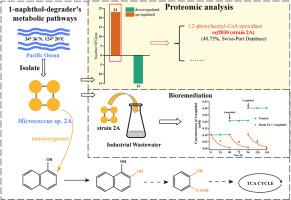
1-Naphthol is an important raw material for organic synthesis such as pharmaceuticals, pesticides, dyes, and also the main metabolite of pesticide carbaryl and naphthalene, as well as a common aromatic pollutant in the environment. Microorganisms are the main driving force responsible for the degradation and transformation of 1-naphthol in the environment. Although many 1-naphthol degrading strains have been reported, strain resources with strong environmental adaptability and degradation ability from the marine environment are still relatively scarce. In this study, a 1-naphthol-degrading bacterial strain, Micrococcus sp. strain 2A, was isolated from seawater. The strain completely degraded 1-naphthol by co-metabolism under strong alkaline (pH = 11) and high salt (4 M NaCl) conditions. 1,2-Dihydroxynaphthalene, 2-hydroxychromene-2-carboxylate, 2-hydroxybenzal pyruvate, salicylaldehyde, and salicylate were identified during 1-naphthol degradation. The functional gene orf2030 responsible for the initial degradation of 1-naphthol was also postulated by genome sequencing and comparative proteome analysis. The bioaugmentation test showed that strain 2A could completely remove 0.3 mM 1-naphthol in the wastewater within 144 h. Our study not only enriches the theory of marine microbial metabolism of 1-naphthol but also provides strain resources and technical reserves for the bioremediation of 1-naphthol in high salinity and strong alkaline fine chemical synthetic wastewater.
期刊介绍:
International Biodeterioration and Biodegradation publishes original research papers and reviews on the biological causes of deterioration or degradation.




 京公网安备 11010802042870号
京ICP备2023020795号-1
京公网安备 11010802042870号
京ICP备2023020795号-1

 分享
分享
 求助内容:
求助内容: 应助结果提醒方式:
 扫码关注我们
