{"title":"Effects of walnut consumption for 2 years on older adults' bone health in the Walnuts and Healthy Aging (WAHA) trial","authors":"Carla Oliver-Pons Msc, Aleix Sala-Vila PhD, Montserrat Cofán PhD, Mercè Serra-Mir RD, Irene Roth PhD, Cinta Valls-Pedret PhD, Mònica Domènech MD, PhD, Emilio Ortega MD, PhD, Sujatha Rajaram PhD, Joan Sabaté PhD, Emilio Ros MD, PhD, Gemma Chiva-Blanch PhD","doi":"10.1111/jgs.19007","DOIUrl":null,"url":null,"abstract":"<div>\n \n \n <section>\n \n <h3> Background</h3>\n \n <p>Nutritional strategies to maintain bone health in aging individuals are of great interest. Given the beneficial nutrient composition of walnuts, rich in alpha-linolenic (the vegetable n-3 fatty acid) and polyphenols, their regular consumption might be a dietary option to reduce age-related bone loss. We determined whether daily walnut consumption improves bone mineral density (BMD) and circulating biomarkers of bone turnover.</p>\n </section>\n \n <section>\n \n <h3> Methods</h3>\n \n <p>The Walnuts and Healthy Aging study (WAHA) is a two-center, parallel, randomized controlled trial evaluating the effect of a diet enriched with walnuts at ≈15% energy compared with a control diet for 2 years on age-related health outcomes in healthy men and women aged 63–79 years. Changes in BMD were a prespecified secondary outcome only at the Barcelona node of the trial, where 352 participants were randomized. Retention rate was 92.6%. Primary endpoints were 2-year changes in BMD at the spine and the nondominant femoral neck, determined by dual-energy X-ray absorptiometry (DXA). Secondary endpoints were 2-year changes in bone turnover biomarkers (adrenocorticotropic hormone, Dickkopf WNT signaling pathway inhibitor-1, osteoprotegerin, osteocalcin, osteopontin, sclerostin, parathyroid hormone, and fibroblast growth factor-23), which were quantified in 211 randomly selected participants.</p>\n </section>\n \n <section>\n \n <h3> Results</h3>\n \n <p>The walnut diet versus the control diet had no effect on 2-year changes in BMD at the spine (0.15% vs. 0.35%, <i>p</i> = 0.632) and femoral neck (−0.90% vs. −0.70%, <i>p</i> = 0.653), or on bone turnover biomarkers. Results were similar in participants treated or not with bone resorption inhibitors or those with or without osteoporosis/osteopenia at inclusion.</p>\n </section>\n \n <section>\n \n <h3> Conclusions</h3>\n \n <p>Compared with the usual diet, a diet enriched with walnuts at 15% of energy for 2 years failed to improve BMD or circulating markers of bone metabolism in healthy older people.</p>\n </section>\n </div>","PeriodicalId":17240,"journal":{"name":"Journal of the American Geriatrics Society","volume":"72 8","pages":"2471-2482"},"PeriodicalIF":4.5000,"publicationDate":"2024-05-31","publicationTypes":"Journal Article","fieldsOfStudy":null,"isOpenAccess":false,"openAccessPdf":"https://onlinelibrary.wiley.com/doi/epdf/10.1111/jgs.19007","citationCount":"0","resultStr":null,"platform":"Semanticscholar","paperid":null,"PeriodicalName":"Journal of the American Geriatrics Society","FirstCategoryId":"3","ListUrlMain":"https://agsjournals.onlinelibrary.wiley.com/doi/10.1111/jgs.19007","RegionNum":2,"RegionCategory":"医学","ArticlePicture":[],"TitleCN":null,"AbstractTextCN":null,"PMCID":null,"EPubDate":"","PubModel":"","JCR":"Q1","JCRName":"GERIATRICS & GERONTOLOGY","Score":null,"Total":0}
引用次数: 0
Abstract
Background
Nutritional strategies to maintain bone health in aging individuals are of great interest. Given the beneficial nutrient composition of walnuts, rich in alpha-linolenic (the vegetable n-3 fatty acid) and polyphenols, their regular consumption might be a dietary option to reduce age-related bone loss. We determined whether daily walnut consumption improves bone mineral density (BMD) and circulating biomarkers of bone turnover.
Methods
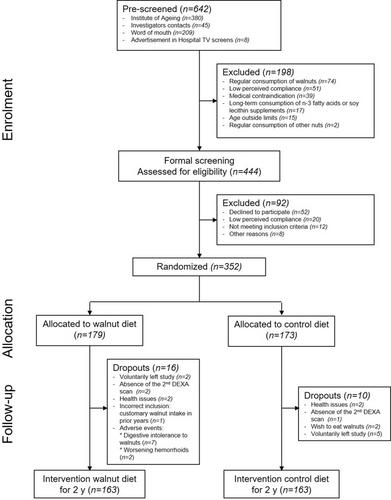
The Walnuts and Healthy Aging study (WAHA) is a two-center, parallel, randomized controlled trial evaluating the effect of a diet enriched with walnuts at ≈15% energy compared with a control diet for 2 years on age-related health outcomes in healthy men and women aged 63–79 years. Changes in BMD were a prespecified secondary outcome only at the Barcelona node of the trial, where 352 participants were randomized. Retention rate was 92.6%. Primary endpoints were 2-year changes in BMD at the spine and the nondominant femoral neck, determined by dual-energy X-ray absorptiometry (DXA). Secondary endpoints were 2-year changes in bone turnover biomarkers (adrenocorticotropic hormone, Dickkopf WNT signaling pathway inhibitor-1, osteoprotegerin, osteocalcin, osteopontin, sclerostin, parathyroid hormone, and fibroblast growth factor-23), which were quantified in 211 randomly selected participants.
Results
The walnut diet versus the control diet had no effect on 2-year changes in BMD at the spine (0.15% vs. 0.35%, p = 0.632) and femoral neck (−0.90% vs. −0.70%, p = 0.653), or on bone turnover biomarkers. Results were similar in participants treated or not with bone resorption inhibitors or those with or without osteoporosis/osteopenia at inclusion.
Conclusions
Compared with the usual diet, a diet enriched with walnuts at 15% of energy for 2 years failed to improve BMD or circulating markers of bone metabolism in healthy older people.
期刊介绍:
Journal of the American Geriatrics Society (JAGS) is the go-to journal for clinical aging research. We provide a diverse, interprofessional community of healthcare professionals with the latest insights on geriatrics education, clinical practice, and public policy—all supporting the high-quality, person-centered care essential to our well-being as we age. Since the publication of our first edition in 1953, JAGS has remained one of the oldest and most impactful journals dedicated exclusively to gerontology and geriatrics.