Ziya Ahmad Khan , Mohmmad Younus Wani , Aijaz Ahmad , Maram T. Basha , Nada A. Aly , Amr A. Yakout
{"title":"Multifunctional chitosan-cross linked- curcumin-tannic acid biocomposites disrupt quorum sensing and biofilm formation in pathogenic bacteria","authors":"Ziya Ahmad Khan , Mohmmad Younus Wani , Aijaz Ahmad , Maram T. Basha , Nada A. Aly , Amr A. Yakout","doi":"10.1016/j.ijbiomac.2024.132719","DOIUrl":null,"url":null,"abstract":"<div><p>Natural products have a long history of success in treating bacterial infections, making them a promising source for novel antibacterial medications. Curcumin, an essential component of turmeric, has shown potential in treating bacterial infections and in this study, we covalently immobilized curcumin (Cur) onto chitosan (CS) using glutaraldehyde and tannic acid (TA), resulting in the fabrication of novel biocomposites with varying CS/Cur/TA ratios. Comprehensive characterization of these ternary biocomposites was conducted using FTIR, SEM, XPS, and XRD to assess their morphology, functional groups, and chemical structures. The inhibitory efficacy of these novel biocomposites (<em>n</em> = 4) against the growth and viability of <em>Pseudomonas aeruginosa</em> (ATCC27853) and <em>Chromobacterium violaceum</em> (ATCC12472) was evaluated and the most promising composite (<strong>C3</strong>) was investigated for its impact on quorum sensing (QS) and biofilm formation in these bacteria. Remarkably, this biocomposite significantly disrupted QS circuits and effectively curtailed biofilm formation in the tested pathogens without inducing appreciable toxicity. These findings underscore its potential for future <em>in vivo</em> studies, positioning it as a promising candidate for the development of biofilm disrupting antibacterial agents.</p></div>","PeriodicalId":333,"journal":{"name":"International Journal of Biological Macromolecules","volume":"271 ","pages":"Article 132719"},"PeriodicalIF":8.5000,"publicationDate":"2024-06-01","publicationTypes":"Journal Article","fieldsOfStudy":null,"isOpenAccess":false,"openAccessPdf":"","citationCount":"0","resultStr":null,"platform":"Semanticscholar","paperid":null,"PeriodicalName":"International Journal of Biological Macromolecules","FirstCategoryId":"92","ListUrlMain":"https://www.sciencedirect.com/science/article/pii/S0141813024035244","RegionNum":1,"RegionCategory":"化学","ArticlePicture":[],"TitleCN":null,"AbstractTextCN":null,"PMCID":null,"EPubDate":"2024/5/31 0:00:00","PubModel":"Epub","JCR":"Q1","JCRName":"BIOCHEMISTRY & MOLECULAR BIOLOGY","Score":null,"Total":0}
引用次数: 0
Abstract
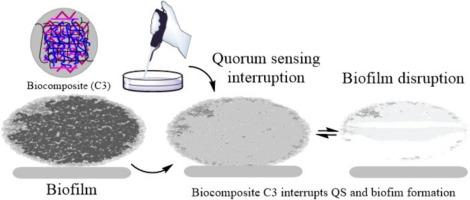
Natural products have a long history of success in treating bacterial infections, making them a promising source for novel antibacterial medications. Curcumin, an essential component of turmeric, has shown potential in treating bacterial infections and in this study, we covalently immobilized curcumin (Cur) onto chitosan (CS) using glutaraldehyde and tannic acid (TA), resulting in the fabrication of novel biocomposites with varying CS/Cur/TA ratios. Comprehensive characterization of these ternary biocomposites was conducted using FTIR, SEM, XPS, and XRD to assess their morphology, functional groups, and chemical structures. The inhibitory efficacy of these novel biocomposites (n = 4) against the growth and viability of Pseudomonas aeruginosa (ATCC27853) and Chromobacterium violaceum (ATCC12472) was evaluated and the most promising composite (C3) was investigated for its impact on quorum sensing (QS) and biofilm formation in these bacteria. Remarkably, this biocomposite significantly disrupted QS circuits and effectively curtailed biofilm formation in the tested pathogens without inducing appreciable toxicity. These findings underscore its potential for future in vivo studies, positioning it as a promising candidate for the development of biofilm disrupting antibacterial agents.
期刊介绍:
The International Journal of Biological Macromolecules is a well-established international journal dedicated to research on the chemical and biological aspects of natural macromolecules. Focusing on proteins, macromolecular carbohydrates, glycoproteins, proteoglycans, lignins, biological poly-acids, and nucleic acids, the journal presents the latest findings in molecular structure, properties, biological activities, interactions, modifications, and functional properties. Papers must offer new and novel insights, encompassing related model systems, structural conformational studies, theoretical developments, and analytical techniques. Each paper is required to primarily focus on at least one named biological macromolecule, reflected in the title, abstract, and text.



 京公网安备 11010802042870号
京ICP备2023020795号-1
京公网安备 11010802042870号
京ICP备2023020795号-1

 分享
分享
 求助内容:
求助内容: 应助结果提醒方式:
 扫码关注我们
