Fang Zhou , Yu-Xin Guo , Rui Gao , Xiao-Yu Ji , Yu-Xuan Tang , Li-Bin Wang , Yuan Zhang , Xing Li
{"title":"Quercetin regulates dendritic cell activation by targeting STAT4 in the treatment of experimental autoimmune encephalomyelitis","authors":"Fang Zhou , Yu-Xin Guo , Rui Gao , Xiao-Yu Ji , Yu-Xuan Tang , Li-Bin Wang , Yuan Zhang , Xing Li","doi":"10.1016/j.taap.2024.116980","DOIUrl":null,"url":null,"abstract":"<div><p>Multiple sclerosis (MS) is a class of autoimmune diseases mainly caused by the immune system attacking the myelin sheath of the axons in the nervous system. Although the pathogenesis of MS is complex, studies have shown that dendritic cells (DCs) play a vital role in the pathogenesis of MS. Quercetin (QU) has a unique advantage in clinical application, especially for treating autoimmune diseases. However, the mechanism of QU in the treatment of experimental autoimmune encephalomyelitis (EAE) remains unclear. In this study, we explore the potential role of QU in EAE. Finally, we find that QU has anti-inflammatory activities and neural protective effects in EAE. The experimental results suggest that the cellular basis for QU's function is to inhibit the activation of DCs while modulating the Th17 cell differentiation in the co-culture system. Further, QU may target STAT4 to inhibit its activation in DCs. This work will be of great significance for the future development and utilization of QU.</p></div>","PeriodicalId":23174,"journal":{"name":"Toxicology and applied pharmacology","volume":"488 ","pages":"Article 116980"},"PeriodicalIF":3.4000,"publicationDate":"2024-07-01","publicationTypes":"Journal Article","fieldsOfStudy":null,"isOpenAccess":false,"openAccessPdf":"","citationCount":"0","resultStr":null,"platform":"Semanticscholar","paperid":null,"PeriodicalName":"Toxicology and applied pharmacology","FirstCategoryId":"3","ListUrlMain":"https://www.sciencedirect.com/science/article/pii/S0041008X24001789","RegionNum":3,"RegionCategory":"医学","ArticlePicture":[],"TitleCN":null,"AbstractTextCN":null,"PMCID":null,"EPubDate":"2024/5/31 0:00:00","PubModel":"Epub","JCR":"Q2","JCRName":"PHARMACOLOGY & PHARMACY","Score":null,"Total":0}
引用次数: 0
Abstract
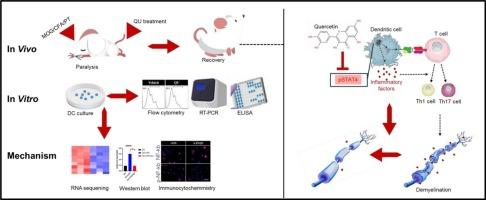
Multiple sclerosis (MS) is a class of autoimmune diseases mainly caused by the immune system attacking the myelin sheath of the axons in the nervous system. Although the pathogenesis of MS is complex, studies have shown that dendritic cells (DCs) play a vital role in the pathogenesis of MS. Quercetin (QU) has a unique advantage in clinical application, especially for treating autoimmune diseases. However, the mechanism of QU in the treatment of experimental autoimmune encephalomyelitis (EAE) remains unclear. In this study, we explore the potential role of QU in EAE. Finally, we find that QU has anti-inflammatory activities and neural protective effects in EAE. The experimental results suggest that the cellular basis for QU's function is to inhibit the activation of DCs while modulating the Th17 cell differentiation in the co-culture system. Further, QU may target STAT4 to inhibit its activation in DCs. This work will be of great significance for the future development and utilization of QU.
期刊介绍:
Toxicology and Applied Pharmacology publishes original scientific research of relevance to animals or humans pertaining to the action of chemicals, drugs, or chemically-defined natural products.
Regular articles address mechanistic approaches to physiological, pharmacologic, biochemical, cellular, or molecular understanding of toxicologic/pathologic lesions and to methods used to describe these responses. Safety Science articles address outstanding state-of-the-art preclinical and human translational characterization of drug and chemical safety employing cutting-edge science. Highly significant Regulatory Safety Science articles will also be considered in this category. Papers concerned with alternatives to the use of experimental animals are encouraged.
Short articles report on high impact studies of broad interest to readers of TAAP that would benefit from rapid publication. These articles should contain no more than a combined total of four figures and tables. Authors should include in their cover letter the justification for consideration of their manuscript as a short article.



 京公网安备 11010802042870号
京ICP备2023020795号-1
京公网安备 11010802042870号
京ICP备2023020795号-1

 分享
分享
 求助内容:
求助内容: 应助结果提醒方式:
 扫码关注我们
