{"title":"Using comics to integrate the social determinants of health in dental education","authors":"Christophe Bedos DDS, MSc, PhD, Newsha Toreihi DDS, Homa Fathi DDS, MSc, Anahita Ranjbar DDS","doi":"10.1002/jdd.13618","DOIUrl":null,"url":null,"abstract":"<p>In November 2023, the World Health Organization (WHO) produced a report<span><sup>1</sup></span> entitled “Integrating the social determinants of health into health workforce education and training.” It urged academic institutions and educators to reform curricula and make “action on the social determinants of health a key part of the role and responsibilities” of all health workers.</p><p>This idea had already surfaced in dentistry with an innovative biopsychosocial approach, the Montreal–Toulouse Model (MTM).<span><sup>2</sup></span> The MTM aims at guiding oral health professionals to provide person-centered care and address the social determinants of health (Figure 1). It presents “three types of tasks (understanding, decision-making, and intervening) that dentists should take in each of three overlapping levels (individual, community, and society).”<span><sup>2</sup></span></p><p>Traditional educational methods, however, with learners considered as passive recipients of knowledge, are insufficient to help them adopt biopsychosocial approaches,<span><sup>3</sup></span> which for many constitute a paradigmatic change. For this, academia needs to adopt or develop educational methodologies and tools more adapted to these important challenges.<span><sup>1, 3</sup></span></p><p>McGill Faculty of Dental Medicine and Oral Health Sciences developed a two-credit graduate course (26 hours in class) to support oral health professionals' adoption of the MTM model. More specifically, our objective was to foster their ability to provide person-centered care and address the social determinants of health.</p><p>To overcome the limitations of traditional educational methods, we adopted a transformative learning methodology, in which students engage in a process of reflection, questioning, and perspective shifting.<span><sup>4</sup></span> To support this process, which emphasizes on critical thinking and students' active participation, we used an original tool: comics.</p><p>Stories with text and pictures, comics constitute a powerful medium to convey emotions and describe complex phenomena such as the interplay between health and people's conditions of life. Green<span><sup>5</sup></span> considers that “comics provide students the freedom to reflect honestly (and safely) about the forces that shape their emerging professional identities.”</p><p>We asked students to read and critically reflect on a selection of comic books addressing, directly or indirectly, various aspects of the MTM (Table 1), before discussing them in the class. In parallel, we invited them to write weekly reflections in which they described their personal development process. Students also received training on how to create comics, before producing a short comic related to the themes of the MTM in lieu of a final essay. The assessment of students' learning was thus formative.</p><p>Students explained that comics, with their vivid storytelling and imagery, made the concepts described in the course tangible and engaging. It opened new perspectives for them, extending beyond theory to practical application. Compared to more conventional approaches, comics illuminated the various aspects of the MTM, allowing students to relate it to their own experiences in a meaningful way.</p><p>They also discovered that creating comics, although challenging, was an enriching process that allowed them, especially when their comic included autobiographic elements, to better understand themselves and the social determinants of health through lived personal experiences. Figure 2 illustrates how Newsha Toreihi, former student and coauthor of this article, reflected on her own experience when discovering that her 8-year-old patient was selling flowers in the streets instead of attending school.</p><p>Overall, the students experienced some degree of transformation in their professional identity and considered biopsychosocial approaches and upstream actions positively. Even though they still need to be rigorously evaluated, transformative methodologies using comics constitute promising ways to train oral health professionals about biopsychosocial approaches. Future work is intended to connect the ideas presented in this paper with specific learning outcomes, including students' ability to address patients' social determinants of health, and engage in upstream activities at the community and societal levels.</p>","PeriodicalId":50216,"journal":{"name":"Journal of Dental Education","volume":"88 S3","pages":"1813-1816"},"PeriodicalIF":1.6000,"publicationDate":"2024-05-31","publicationTypes":"Journal Article","fieldsOfStudy":null,"isOpenAccess":false,"openAccessPdf":"https://www.ncbi.nlm.nih.gov/pmc/articles/PMC11674988/pdf/","citationCount":"0","resultStr":null,"platform":"Semanticscholar","paperid":null,"PeriodicalName":"Journal of Dental Education","FirstCategoryId":"3","ListUrlMain":"https://onlinelibrary.wiley.com/doi/10.1002/jdd.13618","RegionNum":4,"RegionCategory":"医学","ArticlePicture":[],"TitleCN":null,"AbstractTextCN":null,"PMCID":null,"EPubDate":"","PubModel":"","JCR":"Q3","JCRName":"DENTISTRY, ORAL SURGERY & MEDICINE","Score":null,"Total":0}
引用次数: 0
Abstract
In November 2023, the World Health Organization (WHO) produced a report1 entitled “Integrating the social determinants of health into health workforce education and training.” It urged academic institutions and educators to reform curricula and make “action on the social determinants of health a key part of the role and responsibilities” of all health workers.
This idea had already surfaced in dentistry with an innovative biopsychosocial approach, the Montreal–Toulouse Model (MTM).2 The MTM aims at guiding oral health professionals to provide person-centered care and address the social determinants of health (Figure 1). It presents “three types of tasks (understanding, decision-making, and intervening) that dentists should take in each of three overlapping levels (individual, community, and society).”2
Traditional educational methods, however, with learners considered as passive recipients of knowledge, are insufficient to help them adopt biopsychosocial approaches,3 which for many constitute a paradigmatic change. For this, academia needs to adopt or develop educational methodologies and tools more adapted to these important challenges.1, 3
McGill Faculty of Dental Medicine and Oral Health Sciences developed a two-credit graduate course (26 hours in class) to support oral health professionals' adoption of the MTM model. More specifically, our objective was to foster their ability to provide person-centered care and address the social determinants of health.
To overcome the limitations of traditional educational methods, we adopted a transformative learning methodology, in which students engage in a process of reflection, questioning, and perspective shifting.4 To support this process, which emphasizes on critical thinking and students' active participation, we used an original tool: comics.
Stories with text and pictures, comics constitute a powerful medium to convey emotions and describe complex phenomena such as the interplay between health and people's conditions of life. Green5 considers that “comics provide students the freedom to reflect honestly (and safely) about the forces that shape their emerging professional identities.”
We asked students to read and critically reflect on a selection of comic books addressing, directly or indirectly, various aspects of the MTM (Table 1), before discussing them in the class. In parallel, we invited them to write weekly reflections in which they described their personal development process. Students also received training on how to create comics, before producing a short comic related to the themes of the MTM in lieu of a final essay. The assessment of students' learning was thus formative.
Students explained that comics, with their vivid storytelling and imagery, made the concepts described in the course tangible and engaging. It opened new perspectives for them, extending beyond theory to practical application. Compared to more conventional approaches, comics illuminated the various aspects of the MTM, allowing students to relate it to their own experiences in a meaningful way.
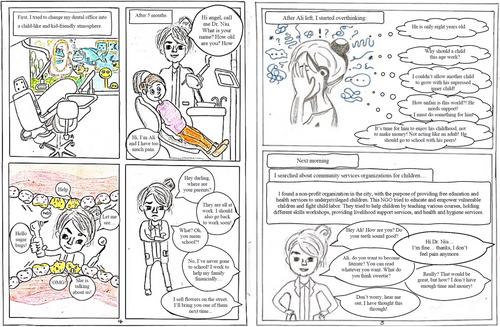
They also discovered that creating comics, although challenging, was an enriching process that allowed them, especially when their comic included autobiographic elements, to better understand themselves and the social determinants of health through lived personal experiences. Figure 2 illustrates how Newsha Toreihi, former student and coauthor of this article, reflected on her own experience when discovering that her 8-year-old patient was selling flowers in the streets instead of attending school.
Overall, the students experienced some degree of transformation in their professional identity and considered biopsychosocial approaches and upstream actions positively. Even though they still need to be rigorously evaluated, transformative methodologies using comics constitute promising ways to train oral health professionals about biopsychosocial approaches. Future work is intended to connect the ideas presented in this paper with specific learning outcomes, including students' ability to address patients' social determinants of health, and engage in upstream activities at the community and societal levels.
期刊介绍:
The Journal of Dental Education (JDE) is a peer-reviewed monthly journal that publishes a wide variety of educational and scientific research in dental, allied dental and advanced dental education. Published continuously by the American Dental Education Association since 1936 and internationally recognized as the premier journal for academic dentistry, the JDE publishes articles on such topics as curriculum reform, education research methods, innovative educational and assessment methodologies, faculty development, community-based dental education, student recruitment and admissions, professional and educational ethics, dental education around the world and systematic reviews of educational interest. The JDE is one of the top scholarly journals publishing the most important work in oral health education today; it celebrated its 80th anniversary in 2016.



 京公网安备 11010802042870号
京ICP备2023020795号-1
京公网安备 11010802042870号
京ICP备2023020795号-1

 分享
分享
 求助内容:
求助内容: 应助结果提醒方式:
 扫码关注我们
