Assembly mechanism of glycosylated soybean protein isolate-chitosan nanocomposite particles and its Pickering emulsion construction for stabilization of Alpinia galanga essential oil: A mechanistic investigation
Wei Liang , Xiangzhen Ge , Qian Lin , Wenqing Zhao , Xinyue Liu , Wenhao Li
{"title":"Assembly mechanism of glycosylated soybean protein isolate-chitosan nanocomposite particles and its Pickering emulsion construction for stabilization of Alpinia galanga essential oil: A mechanistic investigation","authors":"Wei Liang , Xiangzhen Ge , Qian Lin , Wenqing Zhao , Xinyue Liu , Wenhao Li","doi":"10.1016/j.indcrop.2024.118869","DOIUrl":null,"url":null,"abstract":"<div><p>This study aimed to assess the feasibility of stabilization of Pickering emulsion with glycosylated soybean protein isolate-chitosan (SPI-Dex: CS) nanocomposite particles. The results indicated that the glycosylated modifications induced changes in the micromorphology and molecular structure of SPI, which resulted in a decrease in particle size and hydrophobicity and an increase in zeta potential. The complexation of CS-induced changes in the micromorphology and molecular arrangement of the composite nanoparticles, as well as the binding sites and modification effect, decreased with increased CS ratio. SPI-Dex-CS composite nanoparticles successfully stabilize Pickering emulsions loaded with <em>Alpinia galanga</em> essential oil, in which glycosylation and CS complexation jointly improved the encapsulation efficiency, centrifugal/storage stability, and rheological behavior of emulsions for essential oils. Nanocomposite particle assembly was subjected to electrostatic, hydrogen bonding, and hydrophobic forces, with the optimal performance of emulsions in the SPI-Dex<sub>75</sub>: CS<sub>25</sub> ratio. The study is rewarding for applying polysaccharide-protein-based encapsulation systems in food and packaging applications.</p></div>","PeriodicalId":13581,"journal":{"name":"Industrial Crops and Products","volume":"217 ","pages":"Article 118869"},"PeriodicalIF":6.2000,"publicationDate":"2024-10-01","publicationTypes":"Journal Article","fieldsOfStudy":null,"isOpenAccess":false,"openAccessPdf":"","citationCount":"0","resultStr":null,"platform":"Semanticscholar","paperid":null,"PeriodicalName":"Industrial Crops and Products","FirstCategoryId":"97","ListUrlMain":"https://www.sciencedirect.com/science/article/pii/S092666902400846X","RegionNum":1,"RegionCategory":"农林科学","ArticlePicture":[],"TitleCN":null,"AbstractTextCN":null,"PMCID":null,"EPubDate":"2024/5/31 0:00:00","PubModel":"Epub","JCR":"Q1","JCRName":"AGRICULTURAL ENGINEERING","Score":null,"Total":0}
引用次数: 0
Abstract
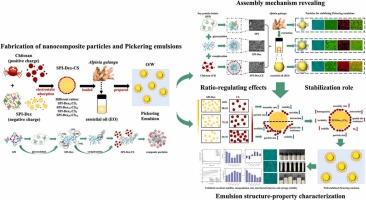
This study aimed to assess the feasibility of stabilization of Pickering emulsion with glycosylated soybean protein isolate-chitosan (SPI-Dex: CS) nanocomposite particles. The results indicated that the glycosylated modifications induced changes in the micromorphology and molecular structure of SPI, which resulted in a decrease in particle size and hydrophobicity and an increase in zeta potential. The complexation of CS-induced changes in the micromorphology and molecular arrangement of the composite nanoparticles, as well as the binding sites and modification effect, decreased with increased CS ratio. SPI-Dex-CS composite nanoparticles successfully stabilize Pickering emulsions loaded with Alpinia galanga essential oil, in which glycosylation and CS complexation jointly improved the encapsulation efficiency, centrifugal/storage stability, and rheological behavior of emulsions for essential oils. Nanocomposite particle assembly was subjected to electrostatic, hydrogen bonding, and hydrophobic forces, with the optimal performance of emulsions in the SPI-Dex75: CS25 ratio. The study is rewarding for applying polysaccharide-protein-based encapsulation systems in food and packaging applications.
期刊介绍:
Industrial Crops and Products is an International Journal publishing academic and industrial research on industrial (defined as non-food/non-feed) crops and products. Papers concern both crop-oriented and bio-based materials from crops-oriented research, and should be of interest to an international audience, hypothesis driven, and where comparisons are made statistics performed.



 京公网安备 11010802042870号
京ICP备2023020795号-1
京公网安备 11010802042870号
京ICP备2023020795号-1

 分享
分享
 求助内容:
求助内容: 应助结果提醒方式:
 扫码关注我们
