Lin Zhang , Jun Zhang , Yumeng Ma , Xueliang Guo , Hui Huang , Zhaozhao Bi , Yilin Wang , Yong Zhang , Chen Xie , Wenchen Luo , Xiaotian Hu , Wei Ma , Yongbo Yuan
{"title":"Improving efficiency and flexibility of non-halogenated solvent-processed dual-layer organic solar cells through solvent vapor annealing","authors":"Lin Zhang , Jun Zhang , Yumeng Ma , Xueliang Guo , Hui Huang , Zhaozhao Bi , Yilin Wang , Yong Zhang , Chen Xie , Wenchen Luo , Xiaotian Hu , Wei Ma , Yongbo Yuan","doi":"10.1016/j.orgel.2024.107075","DOIUrl":null,"url":null,"abstract":"<div><p>Dual-layer organic solar cells (OSCs), fabricated through sequential-casting with separately dissolved donor and acceptor materials, offer simplified solution preparation and morphology control. However, the poor solubility of organic materials in non-halogenated solvents often results in undesirable vertical component distribution and insufficient donor/acceptor interfaces in non-halogenated solvent-processed dual-layer OSCs, adversely affecting photovoltaic performance and flexibility. In this study, we applied a solvent vapor annealing (SVA) method using CS<sub>2</sub> solvent in o-xylene solvent-processed dual-layer OSCs. The SVA method effectively adjusted the vertical component distribution of the active layer and increased the donor/acceptor interfaces, leading to an improved power conversion efficiency (PCE) of 17.24 %. Additionally, SVA films exhibited superior tensile properties, with a crack onset strain of 5.07 %, surpassing that of the as-cast films (4.32 %), attributed to the stronger interaction between the donor and acceptor layers with more donor/acceptor interfaces. Consequently, large-area (1 cm<sup>2</sup>) flexible devices achieved a significant efficiency of 14.20 % and maintained excellent mechanical flexibility, with 80 % of the initial efficiency retained after 1000 bending cycles. This work presents an effective approach for fabricating high-performance non-halogenated solvent-processed flexible dual-layer OSCs.</p></div>","PeriodicalId":399,"journal":{"name":"Organic Electronics","volume":"130 ","pages":"Article 107075"},"PeriodicalIF":2.6000,"publicationDate":"2024-07-01","publicationTypes":"Journal Article","fieldsOfStudy":null,"isOpenAccess":false,"openAccessPdf":"","citationCount":"0","resultStr":null,"platform":"Semanticscholar","paperid":null,"PeriodicalName":"Organic Electronics","FirstCategoryId":"5","ListUrlMain":"https://www.sciencedirect.com/science/article/pii/S1566119924000867","RegionNum":4,"RegionCategory":"工程技术","ArticlePicture":[],"TitleCN":null,"AbstractTextCN":null,"PMCID":null,"EPubDate":"2024/5/27 0:00:00","PubModel":"Epub","JCR":"Q3","JCRName":"MATERIALS SCIENCE, MULTIDISCIPLINARY","Score":null,"Total":0}
引用次数: 0
Abstract
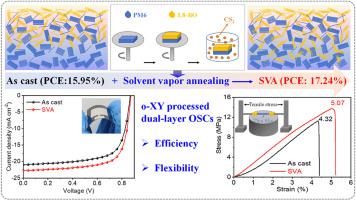
Dual-layer organic solar cells (OSCs), fabricated through sequential-casting with separately dissolved donor and acceptor materials, offer simplified solution preparation and morphology control. However, the poor solubility of organic materials in non-halogenated solvents often results in undesirable vertical component distribution and insufficient donor/acceptor interfaces in non-halogenated solvent-processed dual-layer OSCs, adversely affecting photovoltaic performance and flexibility. In this study, we applied a solvent vapor annealing (SVA) method using CS2 solvent in o-xylene solvent-processed dual-layer OSCs. The SVA method effectively adjusted the vertical component distribution of the active layer and increased the donor/acceptor interfaces, leading to an improved power conversion efficiency (PCE) of 17.24 %. Additionally, SVA films exhibited superior tensile properties, with a crack onset strain of 5.07 %, surpassing that of the as-cast films (4.32 %), attributed to the stronger interaction between the donor and acceptor layers with more donor/acceptor interfaces. Consequently, large-area (1 cm2) flexible devices achieved a significant efficiency of 14.20 % and maintained excellent mechanical flexibility, with 80 % of the initial efficiency retained after 1000 bending cycles. This work presents an effective approach for fabricating high-performance non-halogenated solvent-processed flexible dual-layer OSCs.
期刊介绍:
Organic Electronics is a journal whose primary interdisciplinary focus is on materials and phenomena related to organic devices such as light emitting diodes, thin film transistors, photovoltaic cells, sensors, memories, etc.
Papers suitable for publication in this journal cover such topics as photoconductive and electronic properties of organic materials, thin film structures and characterization in the context of organic devices, charge and exciton transport, organic electronic and optoelectronic devices.



 京公网安备 11010802042870号
京ICP备2023020795号-1
京公网安备 11010802042870号
京ICP备2023020795号-1

 分享
分享
 求助内容:
求助内容: 应助结果提醒方式:
 扫码关注我们
