{"title":"Enhancing Physicochemical Characteristics of Donkey Meat through High-Voltage Electrostatic Stimulation during Acid Excretion","authors":"Xinzhuang Zhang, Shuqi Gong, Jingkai Lin, Manglai Dugarjaviin","doi":"10.1155/2024/4474413","DOIUrl":null,"url":null,"abstract":"<div>\n <p>To investigate the impact of high-voltage electrostatic stimulation on the quality of donkey meat, ten 30-month-old Dezhou donkeys (each weighing 250 ± 50 kg) were selected. Following slaughter, longissimus dorsi (LD) samples from both left and right carcasses were collected. The control group refrigerated the right muscle in a 0–4°C refrigerator for normal acid excretion. Meanwhile, the high-voltage electrostatic group subjected the left muscle to high-voltage electrostatic stimulation (30000 V) for 60 s before refrigerating it in the same conditions for acid excretion. The study showed that at the 1st, 6th, and 24th h of acid excretion, the high-voltage electrostatic group exhibited significantly lower pH levels than the control group (<i>P</i><0.05). Furthermore, a∗ values in the high-voltage electrostatic group showed an increasing trend relative to the control group at the 6th and 24th h of acid excretion (<i>P</i> = 0.0751, <i>P</i> = 0.0860). With increasing acid excretion time, both treatment groups displayed increased PV and TBARS values. At 48 and 72 h, the PV values in the high-voltage electrostatic group were significantly lower than those in the control group (<i>P</i> < 0.05). As acid excretion time increased, T-AOC, SOD, and GSH-Px in both groups decreased. However, the high-voltage electrostatic group consistently exhibited higher antioxidant enzyme activity than the control group at all time points. SOD and GSH-Px activity in the high-voltage electrostatic group showed an increasing trend at 48 h of acid excretion (<i>P</i> = 0.0838, <i>P</i> = 0.0860). At 72nd h of acid excretion, the shear force of donkey meat in the high-voltage electrostatic group was significantly lower than that in the ordinary treatment group (<i>P</i> < 0.05). With increasing acid excretion time, the MFI of both treatment groups gradually increased. In particular, at the 1st and 48th h of acid excretion, the MFI of the high-voltage electrostatic group was significantly higher than that of the ordinary treatment group (<i>P</i> < 0.05). Following high-voltage electrostatic stimulation, ultrastructure images of donkey meat at 6 and 72 h revealed numerous contractions and stretching bands. Therefore, this stimulation significantly improved the tenderness of donkey meat, reduced the oxidation rate of donkey meat, and improved the quality of donkey meat.</p>\n </div>","PeriodicalId":15951,"journal":{"name":"Journal of Food Quality","volume":"2024 1","pages":""},"PeriodicalIF":2.9000,"publicationDate":"2024-06-06","publicationTypes":"Journal Article","fieldsOfStudy":null,"isOpenAccess":false,"openAccessPdf":"https://onlinelibrary.wiley.com/doi/epdf/10.1155/2024/4474413","citationCount":"0","resultStr":null,"platform":"Semanticscholar","paperid":null,"PeriodicalName":"Journal of Food Quality","FirstCategoryId":"97","ListUrlMain":"https://onlinelibrary.wiley.com/doi/10.1155/2024/4474413","RegionNum":3,"RegionCategory":"农林科学","ArticlePicture":[],"TitleCN":null,"AbstractTextCN":null,"PMCID":null,"EPubDate":"","PubModel":"","JCR":"Q2","JCRName":"FOOD SCIENCE & TECHNOLOGY","Score":null,"Total":0}
引用次数: 0
Abstract
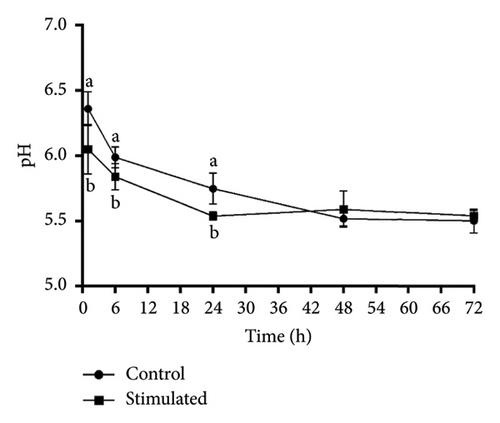
To investigate the impact of high-voltage electrostatic stimulation on the quality of donkey meat, ten 30-month-old Dezhou donkeys (each weighing 250 ± 50 kg) were selected. Following slaughter, longissimus dorsi (LD) samples from both left and right carcasses were collected. The control group refrigerated the right muscle in a 0–4°C refrigerator for normal acid excretion. Meanwhile, the high-voltage electrostatic group subjected the left muscle to high-voltage electrostatic stimulation (30000 V) for 60 s before refrigerating it in the same conditions for acid excretion. The study showed that at the 1st, 6th, and 24th h of acid excretion, the high-voltage electrostatic group exhibited significantly lower pH levels than the control group (P<0.05). Furthermore, a∗ values in the high-voltage electrostatic group showed an increasing trend relative to the control group at the 6th and 24th h of acid excretion (P = 0.0751, P = 0.0860). With increasing acid excretion time, both treatment groups displayed increased PV and TBARS values. At 48 and 72 h, the PV values in the high-voltage electrostatic group were significantly lower than those in the control group (P < 0.05). As acid excretion time increased, T-AOC, SOD, and GSH-Px in both groups decreased. However, the high-voltage electrostatic group consistently exhibited higher antioxidant enzyme activity than the control group at all time points. SOD and GSH-Px activity in the high-voltage electrostatic group showed an increasing trend at 48 h of acid excretion (P = 0.0838, P = 0.0860). At 72nd h of acid excretion, the shear force of donkey meat in the high-voltage electrostatic group was significantly lower than that in the ordinary treatment group (P < 0.05). With increasing acid excretion time, the MFI of both treatment groups gradually increased. In particular, at the 1st and 48th h of acid excretion, the MFI of the high-voltage electrostatic group was significantly higher than that of the ordinary treatment group (P < 0.05). Following high-voltage electrostatic stimulation, ultrastructure images of donkey meat at 6 and 72 h revealed numerous contractions and stretching bands. Therefore, this stimulation significantly improved the tenderness of donkey meat, reduced the oxidation rate of donkey meat, and improved the quality of donkey meat.
期刊介绍:
Journal of Food Quality is a peer-reviewed, Open Access journal that publishes original research articles as well as review articles related to all aspects of food quality characteristics acceptable to consumers. The journal aims to provide a valuable resource for food scientists, nutritionists, food producers, the public health sector, and governmental and non-governmental agencies with an interest in food quality.



 京公网安备 11010802042870号
京ICP备2023020795号-1
京公网安备 11010802042870号
京ICP备2023020795号-1

 分享
分享
 求助内容:
求助内容: 应助结果提醒方式:
 扫码关注我们
