Shrimp-Shell-Derived Carbon Dots for Quantitative Detection by Fluorometry and Colorimetry: A New Analytic Chemistry Experiment for University Education
{"title":"Shrimp-Shell-Derived Carbon Dots for Quantitative Detection by Fluorometry and Colorimetry: A New Analytic Chemistry Experiment for University Education","authors":"Fengshou Wu*, Ruilin Zhang and Ji Zhou, ","doi":"10.1021/acs.jchemed.3c00329","DOIUrl":null,"url":null,"abstract":"<p >Combining the achievements of scientific research projects with experimental teaching, a new comprehensive experiment of “shrimp-shell-derived carbon dots for quantitative detection by fluorometry and colorimetry” was designed for undergraduate college students. The blue-emissive carbon dots (SS-CDs) are synthesized with waste shrimp shell as raw material through a one-step hydrothermal method. Dialysis and freeze-drying are then used for the purification of carbon dots. The structure of the carbon dots is characterized with the assistance of technicians from the testing center. After obtaining the characterization data, students analyze and plot it through Origin. Based on the selective interaction between carbon dots and cobalt ions, it can be used as a fluorescence sensor for Co<sup>2+</sup>, with an average detection limit of 1.68 μM. The doping of iron ions in SS-CDs endows them with excellent peroxidase activity. In the presence of 3,3′,5,5′-tetramethylbenzidine (TMB), H<sub>2</sub>O<sub>2</sub> and glucose can be detected by a colorimetric method, with an average detection limit of 6.02 μM for glucose. This experiment has received positive feedback from the students in our school. First, the synthesis of carbon dots uses waste biomass as raw material, which has the advantages of a wide range of sources and environmental friendliness. Second, the hydrothermal method is easy to operate under mild conditions, which is very suitable for undergraduate students. Third, the fluorometry and colorimetry for ions and glucose detection have the advantages of simple operation, low equipment requirements, and high detection sensitivity. Through this experimental training, students will have a better understanding of the conventional preparation and purification methods of nanomaterials, the use of absorption and fluorescence spectra, and the detection principles of fluorometry and colorimetry.</p>","PeriodicalId":43,"journal":{"name":"Journal of Chemical Education","volume":"101 7","pages":"2784–2789"},"PeriodicalIF":2.9000,"publicationDate":"2024-06-04","publicationTypes":"Journal Article","fieldsOfStudy":null,"isOpenAccess":false,"openAccessPdf":"","citationCount":"0","resultStr":null,"platform":"Semanticscholar","paperid":null,"PeriodicalName":"Journal of Chemical Education","FirstCategoryId":"92","ListUrlMain":"https://pubs.acs.org/doi/10.1021/acs.jchemed.3c00329","RegionNum":3,"RegionCategory":"教育学","ArticlePicture":[],"TitleCN":null,"AbstractTextCN":null,"PMCID":null,"EPubDate":"","PubModel":"","JCR":"Q2","JCRName":"CHEMISTRY, MULTIDISCIPLINARY","Score":null,"Total":0}
引用次数: 0
Abstract
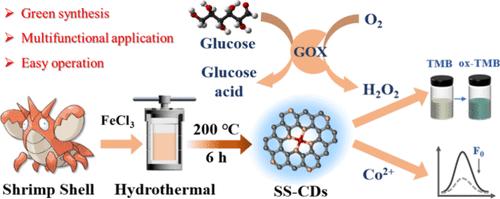
Combining the achievements of scientific research projects with experimental teaching, a new comprehensive experiment of “shrimp-shell-derived carbon dots for quantitative detection by fluorometry and colorimetry” was designed for undergraduate college students. The blue-emissive carbon dots (SS-CDs) are synthesized with waste shrimp shell as raw material through a one-step hydrothermal method. Dialysis and freeze-drying are then used for the purification of carbon dots. The structure of the carbon dots is characterized with the assistance of technicians from the testing center. After obtaining the characterization data, students analyze and plot it through Origin. Based on the selective interaction between carbon dots and cobalt ions, it can be used as a fluorescence sensor for Co2+, with an average detection limit of 1.68 μM. The doping of iron ions in SS-CDs endows them with excellent peroxidase activity. In the presence of 3,3′,5,5′-tetramethylbenzidine (TMB), H2O2 and glucose can be detected by a colorimetric method, with an average detection limit of 6.02 μM for glucose. This experiment has received positive feedback from the students in our school. First, the synthesis of carbon dots uses waste biomass as raw material, which has the advantages of a wide range of sources and environmental friendliness. Second, the hydrothermal method is easy to operate under mild conditions, which is very suitable for undergraduate students. Third, the fluorometry and colorimetry for ions and glucose detection have the advantages of simple operation, low equipment requirements, and high detection sensitivity. Through this experimental training, students will have a better understanding of the conventional preparation and purification methods of nanomaterials, the use of absorption and fluorescence spectra, and the detection principles of fluorometry and colorimetry.
期刊介绍:
The Journal of Chemical Education is the official journal of the Division of Chemical Education of the American Chemical Society, co-published with the American Chemical Society Publications Division. Launched in 1924, the Journal of Chemical Education is the world’s premier chemical education journal. The Journal publishes peer-reviewed articles and related information as a resource to those in the field of chemical education and to those institutions that serve them. JCE typically addresses chemical content, activities, laboratory experiments, instructional methods, and pedagogies. The Journal serves as a means of communication among people across the world who are interested in the teaching and learning of chemistry. This includes instructors of chemistry from middle school through graduate school, professional staff who support these teaching activities, as well as some scientists in commerce, industry, and government.




 京公网安备 11010802042870号
京ICP备2023020795号-1
京公网安备 11010802042870号
京ICP备2023020795号-1

 分享
分享
 求助内容:
求助内容: 应助结果提醒方式:
 扫码关注我们
