Xinyi Luo , Ke Wang , Yingying Xue , Xiaobao Cao , Jianhua Zhou , Jiasi Wang
{"title":"Digital PCR-free technologies for absolute quantitation of nucleic acids at single-molecule level","authors":"Xinyi Luo , Ke Wang , Yingying Xue , Xiaobao Cao , Jianhua Zhou , Jiasi Wang","doi":"10.1016/j.cclet.2024.109924","DOIUrl":null,"url":null,"abstract":"<div><div>Ultrasensitive detection of nucleic acids is of great significance for precision medicine. Digital polymerase chain reaction (dPCR) is the most sensitive method but requires sophisticated and expensive instruments and a long reaction time. Digital PCR-free technologies, which mean the digital assay not relying on thermal cycling to amplify the signal for quantitative detection of nucleic acids at the single-molecule level, include the digital isothermal amplification techniques (dIATs) and the digital clustered regularly interspaced short palindromic repeats (CRISPR) technologies. They combine the advantages of dPCR and IATs, which could be fast and simple, enabling absolute quantification of nucleic acids at a single-molecule level with minimum instrument, representing the next-generation molecular diagnostic technology. Herein, we systematically summarized the strategies and applications of various dIATs, including the digital loop-mediated isothermal amplification (dLAMP), the digital recombinase polymerase amplification (dRPA), the digital rolling circle amplification (dRCA), the digital nucleic acid sequence-based amplification (dNASBA) and the digital multiple displacement amplification (dMDA), and evaluated the pros and cons of each method. The emerging digital CRISPR technologies, including the detection mechanism of CRISPR and the various strategies for signal amplification, are also introduced comprehensively in this review. The current challenges as well as the future perspectives of the digital PCR-free technology were discussed.</div></div>","PeriodicalId":10088,"journal":{"name":"Chinese Chemical Letters","volume":"36 2","pages":"Article 109924"},"PeriodicalIF":8.9000,"publicationDate":"2025-01-01","publicationTypes":"Journal Article","fieldsOfStudy":null,"isOpenAccess":false,"openAccessPdf":"","citationCount":"0","resultStr":null,"platform":"Semanticscholar","paperid":null,"PeriodicalName":"Chinese Chemical Letters","FirstCategoryId":"92","ListUrlMain":"https://www.sciencedirect.com/science/article/pii/S1001841724004431","RegionNum":1,"RegionCategory":"化学","ArticlePicture":[],"TitleCN":null,"AbstractTextCN":null,"PMCID":null,"EPubDate":"2024/6/3 0:00:00","PubModel":"Epub","JCR":"Q1","JCRName":"CHEMISTRY, MULTIDISCIPLINARY","Score":null,"Total":0}
引用次数: 0
Abstract
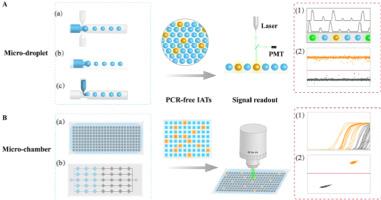
Ultrasensitive detection of nucleic acids is of great significance for precision medicine. Digital polymerase chain reaction (dPCR) is the most sensitive method but requires sophisticated and expensive instruments and a long reaction time. Digital PCR-free technologies, which mean the digital assay not relying on thermal cycling to amplify the signal for quantitative detection of nucleic acids at the single-molecule level, include the digital isothermal amplification techniques (dIATs) and the digital clustered regularly interspaced short palindromic repeats (CRISPR) technologies. They combine the advantages of dPCR and IATs, which could be fast and simple, enabling absolute quantification of nucleic acids at a single-molecule level with minimum instrument, representing the next-generation molecular diagnostic technology. Herein, we systematically summarized the strategies and applications of various dIATs, including the digital loop-mediated isothermal amplification (dLAMP), the digital recombinase polymerase amplification (dRPA), the digital rolling circle amplification (dRCA), the digital nucleic acid sequence-based amplification (dNASBA) and the digital multiple displacement amplification (dMDA), and evaluated the pros and cons of each method. The emerging digital CRISPR technologies, including the detection mechanism of CRISPR and the various strategies for signal amplification, are also introduced comprehensively in this review. The current challenges as well as the future perspectives of the digital PCR-free technology were discussed.
期刊介绍:
Chinese Chemical Letters (CCL) (ISSN 1001-8417) was founded in July 1990. The journal publishes preliminary accounts in the whole field of chemistry, including inorganic chemistry, organic chemistry, analytical chemistry, physical chemistry, polymer chemistry, applied chemistry, etc.Chinese Chemical Letters does not accept articles previously published or scheduled to be published. To verify originality, your article may be checked by the originality detection service CrossCheck.




 京公网安备 11010802042870号
京ICP备2023020795号-1
京公网安备 11010802042870号
京ICP备2023020795号-1

 分享
分享
 求助内容:
求助内容: 应助结果提醒方式:
 扫码关注我们
