Wenhui Fu , Qingyu Lin , Zhequan Fu , Tingting Yang , Dai Shi , Pengcheng Ma , Hongxing Su , Yunze Wang , Guobing Liu , Jing Ding , Hongcheng Shi , Dengfeng Cheng
{"title":"Synthesis and evaluation of TSPO-targeting radioligand [18F]F-TFQC for PET neuroimaging in epileptic rats","authors":"Wenhui Fu , Qingyu Lin , Zhequan Fu , Tingting Yang , Dai Shi , Pengcheng Ma , Hongxing Su , Yunze Wang , Guobing Liu , Jing Ding , Hongcheng Shi , Dengfeng Cheng","doi":"10.1016/j.apsb.2024.05.031","DOIUrl":null,"url":null,"abstract":"<div><div>The translocator protein (TSPO) positron emission tomography (PET) can noninvasively detect neuroinflammation associated with epileptogenesis and epilepsy. This study explored the role of the TSPO-targeting radioligand [<sup>18</sup>F]F-TFQC, an <em>m</em>-trifluoromethyl ER176 analog, in the PET neuroimaging of epileptic rats. Initially, [<sup>18</sup>F]F-TFQC was synthesized with a radiochemical yield of 8%–10% (EOS), a radiochemical purity of over 99%, and a specific activity of 38.21 ± 1.73 MBq/nmol (EOS). After determining that [<sup>18</sup>F]F-TFQC exhibited good biochemical properties, [<sup>18</sup>F]F-TFQC PET neuroimaging was performed in epileptic rats at multiple time points in various stages of disease progression. PET imaging showed specific [<sup>18</sup>F]F-TFQC uptake in the right hippocampus (KA-injected site, <em>i.e.</em>, epileptogenic zone), which was most pronounced at 1 week (T/NT 1.63 ± 0.21) and 1 month (T/NT 1.66 ± 0.20). The PET results were further validated using autoradiography and pathological analysis. Thus, [<sup>18</sup>F]F-TFQC can reflect the TSPO levels and localize the epileptogenic zone, thereby offering the potential for monitoring neuroinflammation and guiding anti-inflammatory treatment in patients with epilepsy.</div></div>","PeriodicalId":6906,"journal":{"name":"Acta Pharmaceutica Sinica. B","volume":"15 2","pages":"Pages 722-736"},"PeriodicalIF":14.6000,"publicationDate":"2025-02-01","publicationTypes":"Journal Article","fieldsOfStudy":null,"isOpenAccess":false,"openAccessPdf":"","citationCount":"0","resultStr":null,"platform":"Semanticscholar","paperid":null,"PeriodicalName":"Acta Pharmaceutica Sinica. B","FirstCategoryId":"92","ListUrlMain":"https://www.sciencedirect.com/science/article/pii/S2211383524002272","RegionNum":1,"RegionCategory":"医学","ArticlePicture":[],"TitleCN":null,"AbstractTextCN":null,"PMCID":null,"EPubDate":"2024/6/3 0:00:00","PubModel":"Epub","JCR":"Q1","JCRName":"PHARMACOLOGY & PHARMACY","Score":null,"Total":0}
引用次数: 0
Abstract
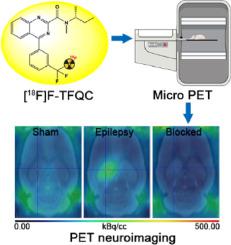
The translocator protein (TSPO) positron emission tomography (PET) can noninvasively detect neuroinflammation associated with epileptogenesis and epilepsy. This study explored the role of the TSPO-targeting radioligand [18F]F-TFQC, an m-trifluoromethyl ER176 analog, in the PET neuroimaging of epileptic rats. Initially, [18F]F-TFQC was synthesized with a radiochemical yield of 8%–10% (EOS), a radiochemical purity of over 99%, and a specific activity of 38.21 ± 1.73 MBq/nmol (EOS). After determining that [18F]F-TFQC exhibited good biochemical properties, [18F]F-TFQC PET neuroimaging was performed in epileptic rats at multiple time points in various stages of disease progression. PET imaging showed specific [18F]F-TFQC uptake in the right hippocampus (KA-injected site, i.e., epileptogenic zone), which was most pronounced at 1 week (T/NT 1.63 ± 0.21) and 1 month (T/NT 1.66 ± 0.20). The PET results were further validated using autoradiography and pathological analysis. Thus, [18F]F-TFQC can reflect the TSPO levels and localize the epileptogenic zone, thereby offering the potential for monitoring neuroinflammation and guiding anti-inflammatory treatment in patients with epilepsy.
Acta Pharmaceutica Sinica. BPharmacology, Toxicology and Pharmaceutics-General Pharmacology, Toxicology and Pharmaceutics
CiteScore
22.40
自引率
5.50%
发文量
1051
审稿时长
19 weeks
期刊介绍:
The Journal of the Institute of Materia Medica, Chinese Academy of Medical Sciences, and the Chinese Pharmaceutical Association oversees the peer review process for Acta Pharmaceutica Sinica. B (APSB).
Published monthly in English, APSB is dedicated to disseminating significant original research articles, rapid communications, and high-quality reviews that highlight recent advances across various pharmaceutical sciences domains. These encompass pharmacology, pharmaceutics, medicinal chemistry, natural products, pharmacognosy, pharmaceutical analysis, and pharmacokinetics.
A part of the Acta Pharmaceutica Sinica series, established in 1953 and indexed in prominent databases like Chemical Abstracts, Index Medicus, SciFinder Scholar, Biological Abstracts, International Pharmaceutical Abstracts, Cambridge Scientific Abstracts, and Current Bibliography on Science and Technology, APSB is sponsored by the Institute of Materia Medica, Chinese Academy of Medical Sciences, and the Chinese Pharmaceutical Association. Its production and hosting are facilitated by Elsevier B.V. This collaborative effort ensures APSB's commitment to delivering valuable contributions to the pharmaceutical sciences community.





 京公网安备 11010802042870号
京ICP备2023020795号-1
京公网安备 11010802042870号
京ICP备2023020795号-1

 分享
分享
 求助内容:
求助内容: 应助结果提醒方式:
 扫码关注我们
