Understanding the effect of refractory metal chemistry on the stacking fault energy and mechanical property of Cantor-based multi-principal element alloys
Prashant Singh , William Trehern , Brent Vela , Prince Sharma , Tanner Kirk , Zongrui Pei , Raymundo Arroyave , Michael C. Gao , Duane D. Johnson
{"title":"Understanding the effect of refractory metal chemistry on the stacking fault energy and mechanical property of Cantor-based multi-principal element alloys","authors":"Prashant Singh , William Trehern , Brent Vela , Prince Sharma , Tanner Kirk , Zongrui Pei , Raymundo Arroyave , Michael C. Gao , Duane D. Johnson","doi":"10.1016/j.ijplas.2024.104020","DOIUrl":null,"url":null,"abstract":"<div><p>Multi-principal-element alloys (MPEAs) based on <em>3d</em>-transition metals show remarkable mechanical properties. The stacking fault energy (SFE) in face-centered cubic (fcc) alloys is a critical property that controls underlying deformation mechanisms and mechanical response. Here, we present an exhaustive density-functional theory study on refractory- and copper-reinforced Cantor-based systems to ascertain the effects of refractory metal chemistry on SFE. We find that even a small percent change in refractory metal composition significantly changes SFEs, which correlates favorably with features like electronegativity variance, size effect, and heat of fusion. For fcc MPEAs, we also detail the changes in mechanical properties, such as bulk, Young's, and shear moduli, as well as yield strength. A Labusch-type solute-solution-strengthening model was used to evaluate the temperature-dependent yield strength, which, combined with SFE, provides a design guide for high-performance alloys. We also analyzed the electronic structures of two down-selected alloys to reveal the underlying origin of optimal SFE and strength range in refractory-reinforced fcc MPEAs. These new insights on tuning SFEs and modifying composition-structure-property correlation in refractory- and copper-reinforced MPEAs by chemical disorder, provide a chemical route to tune twinning- and transformation-induced plasticity behavior.</p></div>","PeriodicalId":340,"journal":{"name":"International Journal of Plasticity","volume":"179 ","pages":"Article 104020"},"PeriodicalIF":12.8000,"publicationDate":"2024-08-01","publicationTypes":"Journal Article","fieldsOfStudy":null,"isOpenAccess":false,"openAccessPdf":"","citationCount":"0","resultStr":null,"platform":"Semanticscholar","paperid":null,"PeriodicalName":"International Journal of Plasticity","FirstCategoryId":"88","ListUrlMain":"https://www.sciencedirect.com/science/article/pii/S0749641924001475","RegionNum":1,"RegionCategory":"材料科学","ArticlePicture":[],"TitleCN":null,"AbstractTextCN":null,"PMCID":null,"EPubDate":"2024/6/4 0:00:00","PubModel":"Epub","JCR":"Q1","JCRName":"ENGINEERING, MECHANICAL","Score":null,"Total":0}
引用次数: 0
Abstract
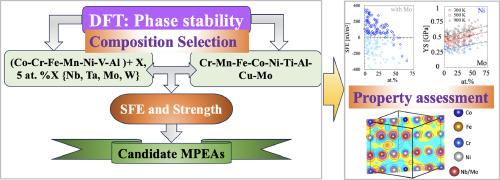
Multi-principal-element alloys (MPEAs) based on 3d-transition metals show remarkable mechanical properties. The stacking fault energy (SFE) in face-centered cubic (fcc) alloys is a critical property that controls underlying deformation mechanisms and mechanical response. Here, we present an exhaustive density-functional theory study on refractory- and copper-reinforced Cantor-based systems to ascertain the effects of refractory metal chemistry on SFE. We find that even a small percent change in refractory metal composition significantly changes SFEs, which correlates favorably with features like electronegativity variance, size effect, and heat of fusion. For fcc MPEAs, we also detail the changes in mechanical properties, such as bulk, Young's, and shear moduli, as well as yield strength. A Labusch-type solute-solution-strengthening model was used to evaluate the temperature-dependent yield strength, which, combined with SFE, provides a design guide for high-performance alloys. We also analyzed the electronic structures of two down-selected alloys to reveal the underlying origin of optimal SFE and strength range in refractory-reinforced fcc MPEAs. These new insights on tuning SFEs and modifying composition-structure-property correlation in refractory- and copper-reinforced MPEAs by chemical disorder, provide a chemical route to tune twinning- and transformation-induced plasticity behavior.
期刊介绍:
International Journal of Plasticity aims to present original research encompassing all facets of plastic deformation, damage, and fracture behavior in both isotropic and anisotropic solids. This includes exploring the thermodynamics of plasticity and fracture, continuum theory, and macroscopic as well as microscopic phenomena.
Topics of interest span the plastic behavior of single crystals and polycrystalline metals, ceramics, rocks, soils, composites, nanocrystalline and microelectronics materials, shape memory alloys, ferroelectric ceramics, thin films, and polymers. Additionally, the journal covers plasticity aspects of failure and fracture mechanics. Contributions involving significant experimental, numerical, or theoretical advancements that enhance the understanding of the plastic behavior of solids are particularly valued. Papers addressing the modeling of finite nonlinear elastic deformation, bearing similarities to the modeling of plastic deformation, are also welcomed.



 京公网安备 11010802042870号
京ICP备2023020795号-1
京公网安备 11010802042870号
京ICP备2023020795号-1

 分享
分享
 求助内容:
求助内容: 应助结果提醒方式:
 扫码关注我们
