Synthesis of naphtho[1,2-b]furan-2-carbaldehydes and naphtho[2,1-b]furan-2-carbaldehydes via electrocatalytic 3,3-rearrangement/cyclization of propargylic aryl ethers under mild conditions
Kaili Cen , Mixia Ouyang , Guojun He , Zhouting Zeng , Qiaolin Wang , Xin Yu , Feng Zhao , Jinhui Cai
{"title":"Synthesis of naphtho[1,2-b]furan-2-carbaldehydes and naphtho[2,1-b]furan-2-carbaldehydes via electrocatalytic 3,3-rearrangement/cyclization of propargylic aryl ethers under mild conditions","authors":"Kaili Cen , Mixia Ouyang , Guojun He , Zhouting Zeng , Qiaolin Wang , Xin Yu , Feng Zhao , Jinhui Cai","doi":"10.1016/j.gresc.2024.05.008","DOIUrl":null,"url":null,"abstract":"<div><div>An electrocatalytic 3,3-rearrangement/cyclization approach has been developed for the transformation of aryl-substituted propargylic aryl ethers to naphtho[1,2-<em>b</em>]furan-2-carbaldehyde and naphtho[2,1-<em>b</em>]furan-2-carbaldehyde derivatives. The reaction proceeded efficiently under mild conditions in the absence of metal- and chemical-oxidant, yielding the desired products with good substrate scope and functional group tolerance <em>via</em> a radical pathway. Furthermore, the control experiment revealed that the phenylselenyl-substituted secondary alcohol might be intermediate, and the <sup>18</sup>O labeling reaction indicated the oxygen source in the product possibly deriving from water. Significantly, further transformations of the product were conducted to showcase the utility of this electrosynthesis strategy.</div></div>","PeriodicalId":12794,"journal":{"name":"Green Synthesis and Catalysis","volume":"6 4","pages":"Pages 444-448"},"PeriodicalIF":0.0000,"publicationDate":"2025-11-01","publicationTypes":"Journal Article","fieldsOfStudy":null,"isOpenAccess":false,"openAccessPdf":"","citationCount":"0","resultStr":null,"platform":"Semanticscholar","paperid":null,"PeriodicalName":"Green Synthesis and Catalysis","FirstCategoryId":"1085","ListUrlMain":"https://www.sciencedirect.com/science/article/pii/S2666554924000632","RegionNum":0,"RegionCategory":null,"ArticlePicture":[],"TitleCN":null,"AbstractTextCN":null,"PMCID":null,"EPubDate":"","PubModel":"","JCR":"","JCRName":"","Score":null,"Total":0}
引用次数: 0
Abstract
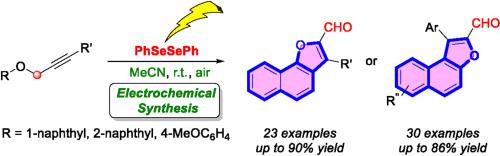
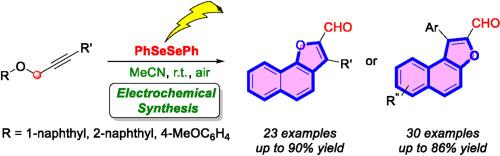
An electrocatalytic 3,3-rearrangement/cyclization approach has been developed for the transformation of aryl-substituted propargylic aryl ethers to naphtho[1,2-b]furan-2-carbaldehyde and naphtho[2,1-b]furan-2-carbaldehyde derivatives. The reaction proceeded efficiently under mild conditions in the absence of metal- and chemical-oxidant, yielding the desired products with good substrate scope and functional group tolerance via a radical pathway. Furthermore, the control experiment revealed that the phenylselenyl-substituted secondary alcohol might be intermediate, and the 18O labeling reaction indicated the oxygen source in the product possibly deriving from water. Significantly, further transformations of the product were conducted to showcase the utility of this electrosynthesis strategy.



 京公网安备 11010802042870号
京ICP备2023020795号-1
京公网安备 11010802042870号
京ICP备2023020795号-1

 分享
分享

 求助内容:
求助内容: 应助结果提醒方式:
 扫码关注我们
