Claus Bachert, Philippe Gevaert, Brian Lipworth, Syed Shahzad Mustafa, Andrew P. Lane, Joaquim Mullol, Paul Rowe, Yamo Deniz, Siddhesh Kamat, Asif H. Khan, Juby Jacob-Nara, Shahid Siddiqui, Marcella Ruddy, Elizabeth Laws, Jérôme Msihid, Sivan Harel, Alexandre Jagerschmidt, Nikhil Amin, Leda Mannent, Raj Rout
{"title":"Dupilumab efficacy across serum IgE and blood eosinophil levels in chronic rhinosinusitis with nasal polyposis","authors":"Claus Bachert, Philippe Gevaert, Brian Lipworth, Syed Shahzad Mustafa, Andrew P. Lane, Joaquim Mullol, Paul Rowe, Yamo Deniz, Siddhesh Kamat, Asif H. Khan, Juby Jacob-Nara, Shahid Siddiqui, Marcella Ruddy, Elizabeth Laws, Jérôme Msihid, Sivan Harel, Alexandre Jagerschmidt, Nikhil Amin, Leda Mannent, Raj Rout","doi":"10.1111/all.16189","DOIUrl":null,"url":null,"abstract":"<p>The pathophysiology of chronic rhinosinusitis with nasal polyposis (CRSwNP) is driven primarily by interleukin (IL)-4, IL-13, and IL-5 cytokines, and up to 87% of CRSwNP patients have a type 2 (T2) inflammatory signature.<span><sup>1, 2</sup></span> Blood eosinophils and serum IgE are easily accessible clinical biomarkers of T2 inflammation; serum IgE correlates with tissue levels of IgE in CRSwNP patients.<span><sup>3</sup></span> Current treatment modalities (endoscopic sinus surgery and intranasal corticosteroids) are associated with high rates of recurrence; hence a need exists for biomarker-based optimization of biologics to improve treatment outcomes. Dupilumab, a fully human monoclonal antibody blocking the shared IL-4 and IL-13 receptor subunit, reduces levels of T2 inflammatory biomarkers in CRSwNP patients.<span><sup>4</sup></span></p><p>This pooled post-hoc analysis from two phase three trials, SINUS-24 (NCT02912468) and SINUS-52 (NCT02898454),<span><sup>5</sup></span> evaluated baseline serum total IgE and blood eosinophils as predictive biomarkers of dupilumab treatment response in CRSwNP. Association between biomarkers (serum total IgE, ≥100 vs. <100 IU/mL; blood eosinophils, ≥150 vs. <150 cells/μL)<span><sup>6</sup></span> and changes in objective (Nasal Polyp Score [NPS]; University of Pennsylvania Smell Identification Test [UPSIT]; Lund-Mackay computed tomography score [LMK-CT]) and subjective measures (Nasal Congestion [NC]; loss of sense of smell (LoS); 22-item Sino-Nasal Outcome Test [SNOT-22]) at Week 24 were analyzed using correlations and linear regression (Methods; Supplement).</p><p>At baseline (intention-to-treat [ITT] population, <i>N</i> = 724), median (Q1–Q3) serum total IgE was 120 IU/mL (54–266) and blood eosinophils was 340 cells/μL (210–550) (Table S1). The correlation between IgE and eosinophils (Spearman's correlation coefficient, <i>ρ</i> = .14) and between biomarkers and objective and subjective measures of CRSwNP severity (IgE, <i>ρ</i> < .05; eosinophils, <i>ρ</i> = .08–.28) were weak (Table S2). Biomarker (IgE and eosinophil) levels were significantly higher (<i>p</i> < .0001) in patients with asthma (<i>n</i> = 428) than in those without (Table S3), but correlations between baseline biomarkers and baseline measures of CRSwNP severity were weak in patients with asthma (IgE, <i>ρ</i> = .02–.06; eosinophils, <i>ρ</i> = .07–.20) (Table S4).</p><p>At Week 24, dupilumab was significantly superior to placebo below or above thresholds for baseline IgE (100 IU/mL) and eosinophils (150 cells/μL) with clinically meaningful changes across all objective and subjective efficacy outcomes in the overall population and in subgroups with/without asthma or with/without prior sinus surgery. For IgE, there was no indication of any difference in treatment effect depending on biomarker level (biomarker-by-treatment interaction <i>p</i>-values >.05). For eosinophils, an increased effect on efficacy outcomes were seen in patients with counts ≥150 versus <150 cells/μL (biomarker-by-treatment interaction <i>p</i>-values <.05) (Figure 1A–F). In the overall population and in patients with/without asthma, correlations were weak between baseline biomarkers and changes from baseline to Week 24 in all measures of disease severity for dupilumab and placebo (Table 1).</p><p>Predictive modeling revealed no statistically significant interaction between continuous baseline IgE and treatment group on objective and subjective outcomes at Week 24 (biomarker-by-treatment interaction <i>p</i>-values >.05). The interaction <i>p</i>-value (<.05) for subjective outcomes NC, LoS, and SNOT-22 suggests baseline eosinophils may be predictive of the effects of dupilumab (Table S5, Figure S1).</p><p>In conclusion, this pooled analysis showed that treatment with dupilumab (300 mg subcutaneously every 2 weeks) compared with placebo improved symptoms of severe CRSwNP irrespective of baseline IgE and blood eosinophils levels, although the higher baseline eosinophil group (≥150 cells/μL) showed increased efficacy. In accordance with the approved dupilumab indication (no requirement for biomarker testing prior to treatment initiation) and overall SINUS-24 and SINUS-52 trial results,<span><sup>6</sup></span> these biomarkers may have limited value as predictors of dupilumab efficacy since there was no evidence of minimum or maximum levels required to start treatment. These results highlight the potential of dupilumab as a viable and effective treatment option for CRSwNP patients with, regardless of baseline biomarker levels.</p><p>Claus Bachert, Philippe Gevaert, Brian Lipworth, Syed Shahzad Mustafa, Andrew P Lane, and Joaquim Mullol generated the idea, supervised the work, and wrote the manuscript draft. Jérôme Msihid designed and conducted the statistical analysis and contributed to analysis interpretation. Paul Rowe, Yamo Deniz, Siddhesh Kamat, Asif H Khan, Juby Jacob-Nara, Shahid Siddiqui, Marcella Ruddy, Elizabeth Laws, Sivan Harel, Alexandre Jagerschmidt, Nikhil Amin, Leda Mannent, and Raj Rout edited and critically revised the manuscript for important intellectual content. All authors revised and approved the final version.</p><p>Claus Bachert is a paid consultant for Sanofi, GSK, Novartis and Meda. Philippe Gevaert, Andrew P Lane, and Joaquim Mullol are paid consultants for Sanofi and Regeneron. Paul Rowe, Asif H Khan, Juby Jacob-Nara, Elizabeth Laws, Jérôme Msihid, Alexandre Jagersmidt, and Leda Mannent are employees of Sanofi, and Raj Rout is a former employee of Sanofi, and may hold shares and/or stock options (<5%) in the company. Yamo Deniz and Siddesh Kamat are employees of Regeneron, and Shahid Siddiqui, Marcella Ruddy, Sivan Harel, and Nikhil Amin are former employees of Regeneron, and may hold shares and/or stock options (<5%) in the company. Brian Lipworth and Syed Shahzad Mustafa have no relevant conflicts of interest to declare.</p>","PeriodicalId":122,"journal":{"name":"Allergy","volume":"79 10","pages":"2858-2861"},"PeriodicalIF":12.0000,"publicationDate":"2024-06-08","publicationTypes":"Journal Article","fieldsOfStudy":null,"isOpenAccess":false,"openAccessPdf":"https://onlinelibrary.wiley.com/doi/epdf/10.1111/all.16189","citationCount":"0","resultStr":null,"platform":"Semanticscholar","paperid":null,"PeriodicalName":"Allergy","FirstCategoryId":"3","ListUrlMain":"https://onlinelibrary.wiley.com/doi/10.1111/all.16189","RegionNum":1,"RegionCategory":"医学","ArticlePicture":[],"TitleCN":null,"AbstractTextCN":null,"PMCID":null,"EPubDate":"","PubModel":"","JCR":"Q1","JCRName":"ALLERGY","Score":null,"Total":0}
引用次数: 0
Abstract
The pathophysiology of chronic rhinosinusitis with nasal polyposis (CRSwNP) is driven primarily by interleukin (IL)-4, IL-13, and IL-5 cytokines, and up to 87% of CRSwNP patients have a type 2 (T2) inflammatory signature.1, 2 Blood eosinophils and serum IgE are easily accessible clinical biomarkers of T2 inflammation; serum IgE correlates with tissue levels of IgE in CRSwNP patients.3 Current treatment modalities (endoscopic sinus surgery and intranasal corticosteroids) are associated with high rates of recurrence; hence a need exists for biomarker-based optimization of biologics to improve treatment outcomes. Dupilumab, a fully human monoclonal antibody blocking the shared IL-4 and IL-13 receptor subunit, reduces levels of T2 inflammatory biomarkers in CRSwNP patients.4
This pooled post-hoc analysis from two phase three trials, SINUS-24 (NCT02912468) and SINUS-52 (NCT02898454),5 evaluated baseline serum total IgE and blood eosinophils as predictive biomarkers of dupilumab treatment response in CRSwNP. Association between biomarkers (serum total IgE, ≥100 vs. <100 IU/mL; blood eosinophils, ≥150 vs. <150 cells/μL)6 and changes in objective (Nasal Polyp Score [NPS]; University of Pennsylvania Smell Identification Test [UPSIT]; Lund-Mackay computed tomography score [LMK-CT]) and subjective measures (Nasal Congestion [NC]; loss of sense of smell (LoS); 22-item Sino-Nasal Outcome Test [SNOT-22]) at Week 24 were analyzed using correlations and linear regression (Methods; Supplement).
At baseline (intention-to-treat [ITT] population, N = 724), median (Q1–Q3) serum total IgE was 120 IU/mL (54–266) and blood eosinophils was 340 cells/μL (210–550) (Table S1). The correlation between IgE and eosinophils (Spearman's correlation coefficient, ρ = .14) and between biomarkers and objective and subjective measures of CRSwNP severity (IgE, ρ < .05; eosinophils, ρ = .08–.28) were weak (Table S2). Biomarker (IgE and eosinophil) levels were significantly higher (p < .0001) in patients with asthma (n = 428) than in those without (Table S3), but correlations between baseline biomarkers and baseline measures of CRSwNP severity were weak in patients with asthma (IgE, ρ = .02–.06; eosinophils, ρ = .07–.20) (Table S4).
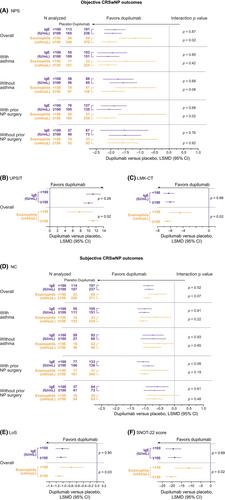
At Week 24, dupilumab was significantly superior to placebo below or above thresholds for baseline IgE (100 IU/mL) and eosinophils (150 cells/μL) with clinically meaningful changes across all objective and subjective efficacy outcomes in the overall population and in subgroups with/without asthma or with/without prior sinus surgery. For IgE, there was no indication of any difference in treatment effect depending on biomarker level (biomarker-by-treatment interaction p-values >.05). For eosinophils, an increased effect on efficacy outcomes were seen in patients with counts ≥150 versus <150 cells/μL (biomarker-by-treatment interaction p-values <.05) (Figure 1A–F). In the overall population and in patients with/without asthma, correlations were weak between baseline biomarkers and changes from baseline to Week 24 in all measures of disease severity for dupilumab and placebo (Table 1).
Predictive modeling revealed no statistically significant interaction between continuous baseline IgE and treatment group on objective and subjective outcomes at Week 24 (biomarker-by-treatment interaction p-values >.05). The interaction p-value (<.05) for subjective outcomes NC, LoS, and SNOT-22 suggests baseline eosinophils may be predictive of the effects of dupilumab (Table S5, Figure S1).
In conclusion, this pooled analysis showed that treatment with dupilumab (300 mg subcutaneously every 2 weeks) compared with placebo improved symptoms of severe CRSwNP irrespective of baseline IgE and blood eosinophils levels, although the higher baseline eosinophil group (≥150 cells/μL) showed increased efficacy. In accordance with the approved dupilumab indication (no requirement for biomarker testing prior to treatment initiation) and overall SINUS-24 and SINUS-52 trial results,6 these biomarkers may have limited value as predictors of dupilumab efficacy since there was no evidence of minimum or maximum levels required to start treatment. These results highlight the potential of dupilumab as a viable and effective treatment option for CRSwNP patients with, regardless of baseline biomarker levels.
Claus Bachert, Philippe Gevaert, Brian Lipworth, Syed Shahzad Mustafa, Andrew P Lane, and Joaquim Mullol generated the idea, supervised the work, and wrote the manuscript draft. Jérôme Msihid designed and conducted the statistical analysis and contributed to analysis interpretation. Paul Rowe, Yamo Deniz, Siddhesh Kamat, Asif H Khan, Juby Jacob-Nara, Shahid Siddiqui, Marcella Ruddy, Elizabeth Laws, Sivan Harel, Alexandre Jagerschmidt, Nikhil Amin, Leda Mannent, and Raj Rout edited and critically revised the manuscript for important intellectual content. All authors revised and approved the final version.
Claus Bachert is a paid consultant for Sanofi, GSK, Novartis and Meda. Philippe Gevaert, Andrew P Lane, and Joaquim Mullol are paid consultants for Sanofi and Regeneron. Paul Rowe, Asif H Khan, Juby Jacob-Nara, Elizabeth Laws, Jérôme Msihid, Alexandre Jagersmidt, and Leda Mannent are employees of Sanofi, and Raj Rout is a former employee of Sanofi, and may hold shares and/or stock options (<5%) in the company. Yamo Deniz and Siddesh Kamat are employees of Regeneron, and Shahid Siddiqui, Marcella Ruddy, Sivan Harel, and Nikhil Amin are former employees of Regeneron, and may hold shares and/or stock options (<5%) in the company. Brian Lipworth and Syed Shahzad Mustafa have no relevant conflicts of interest to declare.
期刊介绍:
Allergy is an international and multidisciplinary journal that aims to advance, impact, and communicate all aspects of the discipline of Allergy/Immunology. It publishes original articles, reviews, position papers, guidelines, editorials, news and commentaries, letters to the editors, and correspondences. The journal accepts articles based on their scientific merit and quality.
Allergy seeks to maintain contact between basic and clinical Allergy/Immunology and encourages contributions from contributors and readers from all countries. In addition to its publication, Allergy also provides abstracting and indexing information. Some of the databases that include Allergy abstracts are Abstracts on Hygiene & Communicable Disease, Academic Search Alumni Edition, AgBiotech News & Information, AGRICOLA Database, Biological Abstracts, PubMed Dietary Supplement Subset, and Global Health, among others.



 京公网安备 11010802042870号
京ICP备2023020795号-1
京公网安备 11010802042870号
京ICP备2023020795号-1

 分享
分享
 求助内容:
求助内容: 应助结果提醒方式:
 扫码关注我们
