Marcela C Smid, Rebecca G Clifton, Kara Rood, Sindhu Srinivas, Hyagriv N Simhan, Brian M Casey, Monica Longo, Ruth Landau, Cora MacPherson, Anna Bartholomew, Amber Sowles, Uma M Reddy, Dwight J Rouse, Jennifer L Bailit, John M Thorp, Suneet P Chauhan, George R Saade, William A Grobman, George A Macones
{"title":"Optimizing Opioid Prescription Quantity After Cesarean Delivery: A Randomized Controlled Trial.","authors":"Marcela C Smid, Rebecca G Clifton, Kara Rood, Sindhu Srinivas, Hyagriv N Simhan, Brian M Casey, Monica Longo, Ruth Landau, Cora MacPherson, Anna Bartholomew, Amber Sowles, Uma M Reddy, Dwight J Rouse, Jennifer L Bailit, John M Thorp, Suneet P Chauhan, George R Saade, William A Grobman, George A Macones","doi":"10.1097/AOG.0000000000005649","DOIUrl":null,"url":null,"abstract":"<p><strong>Objective: </strong>To test whether an individualized opioid-prescription protocol (IOPP) with a shared decision-making component can be used without compromising postcesarean pain management.</p><p><strong>Methods: </strong>In this multicenter randomized controlled noninferiority trial, we compared IOPP with shared decision making with a fixed quantity of opioid tablets at hospital discharge. We recruited at 31 centers participating in the Eunice Kennedy Shriver National Institute of Child Health and Human Development Maternal-Fetal Medicine Units Network. Study participants had uncomplicated cesarean births. Follow-up occurred through 12 weeks postdischarge. Individuals with complicated cesarean births or history of opioid use in the pregnancy were excluded. Participants were randomized 1:1 to IOPP with shared decision making or fixed quantity (20 tablets of 5 mg oxycodone). In the IOPP group, we calculated recommended tablet quantity based on opioid use in the 24 hours before discharge. After an educational module and shared decision making, participants selected a quantity of discharge tablets (up to 20). The primary outcome was moderate to severe pain (score 4 or higher [possible range 0-10]) on the BPI (Brief Pain Inventory) at 1 week after discharge. A total sample size of 5,500 participants was planned to assess whether IOPP with shared decision making was not inferior to the fixed quantity of 20 tablets.</p><p><strong>Results: </strong>From September 2020 to March 2022, 18,990 individuals were screened and 5,521 were enrolled (n=2,748 IOPP group, n=2,773 fixed-quantity group). For the primary outcome, IOPP with shared decision making was not inferior to fixed quantity (59.5% vs 60.1%, risk difference 0.67%; 95% CI, -2.03% to 3.37%, noninferiority margin -5.0) and resulted in significantly fewer tablets received (median 14 [interquartile range 4-20] vs 20, P <.001) through 90 days postpartum.</p><p><strong>Conclusion: </strong>Compared with fixed quantity, IOPP with shared decision making was noninferior for outpatient postcesarean analgesia at 1 week postdischarge and resulted in fewer prescribed opioid tablets at discharge.</p><p><strong>Clinical trial registration: </strong>ClinicalTrials.gov, NCT04296396.</p>","PeriodicalId":19483,"journal":{"name":"Obstetrics and gynecology","volume":" ","pages":"195-205"},"PeriodicalIF":4.7000,"publicationDate":"2024-08-01","publicationTypes":"Journal Article","fieldsOfStudy":null,"isOpenAccess":false,"openAccessPdf":"https://www.ncbi.nlm.nih.gov/pmc/articles/PMC11257794/pdf/","citationCount":"0","resultStr":null,"platform":"Semanticscholar","paperid":null,"PeriodicalName":"Obstetrics and gynecology","FirstCategoryId":"3","ListUrlMain":"https://doi.org/10.1097/AOG.0000000000005649","RegionNum":2,"RegionCategory":"医学","ArticlePicture":[],"TitleCN":null,"AbstractTextCN":null,"PMCID":null,"EPubDate":"2024/6/10 0:00:00","PubModel":"Epub","JCR":"Q1","JCRName":"OBSTETRICS & GYNECOLOGY","Score":null,"Total":0}
引用次数: 0
Abstract
Objective: To test whether an individualized opioid-prescription protocol (IOPP) with a shared decision-making component can be used without compromising postcesarean pain management.
Methods: In this multicenter randomized controlled noninferiority trial, we compared IOPP with shared decision making with a fixed quantity of opioid tablets at hospital discharge. We recruited at 31 centers participating in the Eunice Kennedy Shriver National Institute of Child Health and Human Development Maternal-Fetal Medicine Units Network. Study participants had uncomplicated cesarean births. Follow-up occurred through 12 weeks postdischarge. Individuals with complicated cesarean births or history of opioid use in the pregnancy were excluded. Participants were randomized 1:1 to IOPP with shared decision making or fixed quantity (20 tablets of 5 mg oxycodone). In the IOPP group, we calculated recommended tablet quantity based on opioid use in the 24 hours before discharge. After an educational module and shared decision making, participants selected a quantity of discharge tablets (up to 20). The primary outcome was moderate to severe pain (score 4 or higher [possible range 0-10]) on the BPI (Brief Pain Inventory) at 1 week after discharge. A total sample size of 5,500 participants was planned to assess whether IOPP with shared decision making was not inferior to the fixed quantity of 20 tablets.
Results: From September 2020 to March 2022, 18,990 individuals were screened and 5,521 were enrolled (n=2,748 IOPP group, n=2,773 fixed-quantity group). For the primary outcome, IOPP with shared decision making was not inferior to fixed quantity (59.5% vs 60.1%, risk difference 0.67%; 95% CI, -2.03% to 3.37%, noninferiority margin -5.0) and resulted in significantly fewer tablets received (median 14 [interquartile range 4-20] vs 20, P <.001) through 90 days postpartum.
Conclusion: Compared with fixed quantity, IOPP with shared decision making was noninferior for outpatient postcesarean analgesia at 1 week postdischarge and resulted in fewer prescribed opioid tablets at discharge.
期刊介绍:
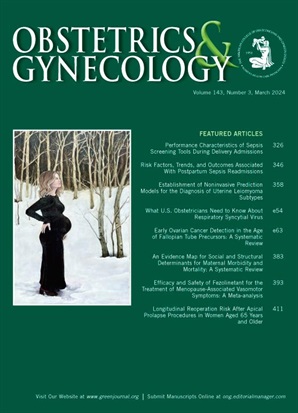
"Obstetrics & Gynecology," affectionately known as "The Green Journal," is the official publication of the American College of Obstetricians and Gynecologists (ACOG). Since its inception in 1953, the journal has been dedicated to advancing the clinical practice of obstetrics and gynecology, as well as related fields. The journal's mission is to promote excellence in these areas by publishing a diverse range of articles that cover translational and clinical topics.
"Obstetrics & Gynecology" provides a platform for the dissemination of evidence-based research, clinical guidelines, and expert opinions that are essential for the continuous improvement of women's health care. The journal's content is designed to inform and educate obstetricians, gynecologists, and other healthcare professionals, ensuring that they stay abreast of the latest developments and best practices in their field.



 京公网安备 11010802042870号
京ICP备2023020795号-1
京公网安备 11010802042870号
京ICP备2023020795号-1

 分享
分享
 求助内容:
求助内容: 应助结果提醒方式:
 扫码关注我们
