{"title":"Chimpanzees (<i>Pan troglodytes</i>) recognize that their guesses could be wrong and can pass a two-cup disjunctive syllogism task.","authors":"Benjamin Jones, Josep Call","doi":"10.1098/rsbl.2024.0051","DOIUrl":null,"url":null,"abstract":"<p><p>When chimpanzees search for hidden food, do they realize that their guesses may not be correct? We applied a post-decision wagering paradigm to a simple two-cup search task, varying whether we gave participants visual access to the baiting and then asking after they had chosen one of the cups whether they would prefer a smaller but certain reward instead of their original choice (experiment 1). Results showed that chimpanzees were more likely to accept the smaller reward in occluded than visible conditions. Experiment 2 found the same effect when we blocked visual access but manipulated the number of hiding locations for the food piece, showing that the effect is not owing to representation type. Experiments 3 and 4 showed that when given information about the contents of the unchosen cup, chimpanzees were able to flexibly update their choice behaviour accordingly. These results suggest that language is not a pre-requisite to solving the disjunctive syllogism and provides a valuable contribution to the debate on logical reasoning in non-human animals.</p>","PeriodicalId":9005,"journal":{"name":"Biology Letters","volume":"20 6","pages":"20240051"},"PeriodicalIF":3.0000,"publicationDate":"2024-06-01","publicationTypes":"Journal Article","fieldsOfStudy":null,"isOpenAccess":false,"openAccessPdf":"https://www.ncbi.nlm.nih.gov/pmc/articles/PMC11285724/pdf/","citationCount":"0","resultStr":null,"platform":"Semanticscholar","paperid":null,"PeriodicalName":"Biology Letters","FirstCategoryId":"99","ListUrlMain":"https://doi.org/10.1098/rsbl.2024.0051","RegionNum":2,"RegionCategory":"生物学","ArticlePicture":[],"TitleCN":null,"AbstractTextCN":null,"PMCID":null,"EPubDate":"2024/6/12 0:00:00","PubModel":"Epub","JCR":"Q2","JCRName":"BIOLOGY","Score":null,"Total":0}
引用次数: 0
Abstract
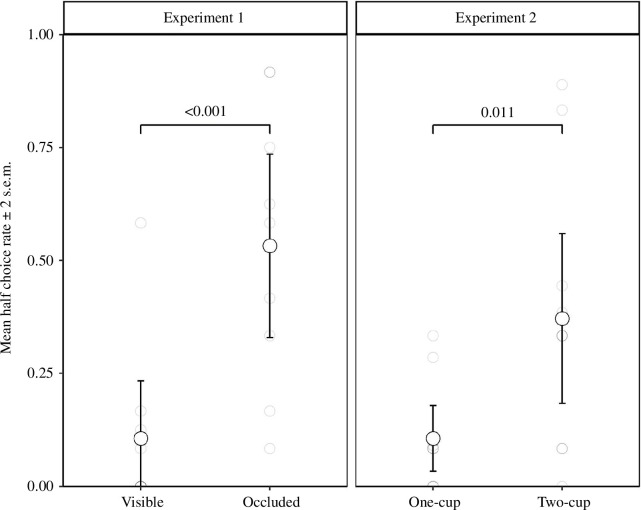
When chimpanzees search for hidden food, do they realize that their guesses may not be correct? We applied a post-decision wagering paradigm to a simple two-cup search task, varying whether we gave participants visual access to the baiting and then asking after they had chosen one of the cups whether they would prefer a smaller but certain reward instead of their original choice (experiment 1). Results showed that chimpanzees were more likely to accept the smaller reward in occluded than visible conditions. Experiment 2 found the same effect when we blocked visual access but manipulated the number of hiding locations for the food piece, showing that the effect is not owing to representation type. Experiments 3 and 4 showed that when given information about the contents of the unchosen cup, chimpanzees were able to flexibly update their choice behaviour accordingly. These results suggest that language is not a pre-requisite to solving the disjunctive syllogism and provides a valuable contribution to the debate on logical reasoning in non-human animals.
期刊介绍:
Previously a supplement to Proceedings B, and launched as an independent journal in 2005, Biology Letters is a primarily online, peer-reviewed journal that publishes short, high-quality articles, reviews and opinion pieces from across the biological sciences. The scope of Biology Letters is vast - publishing high-quality research in any area of the biological sciences. However, we have particular strengths in the biology, evolution and ecology of whole organisms. We also publish in other areas of biology, such as molecular ecology and evolution, environmental science, and phylogenetics.





 京公网安备 11010802042870号
京ICP备2023020795号-1
京公网安备 11010802042870号
京ICP备2023020795号-1

 分享
分享
 求助内容:
求助内容: 应助结果提醒方式:
 扫码关注我们
