{"title":"PSMD14 is a novel prognostic marker and therapeutic target in osteosarcoma.","authors":"Jiabin Lai, Weike Kong, Qiangchang Fu, Zhaochang Jiang, Bohao Sun, Xin Ye, Jing Kong, Shumei Wei, Lifeng Jiang","doi":"10.1186/s13000-024-01489-y","DOIUrl":null,"url":null,"abstract":"<p><strong>Background: </strong>Osteosarcoma is a bone tumor that is characterized by high malignancy and a high mortality rate, and that originates from primitive osteoblastic mesenchymal cells and is most common in rapidly growing long bones. PSMD14, also known as RPN11 or POH1, is a member of the JAMM isopeptidase family, which is able to remove the substrate protein ubiquitination label, thereby regulating the stability and function of the substrate protein. In this study, we explored the expression and potential biological significance of the PSMD14 deubiquitinating enzyme in osteosarcoma.</p><p><strong>Methods: </strong>Immunohistochemical methods were used to detect the expression of PSMD14 in biopsies of 91 osteosarcoma patients, and the specimens were classified into high and low PSMD14 expression groups. The correlation between PSMD14 expression and clinical indicators and prognosis was compared.SiRNA was used to downregulate PSMD14 in two osteosarcoma cell lines (HOS and SJSA-1), and the effects of downregulation of PSMD14 on the viability, proliferation, and invasion ability of osteosarcoma cells were analyzed.</p><p><strong>Results: </strong>We identified significant differences in recurrence, metastasis, and survival time of the osteosarcoma patients on the basis of PSMD14 expression. High expression of PSMD14 in osteosarcoma patients was associated with a low survival rate and high risk of metastasis and recurrence. Down-regulation of PSMD14 inhibited the viability, proliferation, and invasiveness of osteosarcoma cell lines.</p><p><strong>Conclusions: </strong>PSMD14 may be a new prognostic marker and therapeutic target for osteosarcoma.</p>","PeriodicalId":11237,"journal":{"name":"Diagnostic Pathology","volume":"19 1","pages":"79"},"PeriodicalIF":2.3000,"publicationDate":"2024-06-11","publicationTypes":"Journal Article","fieldsOfStudy":null,"isOpenAccess":false,"openAccessPdf":"https://www.ncbi.nlm.nih.gov/pmc/articles/PMC11165824/pdf/","citationCount":"0","resultStr":null,"platform":"Semanticscholar","paperid":null,"PeriodicalName":"Diagnostic Pathology","FirstCategoryId":"3","ListUrlMain":"https://doi.org/10.1186/s13000-024-01489-y","RegionNum":3,"RegionCategory":"医学","ArticlePicture":[],"TitleCN":null,"AbstractTextCN":null,"PMCID":null,"EPubDate":"","PubModel":"","JCR":"Q2","JCRName":"PATHOLOGY","Score":null,"Total":0}
引用次数: 0
Abstract
Background: Osteosarcoma is a bone tumor that is characterized by high malignancy and a high mortality rate, and that originates from primitive osteoblastic mesenchymal cells and is most common in rapidly growing long bones. PSMD14, also known as RPN11 or POH1, is a member of the JAMM isopeptidase family, which is able to remove the substrate protein ubiquitination label, thereby regulating the stability and function of the substrate protein. In this study, we explored the expression and potential biological significance of the PSMD14 deubiquitinating enzyme in osteosarcoma.
Methods: Immunohistochemical methods were used to detect the expression of PSMD14 in biopsies of 91 osteosarcoma patients, and the specimens were classified into high and low PSMD14 expression groups. The correlation between PSMD14 expression and clinical indicators and prognosis was compared.SiRNA was used to downregulate PSMD14 in two osteosarcoma cell lines (HOS and SJSA-1), and the effects of downregulation of PSMD14 on the viability, proliferation, and invasion ability of osteosarcoma cells were analyzed.
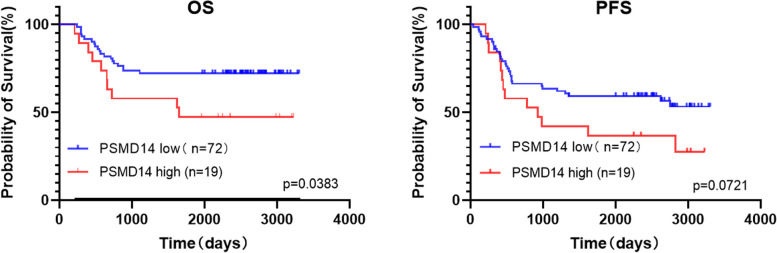
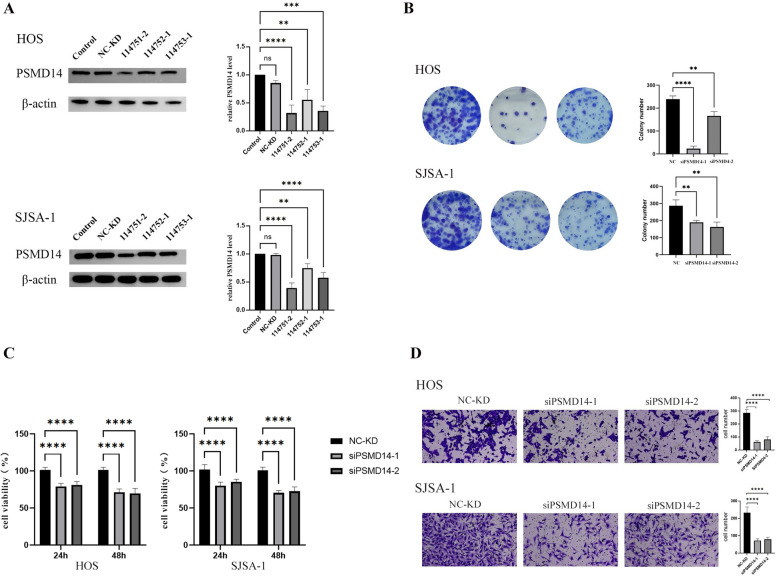
Results: We identified significant differences in recurrence, metastasis, and survival time of the osteosarcoma patients on the basis of PSMD14 expression. High expression of PSMD14 in osteosarcoma patients was associated with a low survival rate and high risk of metastasis and recurrence. Down-regulation of PSMD14 inhibited the viability, proliferation, and invasiveness of osteosarcoma cell lines.
Conclusions: PSMD14 may be a new prognostic marker and therapeutic target for osteosarcoma.
期刊介绍:
Diagnostic Pathology is an open access, peer-reviewed, online journal that considers research in surgical and clinical pathology, immunology, and biology, with a special focus on cutting-edge approaches in diagnostic pathology and tissue-based therapy. The journal covers all aspects of surgical pathology, including classic diagnostic pathology, prognosis-related diagnosis (tumor stages, prognosis markers, such as MIB-percentage, hormone receptors, etc.), and therapy-related findings. The journal also focuses on the technological aspects of pathology, including molecular biology techniques, morphometry aspects (stereology, DNA analysis, syntactic structure analysis), communication aspects (telecommunication, virtual microscopy, virtual pathology institutions, etc.), and electronic education and quality assurance (for example interactive publication, on-line references with automated updating, etc.).




 京公网安备 11010802042870号
京ICP备2023020795号-1
京公网安备 11010802042870号
京ICP备2023020795号-1

 分享
分享
 求助内容:
求助内容: 应助结果提醒方式:
 扫码关注我们
