{"title":"Pseudo-twin boundary improves flow stress and cyclic stability of TiAl single crystal","authors":"Yiqi Zhu, Min Yi, Wanlin Guo","doi":"10.1016/j.ijplas.2024.104021","DOIUrl":null,"url":null,"abstract":"<div><p>Polysynthetically twinned (PST) TiAl single crystal with lamellar structures exhibits great mechanical properties at room temperature. Therein twin boundaries (TBs) are important for achieving optimized ductile and fatigue performance of PST TiAl, but their role and the associated mechanism are elusive. Herein, we decipher the role of true TB (TTB) and pseudo TB (PTB) by a combined atomistic simulation and mesoscopic modeling, and find that PTB could remarkably improve room-temperature flow stress and cyclic stability of TiAl single crystal. It is revealed that dislocations pile up at PTB while unobstructedly traverse TTB. The emergency of back stress and the movement of dislocations along PTB contribute to the strengthening mechanism. The flow stress of TiAl single crystal with PTB is 34% higher than that with TTB. It is further found that as the twin thickness decreases, the flow stress of TiAl single crystal with TTB initially increases and then decreases (i.e., inverse Hall–Petch like behavior), whereas that with PTB always increases owing to the extra back stress and interfacial stress (i.e., Hall–Petch like behavior). Atomistic-informed mesoscopic theoretical models are then proposed to describe the flow stress as a function of twin thickness. Under cyclic loading, PTB is found to facilitate strain delocalization of TiAl single crystal during plastic deformation and thus noticeably improve the cyclic stability. These findings should shed light on achieving strong TiAl alloys with enhanced fatigue performance by the introduction and design of PTB.</p></div>","PeriodicalId":340,"journal":{"name":"International Journal of Plasticity","volume":"179 ","pages":"Article 104021"},"PeriodicalIF":12.8000,"publicationDate":"2024-06-05","publicationTypes":"Journal Article","fieldsOfStudy":null,"isOpenAccess":false,"openAccessPdf":"","citationCount":"0","resultStr":null,"platform":"Semanticscholar","paperid":null,"PeriodicalName":"International Journal of Plasticity","FirstCategoryId":"88","ListUrlMain":"https://www.sciencedirect.com/science/article/pii/S0749641924001487","RegionNum":1,"RegionCategory":"材料科学","ArticlePicture":[],"TitleCN":null,"AbstractTextCN":null,"PMCID":null,"EPubDate":"","PubModel":"","JCR":"Q1","JCRName":"ENGINEERING, MECHANICAL","Score":null,"Total":0}
引用次数: 0
Abstract
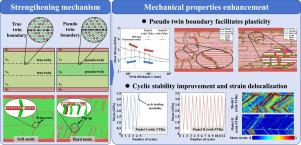
Polysynthetically twinned (PST) TiAl single crystal with lamellar structures exhibits great mechanical properties at room temperature. Therein twin boundaries (TBs) are important for achieving optimized ductile and fatigue performance of PST TiAl, but their role and the associated mechanism are elusive. Herein, we decipher the role of true TB (TTB) and pseudo TB (PTB) by a combined atomistic simulation and mesoscopic modeling, and find that PTB could remarkably improve room-temperature flow stress and cyclic stability of TiAl single crystal. It is revealed that dislocations pile up at PTB while unobstructedly traverse TTB. The emergency of back stress and the movement of dislocations along PTB contribute to the strengthening mechanism. The flow stress of TiAl single crystal with PTB is 34% higher than that with TTB. It is further found that as the twin thickness decreases, the flow stress of TiAl single crystal with TTB initially increases and then decreases (i.e., inverse Hall–Petch like behavior), whereas that with PTB always increases owing to the extra back stress and interfacial stress (i.e., Hall–Petch like behavior). Atomistic-informed mesoscopic theoretical models are then proposed to describe the flow stress as a function of twin thickness. Under cyclic loading, PTB is found to facilitate strain delocalization of TiAl single crystal during plastic deformation and thus noticeably improve the cyclic stability. These findings should shed light on achieving strong TiAl alloys with enhanced fatigue performance by the introduction and design of PTB.
期刊介绍:
International Journal of Plasticity aims to present original research encompassing all facets of plastic deformation, damage, and fracture behavior in both isotropic and anisotropic solids. This includes exploring the thermodynamics of plasticity and fracture, continuum theory, and macroscopic as well as microscopic phenomena.
Topics of interest span the plastic behavior of single crystals and polycrystalline metals, ceramics, rocks, soils, composites, nanocrystalline and microelectronics materials, shape memory alloys, ferroelectric ceramics, thin films, and polymers. Additionally, the journal covers plasticity aspects of failure and fracture mechanics. Contributions involving significant experimental, numerical, or theoretical advancements that enhance the understanding of the plastic behavior of solids are particularly valued. Papers addressing the modeling of finite nonlinear elastic deformation, bearing similarities to the modeling of plastic deformation, are also welcomed.



 京公网安备 11010802042870号
京ICP备2023020795号-1
京公网安备 11010802042870号
京ICP备2023020795号-1

 分享
分享
 求助内容:
求助内容: 应助结果提醒方式:
 扫码关注我们
