{"title":"Hydrogels for next generation neural interfaces","authors":"Simin Cheng, Ruiqi Zhu, Xiaomin Xu","doi":"10.1038/s43246-024-00541-0","DOIUrl":null,"url":null,"abstract":"Overcoming the mechanical disparities between implantable neural electrodes and biological tissue is crucial in mitigating immune responses, reducing shear motion, and ensuring durable functionality. Emerging hydrogel-based neural interfaces, with their volumetric capacitance, customizable conductivity, and tissue-mimicking mechanical properties, offer a more efficient, less detrimental, and chronically stable alternative to their rigid counterparts. Here, we provide an overview of the exceptional advantages of hydrogels for the development of next-generation neural interfaces and highlight recent advancements that are transforming the field. Materials are needed that can form stable interfaces with neurons, and soft materials are the most promising for this. Here, the advantages and challenges associated with neural interfaces using hydrogels, particularly conductive hydrogels, are discussed.","PeriodicalId":10589,"journal":{"name":"Communications Materials","volume":" ","pages":"1-9"},"PeriodicalIF":9.6000,"publicationDate":"2024-06-12","publicationTypes":"Journal Article","fieldsOfStudy":null,"isOpenAccess":false,"openAccessPdf":"https://www.nature.com/articles/s43246-024-00541-0.pdf","citationCount":"0","resultStr":null,"platform":"Semanticscholar","paperid":null,"PeriodicalName":"Communications Materials","FirstCategoryId":"1085","ListUrlMain":"https://www.nature.com/articles/s43246-024-00541-0","RegionNum":0,"RegionCategory":null,"ArticlePicture":[],"TitleCN":null,"AbstractTextCN":null,"PMCID":null,"EPubDate":"","PubModel":"","JCR":"Q1","JCRName":"MATERIALS SCIENCE, MULTIDISCIPLINARY","Score":null,"Total":0}
引用次数: 0
Abstract
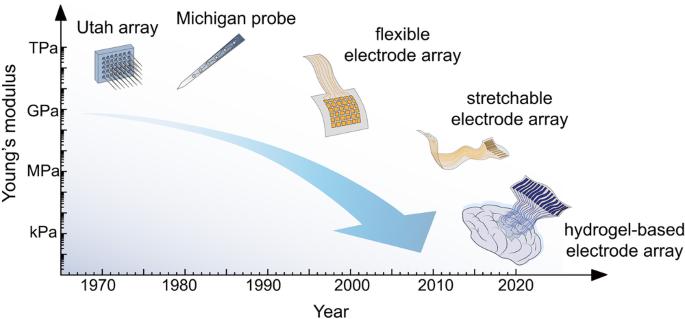
Overcoming the mechanical disparities between implantable neural electrodes and biological tissue is crucial in mitigating immune responses, reducing shear motion, and ensuring durable functionality. Emerging hydrogel-based neural interfaces, with their volumetric capacitance, customizable conductivity, and tissue-mimicking mechanical properties, offer a more efficient, less detrimental, and chronically stable alternative to their rigid counterparts. Here, we provide an overview of the exceptional advantages of hydrogels for the development of next-generation neural interfaces and highlight recent advancements that are transforming the field. Materials are needed that can form stable interfaces with neurons, and soft materials are the most promising for this. Here, the advantages and challenges associated with neural interfaces using hydrogels, particularly conductive hydrogels, are discussed.
期刊介绍:
Communications Materials, a selective open access journal within Nature Portfolio, is dedicated to publishing top-tier research, reviews, and commentary across all facets of materials science. The journal showcases significant advancements in specialized research areas, encompassing both fundamental and applied studies. Serving as an open access option for materials sciences, Communications Materials applies less stringent criteria for impact and significance compared to Nature-branded journals, including Nature Communications.



 京公网安备 11010802042870号
京ICP备2023020795号-1
京公网安备 11010802042870号
京ICP备2023020795号-1

 分享
分享
 求助内容:
求助内容: 应助结果提醒方式:
 扫码关注我们
