Boya Zhang, Nona Naderi, Rahul Mishra, Douglas Teodoro
{"title":"Online Health Search Via Multidimensional Information Quality Assessment Based on Deep Language Models: Algorithm Development and Validation.","authors":"Boya Zhang, Nona Naderi, Rahul Mishra, Douglas Teodoro","doi":"10.2196/42630","DOIUrl":null,"url":null,"abstract":"<p><strong>Background: </strong>Widespread misinformation in web resources can lead to serious implications for individuals seeking health advice. Despite that, information retrieval models are often focused only on the query-document relevance dimension to rank results.</p><p><strong>Objective: </strong>We investigate a multidimensional information quality retrieval model based on deep learning to enhance the effectiveness of online health care information search results.</p><p><strong>Methods: </strong>In this study, we simulated online health information search scenarios with a topic set of 32 different health-related inquiries and a corpus containing 1 billion web documents from the April 2019 snapshot of Common Crawl. Using state-of-the-art pretrained language models, we assessed the quality of the retrieved documents according to their usefulness, supportiveness, and credibility dimensions for a given search query on 6030 human-annotated, query-document pairs. We evaluated this approach using transfer learning and more specific domain adaptation techniques.</p><p><strong>Results: </strong>In the transfer learning setting, the usefulness model provided the largest distinction between help- and harm-compatible documents, with a difference of +5.6%, leading to a majority of helpful documents in the top 10 retrieved. The supportiveness model achieved the best harm compatibility (+2.4%), while the combination of usefulness, supportiveness, and credibility models achieved the largest distinction between help- and harm-compatibility on helpful topics (+16.9%). In the domain adaptation setting, the linear combination of different models showed robust performance, with help-harm compatibility above +4.4% for all dimensions and going as high as +6.8%.</p><p><strong>Conclusions: </strong>These results suggest that integrating automatic ranking models created for specific information quality dimensions can increase the effectiveness of health-related information retrieval. Thus, our approach could be used to enhance searches made by individuals seeking online health information.</p>","PeriodicalId":73551,"journal":{"name":"JMIR AI","volume":"3 ","pages":"e42630"},"PeriodicalIF":6.1000,"publicationDate":"2024-05-02","publicationTypes":"Journal Article","fieldsOfStudy":null,"isOpenAccess":false,"openAccessPdf":"https://www.ncbi.nlm.nih.gov/pmc/articles/PMC11099810/pdf/","citationCount":"0","resultStr":null,"platform":"Semanticscholar","paperid":null,"PeriodicalName":"JMIR AI","FirstCategoryId":"1085","ListUrlMain":"https://doi.org/10.2196/42630","RegionNum":0,"RegionCategory":null,"ArticlePicture":[],"TitleCN":null,"AbstractTextCN":null,"PMCID":null,"EPubDate":"","PubModel":"","JCR":"","JCRName":"","Score":null,"Total":0}
引用次数: 0
Abstract
Background: Widespread misinformation in web resources can lead to serious implications for individuals seeking health advice. Despite that, information retrieval models are often focused only on the query-document relevance dimension to rank results.
Objective: We investigate a multidimensional information quality retrieval model based on deep learning to enhance the effectiveness of online health care information search results.
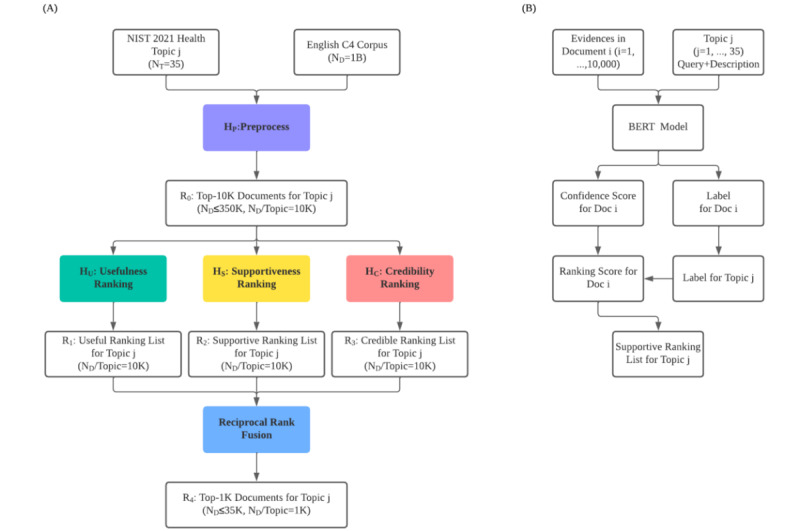
Methods: In this study, we simulated online health information search scenarios with a topic set of 32 different health-related inquiries and a corpus containing 1 billion web documents from the April 2019 snapshot of Common Crawl. Using state-of-the-art pretrained language models, we assessed the quality of the retrieved documents according to their usefulness, supportiveness, and credibility dimensions for a given search query on 6030 human-annotated, query-document pairs. We evaluated this approach using transfer learning and more specific domain adaptation techniques.
Results: In the transfer learning setting, the usefulness model provided the largest distinction between help- and harm-compatible documents, with a difference of +5.6%, leading to a majority of helpful documents in the top 10 retrieved. The supportiveness model achieved the best harm compatibility (+2.4%), while the combination of usefulness, supportiveness, and credibility models achieved the largest distinction between help- and harm-compatibility on helpful topics (+16.9%). In the domain adaptation setting, the linear combination of different models showed robust performance, with help-harm compatibility above +4.4% for all dimensions and going as high as +6.8%.
Conclusions: These results suggest that integrating automatic ranking models created for specific information quality dimensions can increase the effectiveness of health-related information retrieval. Thus, our approach could be used to enhance searches made by individuals seeking online health information.






 京公网安备 11010802042870号
京ICP备2023020795号-1
京公网安备 11010802042870号
京ICP备2023020795号-1

 分享
分享

 求助内容:
求助内容: 应助结果提醒方式:
 扫码关注我们
