Dam-Bé L. Douti, Chérif Ouro-Wassara, Essohana Mabafei
{"title":"FriiTriga, a triggered controller with an optical beam shutter using a hard disk drive voice-coil actuator","authors":"Dam-Bé L. Douti, Chérif Ouro-Wassara, Essohana Mabafei","doi":"10.1016/j.ohx.2024.e00542","DOIUrl":null,"url":null,"abstract":"<div><p>We present in this article the complete setup to build a triggered controller with a mechanical optical shutter. The system is a low cost, Do-It-Yourself, and easy to implement setup with three functionalities: Manual mode, direct mode with TTL signal command and Triggered mode with a TTL signal command. Our setup is primarily intended to be integrated in optical setup where one needs to control the opening time of a light path, but can be used also for any other setup where one wants to send a TTL signal to command another subsystem (in our case the shutter is that subsystem). The shutter used here is hard disk drive voice-coil actuator, which was already demonstrated to have interesting potentialities to be a mechanical shutter.</p><p>In the Manual mode, this setup achieves an opening and closing time of 3 ms. In Direct mode with TTL signal command, the setup has a delay response time of 19 ms and a minimum open pulse time of 23 ms. This low cost device which can be made with less than 50€, have similar characteristics with commercial ones which can be twenty times more expensive.</p></div>","PeriodicalId":37503,"journal":{"name":"HardwareX","volume":"19 ","pages":"Article e00542"},"PeriodicalIF":2.1000,"publicationDate":"2024-09-01","publicationTypes":"Journal Article","fieldsOfStudy":null,"isOpenAccess":false,"openAccessPdf":"https://www.sciencedirect.com/science/article/pii/S2468067224000361/pdfft?md5=2caef0e9157e28a65c774adc62ab45fe&pid=1-s2.0-S2468067224000361-main.pdf","citationCount":"0","resultStr":null,"platform":"Semanticscholar","paperid":null,"PeriodicalName":"HardwareX","FirstCategoryId":"1085","ListUrlMain":"https://www.sciencedirect.com/science/article/pii/S2468067224000361","RegionNum":0,"RegionCategory":null,"ArticlePicture":[],"TitleCN":null,"AbstractTextCN":null,"PMCID":null,"EPubDate":"2024/6/7 0:00:00","PubModel":"Epub","JCR":"Q3","JCRName":"ENGINEERING, ELECTRICAL & ELECTRONIC","Score":null,"Total":0}
引用次数: 0
Abstract
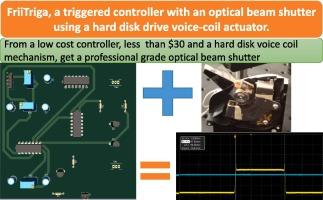
We present in this article the complete setup to build a triggered controller with a mechanical optical shutter. The system is a low cost, Do-It-Yourself, and easy to implement setup with three functionalities: Manual mode, direct mode with TTL signal command and Triggered mode with a TTL signal command. Our setup is primarily intended to be integrated in optical setup where one needs to control the opening time of a light path, but can be used also for any other setup where one wants to send a TTL signal to command another subsystem (in our case the shutter is that subsystem). The shutter used here is hard disk drive voice-coil actuator, which was already demonstrated to have interesting potentialities to be a mechanical shutter.
In the Manual mode, this setup achieves an opening and closing time of 3 ms. In Direct mode with TTL signal command, the setup has a delay response time of 19 ms and a minimum open pulse time of 23 ms. This low cost device which can be made with less than 50€, have similar characteristics with commercial ones which can be twenty times more expensive.
HardwareXEngineering-Industrial and Manufacturing Engineering
CiteScore
4.10
自引率
18.20%
发文量
124
审稿时长
24 weeks
期刊介绍:
HardwareX is an open access journal established to promote free and open source designing, building and customizing of scientific infrastructure (hardware). HardwareX aims to recognize researchers for the time and effort in developing scientific infrastructure while providing end-users with sufficient information to replicate and validate the advances presented. HardwareX is open to input from all scientific, technological and medical disciplines. Scientific infrastructure will be interpreted in the broadest sense. Including hardware modifications to existing infrastructure, sensors and tools that perform measurements and other functions outside of the traditional lab setting (such as wearables, air/water quality sensors, and low cost alternatives to existing tools), and the creation of wholly new tools for either standard or novel laboratory tasks. Authors are encouraged to submit hardware developments that address all aspects of science, not only the final measurement, for example, enhancements in sample preparation and handling, user safety, and quality control. The use of distributed digital manufacturing strategies (e.g. 3-D printing) is encouraged. All designs must be submitted under an open hardware license.





 京公网安备 11010802042870号
京ICP备2023020795号-1
京公网安备 11010802042870号
京ICP备2023020795号-1

 分享
分享
 求助内容:
求助内容: 应助结果提醒方式:
 扫码关注我们
