Michele Stella Ngono Mbenti , Roger Firmin Donald Ntouala , Rodrigue Cyriaque Kaze , Marie Thérèse Nanga Bineli , Arnaud Ngo'o Ze , Vincent Laurent Onana
{"title":"Potentiality of some lateritic clayey material from Meiganga as raw material in fired bricks making","authors":"Michele Stella Ngono Mbenti , Roger Firmin Donald Ntouala , Rodrigue Cyriaque Kaze , Marie Thérèse Nanga Bineli , Arnaud Ngo'o Ze , Vincent Laurent Onana","doi":"10.1016/j.oceram.2024.100619","DOIUrl":null,"url":null,"abstract":"<div><p>The Meiganga lateritic clays and termite mounds were characterized for their use as construction materials. The six collected samples were subjected to mineralogical, geochemical, and physico-mechanical tests. Quartz, kaolinite, hematite, goethite, gibbsite, muscovite, and anatase are the main minerals in raw materials, while after firing at 1050 °C, mullite is formed. The SiO<sub>2</sub>/Al<sub>2</sub>O<sub>3</sub> ratio greater than 1 indicates a high SiO<sub>2</sub> content, which is consistent with the presence of quartz as an associate mineral to kaolinite. Considering linear shrinkage globally less than 5 % and flexural and compressive strengths greater than 2 and 7 MPa, respectively, four clay materials are suitable to produce bricks at all the studied temperatures, whereas two others only after firing at 1050 °C. As the studied characteristics do not depend on the nature of the material, exploring termite mound material in the Meiganga area would provide additional good-quality material to make up for any deficit that might arise.</p></div>","PeriodicalId":34140,"journal":{"name":"Open Ceramics","volume":"19 ","pages":"Article 100619"},"PeriodicalIF":2.8000,"publicationDate":"2024-06-10","publicationTypes":"Journal Article","fieldsOfStudy":null,"isOpenAccess":false,"openAccessPdf":"https://www.sciencedirect.com/science/article/pii/S266653952400083X/pdfft?md5=0b0830af3d0a86aa8ca01e68bbf8eb9a&pid=1-s2.0-S266653952400083X-main.pdf","citationCount":"0","resultStr":null,"platform":"Semanticscholar","paperid":null,"PeriodicalName":"Open Ceramics","FirstCategoryId":"1085","ListUrlMain":"https://www.sciencedirect.com/science/article/pii/S266653952400083X","RegionNum":0,"RegionCategory":null,"ArticlePicture":[],"TitleCN":null,"AbstractTextCN":null,"PMCID":null,"EPubDate":"","PubModel":"","JCR":"Q1","JCRName":"MATERIALS SCIENCE, CERAMICS","Score":null,"Total":0}
引用次数: 0
Abstract
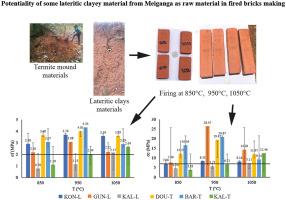
The Meiganga lateritic clays and termite mounds were characterized for their use as construction materials. The six collected samples were subjected to mineralogical, geochemical, and physico-mechanical tests. Quartz, kaolinite, hematite, goethite, gibbsite, muscovite, and anatase are the main minerals in raw materials, while after firing at 1050 °C, mullite is formed. The SiO2/Al2O3 ratio greater than 1 indicates a high SiO2 content, which is consistent with the presence of quartz as an associate mineral to kaolinite. Considering linear shrinkage globally less than 5 % and flexural and compressive strengths greater than 2 and 7 MPa, respectively, four clay materials are suitable to produce bricks at all the studied temperatures, whereas two others only after firing at 1050 °C. As the studied characteristics do not depend on the nature of the material, exploring termite mound material in the Meiganga area would provide additional good-quality material to make up for any deficit that might arise.



 京公网安备 11010802042870号
京ICP备2023020795号-1
京公网安备 11010802042870号
京ICP备2023020795号-1

 分享
分享
 求助内容:
求助内容: 应助结果提醒方式:
 扫码关注我们
