Ce Yang, Yayun Xie, Xiaoxiao Yang, Jun Yin, Binghe Wang
{"title":"Reversible in-situ assembly of PROTACs using iminoboronate conjugation","authors":"Ce Yang, Yayun Xie, Xiaoxiao Yang, Jun Yin, Binghe Wang","doi":"10.1007/s00044-024-03258-4","DOIUrl":null,"url":null,"abstract":"<div><p>Proteolysis targeting chimeras (PROTACs) offer a promising degradation-based alternative to classical inhibition-based therapeutic interventions. PROTACs are hetero-bifunctional molecules, which incorporate a ligand for the target protein, an E3 ubiquitin ligase recruiting group, and a linker to bring together ubiquitinating machinery and the target protein for degradation. Such bifunctional molecules generally have molecular weights in a significantly higher range than “mono-functional” inhibitors of various targets. The high molecular weight of PROTACs can limit cellular permeation and other drug-like properties. With these challenges in mind, we envision the idea of reversible covalent assembly of PROTAC molecules to allow for cellular penetration of individual components and then in-situ assembly at the site of action. A key to the realization of this idea is to select the right “assembly chemistry,” which offers the appropriate affinity for dissociation for cellular penetration and yet assembly on-site. For this, we resort to neighboring-group (boronic acid) assisted conjugation of a carbonyl group with an oxyamine or hydrazine for the assembly of hetero-bifunctional PROTACs, the use of a GFP-fused HaloTag as a model system for studying protein degradation, and ligands for cereblon and VHL as the E3 ligands. These options lead to several combinations and thus different PROTAC assemblies. In this initial feasibility study, we demonstrate the reversible assembly of the two components, as designed. We further demonstrate the ability of such assemblies to induce protein degradation by flow cytometry and western blot studies. Varying degree of potencies for the different assemblies were observed, demonstrating the need for further optimization.</p></div>","PeriodicalId":699,"journal":{"name":"Medicinal Chemistry Research","volume":"33 in","pages":"1432 - 1439"},"PeriodicalIF":3.1000,"publicationDate":"2024-06-15","publicationTypes":"Journal Article","fieldsOfStudy":null,"isOpenAccess":false,"openAccessPdf":"","citationCount":"0","resultStr":null,"platform":"Semanticscholar","paperid":null,"PeriodicalName":"Medicinal Chemistry Research","FirstCategoryId":"3","ListUrlMain":"https://link.springer.com/article/10.1007/s00044-024-03258-4","RegionNum":4,"RegionCategory":"医学","ArticlePicture":[],"TitleCN":null,"AbstractTextCN":null,"PMCID":null,"EPubDate":"","PubModel":"","JCR":"Q3","JCRName":"CHEMISTRY, MEDICINAL","Score":null,"Total":0}
引用次数: 0
Abstract
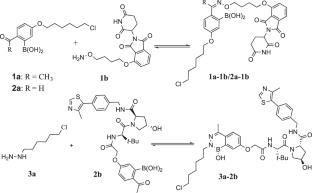
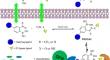
Proteolysis targeting chimeras (PROTACs) offer a promising degradation-based alternative to classical inhibition-based therapeutic interventions. PROTACs are hetero-bifunctional molecules, which incorporate a ligand for the target protein, an E3 ubiquitin ligase recruiting group, and a linker to bring together ubiquitinating machinery and the target protein for degradation. Such bifunctional molecules generally have molecular weights in a significantly higher range than “mono-functional” inhibitors of various targets. The high molecular weight of PROTACs can limit cellular permeation and other drug-like properties. With these challenges in mind, we envision the idea of reversible covalent assembly of PROTAC molecules to allow for cellular penetration of individual components and then in-situ assembly at the site of action. A key to the realization of this idea is to select the right “assembly chemistry,” which offers the appropriate affinity for dissociation for cellular penetration and yet assembly on-site. For this, we resort to neighboring-group (boronic acid) assisted conjugation of a carbonyl group with an oxyamine or hydrazine for the assembly of hetero-bifunctional PROTACs, the use of a GFP-fused HaloTag as a model system for studying protein degradation, and ligands for cereblon and VHL as the E3 ligands. These options lead to several combinations and thus different PROTAC assemblies. In this initial feasibility study, we demonstrate the reversible assembly of the two components, as designed. We further demonstrate the ability of such assemblies to induce protein degradation by flow cytometry and western blot studies. Varying degree of potencies for the different assemblies were observed, demonstrating the need for further optimization.
期刊介绍:
Medicinal Chemistry Research (MCRE) publishes papers on a wide range of topics, favoring research with significant, new, and up-to-date information. Although the journal has a demanding peer review process, MCRE still boasts rapid publication, due in part, to the length of the submissions. The journal publishes significant research on various topics, many of which emphasize the structure-activity relationships of molecular biology.



 京公网安备 11010802042870号
京ICP备2023020795号-1
京公网安备 11010802042870号
京ICP备2023020795号-1

 分享
分享
 求助内容:
求助内容: 应助结果提醒方式:
 扫码关注我们
