Faisal Abbas, Muhammad Tahir, Asif Hussain Khoja, Nadia Shahzad, Mustafa Anwar, Muniba Ayub, Sehar Shakir
{"title":"Synthesis and Performance Analysis of a Carbon-Doped Titania (C–TiO2) Counter Electrode (CE) for Dye-Sensitized Solar Cells (DSSCs)","authors":"Faisal Abbas, Muhammad Tahir, Asif Hussain Khoja, Nadia Shahzad, Mustafa Anwar, Muniba Ayub, Sehar Shakir","doi":"10.1007/s11664-024-11222-6","DOIUrl":null,"url":null,"abstract":"<div><p>In this study, we fabricated an efficient and low-cost carbon-doped titania (C–TiO<sub>2</sub>) counter electrode (CE) as a substitute for platinum (Pt) in dye-sensitized solar cells (DSSCs). By varying different weight ratios, C–TiO<sub>2</sub> samples were synthesized through the hydrothermal synthesis method followed by calcination in a tube furnace. The doctor blade coating method was used to deposit thin films of the synthesized samples onto the fluorine-doped tin oxide (FTO) substrates. Structural and morphological properties were studied by using various analytical techniques. Moreover, the electrochemical and photo-conversion characteristics of the fabricated CEs were investigated. Cyclic voltammetry (CV) results of the fabricated CEs showed electrocatalytic activity comparable to the Pt in the DSSCs. Meanwhile, photovoltaic measurement results showed the best-performing 15% C–TiO<sub>2</sub> CE having 1.56% power conversion efficiency (PCE) as compared to Pt, which is 2.12%. This study proposed a simple method to fabricate a low-cost and efficient C–TiO<sub>2</sub> CE for DSSCs.</p><h3>Graphical Abstract</h3>\n<div><figure><div><div><picture><source><img></source></picture></div></div></figure></div></div>","PeriodicalId":626,"journal":{"name":"Journal of Electronic Materials","volume":"53 8","pages":"4773 - 4781"},"PeriodicalIF":2.8000,"publicationDate":"2024-06-15","publicationTypes":"Journal Article","fieldsOfStudy":null,"isOpenAccess":false,"openAccessPdf":"","citationCount":"0","resultStr":null,"platform":"Semanticscholar","paperid":null,"PeriodicalName":"Journal of Electronic Materials","FirstCategoryId":"5","ListUrlMain":"https://link.springer.com/article/10.1007/s11664-024-11222-6","RegionNum":4,"RegionCategory":"工程技术","ArticlePicture":[],"TitleCN":null,"AbstractTextCN":null,"PMCID":null,"EPubDate":"","PubModel":"","JCR":"Q3","JCRName":"ENGINEERING, ELECTRICAL & ELECTRONIC","Score":null,"Total":0}
引用次数: 0
Abstract
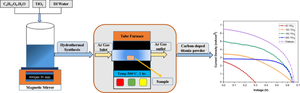
In this study, we fabricated an efficient and low-cost carbon-doped titania (C–TiO2) counter electrode (CE) as a substitute for platinum (Pt) in dye-sensitized solar cells (DSSCs). By varying different weight ratios, C–TiO2 samples were synthesized through the hydrothermal synthesis method followed by calcination in a tube furnace. The doctor blade coating method was used to deposit thin films of the synthesized samples onto the fluorine-doped tin oxide (FTO) substrates. Structural and morphological properties were studied by using various analytical techniques. Moreover, the electrochemical and photo-conversion characteristics of the fabricated CEs were investigated. Cyclic voltammetry (CV) results of the fabricated CEs showed electrocatalytic activity comparable to the Pt in the DSSCs. Meanwhile, photovoltaic measurement results showed the best-performing 15% C–TiO2 CE having 1.56% power conversion efficiency (PCE) as compared to Pt, which is 2.12%. This study proposed a simple method to fabricate a low-cost and efficient C–TiO2 CE for DSSCs.
期刊介绍:
The Journal of Electronic Materials (JEM) reports monthly on the science and technology of electronic materials, while examining new applications for semiconductors, magnetic alloys, dielectrics, nanoscale materials, and photonic materials. The journal welcomes articles on methods for preparing and evaluating the chemical, physical, electronic, and optical properties of these materials. Specific areas of interest are materials for state-of-the-art transistors, nanotechnology, electronic packaging, detectors, emitters, metallization, superconductivity, and energy applications.
Review papers on current topics enable individuals in the field of electronics to keep abreast of activities in areas peripheral to their own. JEM also selects papers from conferences such as the Electronic Materials Conference, the U.S. Workshop on the Physics and Chemistry of II-VI Materials, and the International Conference on Thermoelectrics. It benefits both specialists and non-specialists in the electronic materials field.
A journal of The Minerals, Metals & Materials Society.




 京公网安备 11010802042870号
京ICP备2023020795号-1
京公网安备 11010802042870号
京ICP备2023020795号-1

 分享
分享
 求助内容:
求助内容: 应助结果提醒方式:
 扫码关注我们
