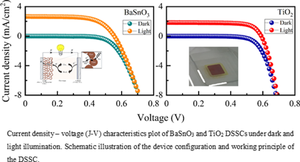
{"title":"Comparative Study of BaSnO3 and TiO2-Based Dye Sensitized Solar Cells Utilizing Complex Ruthenium-Derived N719 Dye","authors":"Kaushlendra Pandey, Sunil Chauhan, Manoj Kumar","doi":"10.1007/s11664-024-11231-5","DOIUrl":null,"url":null,"abstract":"<div><p>Dye-sensitized solar cells (DSSCs) are garnering significant interest because of their cost-effective production process and promising potential for future prospects. This paper presents an innovative approach to the fabrication of DSSCs. Further, a comparative study of DSSCs has been carried to evaluate the performance of the solar cells. BaSnO<sub>3</sub> (BSO)- and TiO<sub>2</sub>-based DSSCs were fabricated with the incorporation of a ruthenium-based N719 dye [(Bu<sub>4</sub>N)<sub>2</sub>(Ru)(dcbpyH)<sub>2</sub>(NCS)<sub>2</sub>]. The sol–gel technique, facilitated by a microwave oven, was employed for the synthesis of the solar cell materials. Subsequently, these materials were deposited on a fluorine-doped SnO<sub>2</sub> glass substrate via doctor blade method. Comprehensive analysis of the structural, optical, and electrical properties of the powder and FTO/BSO/N719/electrolyte/Pt and FTO/TiO<sub>2</sub>/N719/electrolyte/Pt cells was conducted using x-ray diffraction, scanning electron microscopy, UV–Vis–NIR spectroscopy, and current–voltage (<i>J</i>–<i>V</i>) characteristics. The BSO DSSC demonstrated higher incident photon-to-current conversion efficiency in the UV–Vis region and better overall performance than the TiO<sub>2</sub>-based cell with a similar experimental environment. The BSO-based DSSC exhibited maximum conversion efficiency (ƞ) of 2.64%, whereas the TiO<sub>2</sub>-based DSSC demonstrated maximum conversion efficiency of 2.19%.</p><h3>Graphical Abstract</h3>\n<div><figure><div><div><picture><source><img></source></picture></div></div></figure></div></div>","PeriodicalId":626,"journal":{"name":"Journal of Electronic Materials","volume":"53 8","pages":"4782 - 4789"},"PeriodicalIF":2.5000,"publicationDate":"2024-06-15","publicationTypes":"Journal Article","fieldsOfStudy":null,"isOpenAccess":false,"openAccessPdf":"","citationCount":"0","resultStr":null,"platform":"Semanticscholar","paperid":null,"PeriodicalName":"Journal of Electronic Materials","FirstCategoryId":"5","ListUrlMain":"https://link.springer.com/article/10.1007/s11664-024-11231-5","RegionNum":4,"RegionCategory":"工程技术","ArticlePicture":[],"TitleCN":null,"AbstractTextCN":null,"PMCID":null,"EPubDate":"","PubModel":"","JCR":"Q3","JCRName":"ENGINEERING, ELECTRICAL & ELECTRONIC","Score":null,"Total":0}
引用次数: 0
Abstract
Dye-sensitized solar cells (DSSCs) are garnering significant interest because of their cost-effective production process and promising potential for future prospects. This paper presents an innovative approach to the fabrication of DSSCs. Further, a comparative study of DSSCs has been carried to evaluate the performance of the solar cells. BaSnO3 (BSO)- and TiO2-based DSSCs were fabricated with the incorporation of a ruthenium-based N719 dye [(Bu4N)2(Ru)(dcbpyH)2(NCS)2]. The sol–gel technique, facilitated by a microwave oven, was employed for the synthesis of the solar cell materials. Subsequently, these materials were deposited on a fluorine-doped SnO2 glass substrate via doctor blade method. Comprehensive analysis of the structural, optical, and electrical properties of the powder and FTO/BSO/N719/electrolyte/Pt and FTO/TiO2/N719/electrolyte/Pt cells was conducted using x-ray diffraction, scanning electron microscopy, UV–Vis–NIR spectroscopy, and current–voltage (J–V) characteristics. The BSO DSSC demonstrated higher incident photon-to-current conversion efficiency in the UV–Vis region and better overall performance than the TiO2-based cell with a similar experimental environment. The BSO-based DSSC exhibited maximum conversion efficiency (ƞ) of 2.64%, whereas the TiO2-based DSSC demonstrated maximum conversion efficiency of 2.19%.
期刊介绍:
The Journal of Electronic Materials (JEM) reports monthly on the science and technology of electronic materials, while examining new applications for semiconductors, magnetic alloys, dielectrics, nanoscale materials, and photonic materials. The journal welcomes articles on methods for preparing and evaluating the chemical, physical, electronic, and optical properties of these materials. Specific areas of interest are materials for state-of-the-art transistors, nanotechnology, electronic packaging, detectors, emitters, metallization, superconductivity, and energy applications.
Review papers on current topics enable individuals in the field of electronics to keep abreast of activities in areas peripheral to their own. JEM also selects papers from conferences such as the Electronic Materials Conference, the U.S. Workshop on the Physics and Chemistry of II-VI Materials, and the International Conference on Thermoelectrics. It benefits both specialists and non-specialists in the electronic materials field.
A journal of The Minerals, Metals & Materials Society.



 京公网安备 11010802042870号
京ICP备2023020795号-1
京公网安备 11010802042870号
京ICP备2023020795号-1

 分享
分享
 求助内容:
求助内容: 应助结果提醒方式:
 扫码关注我们
