{"title":"Effects of Lithium Ion Irradiation on Yttria-Stabilized Zirconia Thin Films: Structural and Optical Investigations","authors":"Praveen Gothwal, Fouran Singh, Vishnu Chauhan, Bhawana Joshi","doi":"10.1007/s11664-024-11230-6","DOIUrl":null,"url":null,"abstract":"<div><p>Thin films of yttria-stabilized zirconia (YSZ) were synthesized using spin coating technique on glass substrates with various concentration of yttria. The films were irradiated with Li<sup>3+</sup> ions of energy 50 MeV and fluence values of 1 × 10<sup>11</sup>, 5 × 10<sup>12</sup> and 5 × 10<sup>13</sup> ions/cm<sup>2</sup>. The results obtained for the irradiated films are compared with the pristine sample. X-ray diffraction (XRD) was employed to confirm the structural phase and investigate the variation in crystallinity of irradiated thin films. X-ray diffraction analysis confirmed that the higher yttria concentrations corresponded to decrease in crystallinity in the zirconia, corroborated by calculated crystallite sizes. Interestingly, no phase formation was observed in sample YSZ (8%), highlighting the necessity of elevated annealing temperatures for phase formation, particularly at higher yttria concentrations. Significantly, the structural information was validated through Raman spectroscopy which revealed the decrease in the monoclinic phase with increasing yttria doping. The optical band gap of Zirconia increased with higher yttria doping concentration, resulting in a range of band gap from 4.11 eV to 4.15 eV. The exposure of YSZ thin films to Li<sup>3+</sup> ions with an energy of 50 MeV unveiled impacts of ion fluence. Lower fluence levels resulted in observable damage to crystallinity when contrasted with pristine YSZ samples, as manifested by the broadening of diffraction peaks. At moderate fluence levels, a decrease in crystallinity damage was noted, nonetheless, at higher fluence levels, the damage intensified once more. The ion irradiation of YSZ (8%) resulted in the emergence and growth of crystalline phases.</p></div>","PeriodicalId":626,"journal":{"name":"Journal of Electronic Materials","volume":"53 9","pages":"5204 - 5211"},"PeriodicalIF":2.5000,"publicationDate":"2024-06-15","publicationTypes":"Journal Article","fieldsOfStudy":null,"isOpenAccess":false,"openAccessPdf":"","citationCount":"0","resultStr":null,"platform":"Semanticscholar","paperid":null,"PeriodicalName":"Journal of Electronic Materials","FirstCategoryId":"5","ListUrlMain":"https://link.springer.com/article/10.1007/s11664-024-11230-6","RegionNum":4,"RegionCategory":"工程技术","ArticlePicture":[],"TitleCN":null,"AbstractTextCN":null,"PMCID":null,"EPubDate":"","PubModel":"","JCR":"Q3","JCRName":"ENGINEERING, ELECTRICAL & ELECTRONIC","Score":null,"Total":0}
引用次数: 0
Abstract
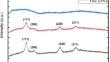
Thin films of yttria-stabilized zirconia (YSZ) were synthesized using spin coating technique on glass substrates with various concentration of yttria. The films were irradiated with Li3+ ions of energy 50 MeV and fluence values of 1 × 10¹¹, 5 × 10¹² and 5 × 10¹³ ions/cm2. The results obtained for the irradiated films are compared with the pristine sample. X-ray diffraction (XRD) was employed to confirm the structural phase and investigate the variation in crystallinity of irradiated thin films. X-ray diffraction analysis confirmed that the higher yttria concentrations corresponded to decrease in crystallinity in the zirconia, corroborated by calculated crystallite sizes. Interestingly, no phase formation was observed in sample YSZ (8%), highlighting the necessity of elevated annealing temperatures for phase formation, particularly at higher yttria concentrations. Significantly, the structural information was validated through Raman spectroscopy which revealed the decrease in the monoclinic phase with increasing yttria doping. The optical band gap of Zirconia increased with higher yttria doping concentration, resulting in a range of band gap from 4.11 eV to 4.15 eV. The exposure of YSZ thin films to Li3+ ions with an energy of 50 MeV unveiled impacts of ion fluence. Lower fluence levels resulted in observable damage to crystallinity when contrasted with pristine YSZ samples, as manifested by the broadening of diffraction peaks. At moderate fluence levels, a decrease in crystallinity damage was noted, nonetheless, at higher fluence levels, the damage intensified once more. The ion irradiation of YSZ (8%) resulted in the emergence and growth of crystalline phases.
期刊介绍:
The Journal of Electronic Materials (JEM) reports monthly on the science and technology of electronic materials, while examining new applications for semiconductors, magnetic alloys, dielectrics, nanoscale materials, and photonic materials. The journal welcomes articles on methods for preparing and evaluating the chemical, physical, electronic, and optical properties of these materials. Specific areas of interest are materials for state-of-the-art transistors, nanotechnology, electronic packaging, detectors, emitters, metallization, superconductivity, and energy applications.
Review papers on current topics enable individuals in the field of electronics to keep abreast of activities in areas peripheral to their own. JEM also selects papers from conferences such as the Electronic Materials Conference, the U.S. Workshop on the Physics and Chemistry of II-VI Materials, and the International Conference on Thermoelectrics. It benefits both specialists and non-specialists in the electronic materials field.
A journal of The Minerals, Metals & Materials Society.



 京公网安备 11010802042870号
京ICP备2023020795号-1
京公网安备 11010802042870号
京ICP备2023020795号-1

 分享
分享
 求助内容:
求助内容: 应助结果提醒方式:
 扫码关注我们
