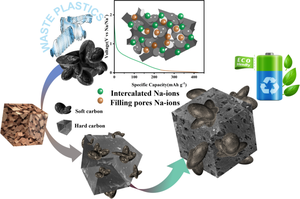
{"title":"PVC-Derived Amorphous Carbon Materials for Sodium Storage Anodes","authors":"Xi Wang, Xinping He, Yaning Liu, Shuai Ruan, Zheyu Jin, Zhongwei Wang, Chen Wang, Wangjun Wan, Wenkui Zhang","doi":"10.1007/s11664-024-11182-x","DOIUrl":null,"url":null,"abstract":"<div><p>A soft–hard carbon composite anode is prepared using polyvinyl chloride (PVC), the primary component of plastic waste, as a soft carbon material. In order to solve the inherent problems of small capacity and low first-charge/discharge efficiency of soft carbon, the structural modification of PVC-derived carbon materials is carried out using the composite method for soft and hard carbon materials and the molten salt pore-forming method. The pore formation not only improves the capacity of Na<sup>+</sup> storage in pores, but also prevents the growth of sodium dendrites and avoids structural collapse when sodium is stored at a low potential platform, which helps to enhance the stability of the structure at high current density. The optimized sample achieves initial coulombic efficiency of 63%, capacity of 276.39 mAh g<sup>−1</sup> at 0.05 C (C = 372 mA g<sup>−1</sup>), and good rate capability (e.g., 131 mAh g<sup>−1</sup> at 5 C). Generally speaking, this work not only realizes high-performance carbon material with appealing high-power sodium storage properties, but also opens up a new field of vision for the considerable performance potential of soft carbon-based energy storage electrodes, and provides a reasonable and simple strategy for the recycling of waste plastics.</p><h3>Graphical Abstract</h3>\n<div><figure><div><div><picture><source><img></source></picture></div></div></figure></div></div>","PeriodicalId":626,"journal":{"name":"Journal of Electronic Materials","volume":"53 9","pages":"4911 - 4921"},"PeriodicalIF":2.5000,"publicationDate":"2024-06-14","publicationTypes":"Journal Article","fieldsOfStudy":null,"isOpenAccess":false,"openAccessPdf":"","citationCount":"0","resultStr":null,"platform":"Semanticscholar","paperid":null,"PeriodicalName":"Journal of Electronic Materials","FirstCategoryId":"5","ListUrlMain":"https://link.springer.com/article/10.1007/s11664-024-11182-x","RegionNum":4,"RegionCategory":"工程技术","ArticlePicture":[],"TitleCN":null,"AbstractTextCN":null,"PMCID":null,"EPubDate":"","PubModel":"","JCR":"Q3","JCRName":"ENGINEERING, ELECTRICAL & ELECTRONIC","Score":null,"Total":0}
引用次数: 0
Abstract
A soft–hard carbon composite anode is prepared using polyvinyl chloride (PVC), the primary component of plastic waste, as a soft carbon material. In order to solve the inherent problems of small capacity and low first-charge/discharge efficiency of soft carbon, the structural modification of PVC-derived carbon materials is carried out using the composite method for soft and hard carbon materials and the molten salt pore-forming method. The pore formation not only improves the capacity of Na+ storage in pores, but also prevents the growth of sodium dendrites and avoids structural collapse when sodium is stored at a low potential platform, which helps to enhance the stability of the structure at high current density. The optimized sample achieves initial coulombic efficiency of 63%, capacity of 276.39 mAh g−1 at 0.05 C (C = 372 mA g−1), and good rate capability (e.g., 131 mAh g−1 at 5 C). Generally speaking, this work not only realizes high-performance carbon material with appealing high-power sodium storage properties, but also opens up a new field of vision for the considerable performance potential of soft carbon-based energy storage electrodes, and provides a reasonable and simple strategy for the recycling of waste plastics.
以塑料废弃物的主要成分聚氯乙烯(PVC)为软碳材料制备软硬碳复合阳极。为解决软碳容量小、初充放电效率低的固有问题,采用软硬碳材料复合方法和熔盐成孔法对pvc衍生碳材料进行结构改性。孔隙的形成不仅提高了孔隙中Na+的存储能力,还可以防止钠枝晶的生长,避免钠在低电位平台存储时结构崩溃,有助于增强结构在高电流密度下的稳定性。优化后的样品达到了63%的初始库仑效率,0.05℃(C = 372 mA g−1)时的容量为276.39 mAh g−1,以及良好的倍率能力(例如,5℃时的131 mAh g−1)。总的来说,本工作不仅实现了具有吸引人的大功率储钠性能的高性能碳材料,而且为具有可观性能潜力的软碳基储能电极开辟了新的视野,为废塑料的回收利用提供了合理而简单的策略。图形抽象
期刊介绍:
The Journal of Electronic Materials (JEM) reports monthly on the science and technology of electronic materials, while examining new applications for semiconductors, magnetic alloys, dielectrics, nanoscale materials, and photonic materials. The journal welcomes articles on methods for preparing and evaluating the chemical, physical, electronic, and optical properties of these materials. Specific areas of interest are materials for state-of-the-art transistors, nanotechnology, electronic packaging, detectors, emitters, metallization, superconductivity, and energy applications.
Review papers on current topics enable individuals in the field of electronics to keep abreast of activities in areas peripheral to their own. JEM also selects papers from conferences such as the Electronic Materials Conference, the U.S. Workshop on the Physics and Chemistry of II-VI Materials, and the International Conference on Thermoelectrics. It benefits both specialists and non-specialists in the electronic materials field.
A journal of The Minerals, Metals & Materials Society.



 京公网安备 11010802042870号
京ICP备2023020795号-1
京公网安备 11010802042870号
京ICP备2023020795号-1

 分享
分享
 求助内容:
求助内容: 应助结果提醒方式:
 扫码关注我们
