Geng Cheng, Yuanxin Liang, Haining Zhang, Chengxun Xu, Qi Li
{"title":"A comparative study of the survival, growth, and gonad development of the diploid and triploid Pacific oyster, “Haida No.2” strain","authors":"Geng Cheng, Yuanxin Liang, Haining Zhang, Chengxun Xu, Qi Li","doi":"10.1007/s10499-024-01554-9","DOIUrl":null,"url":null,"abstract":"<div><p>The Pacific oyster, <i>Crassostrea gigas</i>, is an important cultured species in the northern coastal areas of China. In recent years, the triploid oyster was popular worldwide because of its fast growth and high meat quality and has rapidly occupied a large portion of the oyster market. As a multi-generation selection strain, “Haida No.2” of <i>C. gigas</i> has good growth performance. At the same time, we have successfully obtained the triploid and tetraploid “Haida No.2.” This study was conducted to evaluate the performance of the triploid of “Haida No.2” under different rearing environments. The results showed that there was no significant difference in fertilization rate and hatching rate between diploids and triploids, and so did the survival rate at the larval stage, while the cumulative survival rate of triploids was significantly lower than that of diploids. At grow-out stage, the growth and survival rate of triploids were significantly higher than diploids on day 420 at two sites; meanwhile, the triploid rate was slight decline but still kept a high level (96–98%) on 420 days at two sites. However, high gametogenesis and subsequent mass spawning of triploid females were observed at two sites (32% at Rongcheng and 54% at Rushan), and the fecundity of triploid females relative to diploid females was high (23.73% at Rongcheng and 41.15% at Rushan) under different rearing environments. Our results showed that the triploid of “Haida No.2” had better performance at grow-out stage than diploids. However, the phenomenon of high gametogenesis of triploid and spawning is not favorable for the industrialization of triploid oysters, and the mechanism of high gametogenesis of triploids needs further study.</p></div>","PeriodicalId":8122,"journal":{"name":"Aquaculture International","volume":"32 6","pages":"8035 - 8052"},"PeriodicalIF":2.4000,"publicationDate":"2024-06-13","publicationTypes":"Journal Article","fieldsOfStudy":null,"isOpenAccess":false,"openAccessPdf":"","citationCount":"0","resultStr":null,"platform":"Semanticscholar","paperid":null,"PeriodicalName":"Aquaculture International","FirstCategoryId":"97","ListUrlMain":"https://link.springer.com/article/10.1007/s10499-024-01554-9","RegionNum":3,"RegionCategory":"农林科学","ArticlePicture":[],"TitleCN":null,"AbstractTextCN":null,"PMCID":null,"EPubDate":"","PubModel":"","JCR":"Q2","JCRName":"FISHERIES","Score":null,"Total":0}
引用次数: 0
Abstract
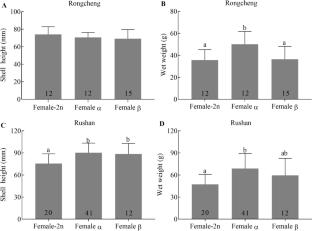
The Pacific oyster, Crassostrea gigas, is an important cultured species in the northern coastal areas of China. In recent years, the triploid oyster was popular worldwide because of its fast growth and high meat quality and has rapidly occupied a large portion of the oyster market. As a multi-generation selection strain, “Haida No.2” of C. gigas has good growth performance. At the same time, we have successfully obtained the triploid and tetraploid “Haida No.2.” This study was conducted to evaluate the performance of the triploid of “Haida No.2” under different rearing environments. The results showed that there was no significant difference in fertilization rate and hatching rate between diploids and triploids, and so did the survival rate at the larval stage, while the cumulative survival rate of triploids was significantly lower than that of diploids. At grow-out stage, the growth and survival rate of triploids were significantly higher than diploids on day 420 at two sites; meanwhile, the triploid rate was slight decline but still kept a high level (96–98%) on 420 days at two sites. However, high gametogenesis and subsequent mass spawning of triploid females were observed at two sites (32% at Rongcheng and 54% at Rushan), and the fecundity of triploid females relative to diploid females was high (23.73% at Rongcheng and 41.15% at Rushan) under different rearing environments. Our results showed that the triploid of “Haida No.2” had better performance at grow-out stage than diploids. However, the phenomenon of high gametogenesis of triploid and spawning is not favorable for the industrialization of triploid oysters, and the mechanism of high gametogenesis of triploids needs further study.
期刊介绍:
Aquaculture International is an international journal publishing original research papers, short communications, technical notes and review papers on all aspects of aquaculture.
The Journal covers topics such as the biology, physiology, pathology and genetics of cultured fish, crustaceans, molluscs and plants, especially new species; water quality of supply systems, fluctuations in water quality within farms and the environmental impacts of aquacultural operations; nutrition, feeding and stocking practices, especially as they affect the health and growth rates of cultured species; sustainable production techniques; bioengineering studies on the design and management of offshore and land-based systems; the improvement of quality and marketing of farmed products; sociological and societal impacts of aquaculture, and more.
This is the official Journal of the European Aquaculture Society.




 京公网安备 11010802042870号
京ICP备2023020795号-1
京公网安备 11010802042870号
京ICP备2023020795号-1

 分享
分享
 求助内容:
求助内容: 应助结果提醒方式:
 扫码关注我们
