{"title":"Photocatalytic Activity of MWCNT-Reinforced MoS2 Nanosheets","authors":"Shweta, Varsha Singh, Vinamrita Singh, Sridharbabu Yarramaneni, Mohammad Ashiq, Kaushal Kumar, Prikshit Gautam, Arun Kumar","doi":"10.1007/s11664-024-11187-6","DOIUrl":null,"url":null,"abstract":"<div><p>Two-dimensional transition metal dichalcogenides, especially MoS<sub>2</sub>, are widely exploited for their proficiency owing to the optimum energy band gap required for photocatalytic mechanism. However, the electron–hole pair recombination hampers the photocatalytic efficiency of pristine 2D MoS<sub>2</sub>. In this work, multi-walled carbon nanotubes (MWCNTs) are reinforced into 2D MoS<sub>2</sub> nanosheets via an ultrasound-driven liquid exfoliation technique to synthesize an efficient photocatalyst. The resulting composite nanosheets are characterized structurally by high-resolution transmission electron microscopy (HRTEM), Fourier-transform infrared spectroscopy (FTIR), and Raman spectroscopy. The ultraviolet–visible (UV–vis) absorption and photoluminescence spectroscopy reveal changes in the band gap and the recombination rate probability of the photogenerated charge carriers, respectively. The photocatalytic performance of the composite nanosheets is investigated by photodegradation of methylene blue dye. The efficiency of the photocatalysts is studied for varying concentrations of the reinforcement. The values of rate constant (at 665 nm) are 0.0047 min<sup>−1</sup> for pristine MoS<sub>2</sub> nanosheets, 0.0171 min<sup>−1</sup>, 0.0177 min<sup>−1</sup>, and 0.0183 min<sup>−1</sup> for MoS<sub>2</sub>@MWCNT composite nanosheets of 2%, 4%, and 8% of MWCNT, respectively. The degradation percentage is 60%, 84%, 85%, and 86% for pristine MoS<sub>2</sub>, MoS<sub>2</sub>@MWCNT composite nanosheets of 2%, 4%, and 8% of MWCNT, respectively. The results of the study show the enhanced degradation efficiency of the MoS<sub>2</sub>@MWCNT composite nanosheets in comparison to pristine MoS<sub>2</sub> nanosheets. Consequently, this work suggests an alternate hybrid of MoS<sub>2</sub> with MWCNTs synthesized via a rapid, easy, cost-effective, and efficient route for superior degradation efficiency, which can be beneficial for engineering hybrid structures of MoS<sub>2</sub> -based photocatalysts with promising potential for photocatalytic activities.</p></div>","PeriodicalId":626,"journal":{"name":"Journal of Electronic Materials","volume":"53 9","pages":"5193 - 5203"},"PeriodicalIF":2.5000,"publicationDate":"2024-06-13","publicationTypes":"Journal Article","fieldsOfStudy":null,"isOpenAccess":false,"openAccessPdf":"","citationCount":"0","resultStr":null,"platform":"Semanticscholar","paperid":null,"PeriodicalName":"Journal of Electronic Materials","FirstCategoryId":"5","ListUrlMain":"https://link.springer.com/article/10.1007/s11664-024-11187-6","RegionNum":4,"RegionCategory":"工程技术","ArticlePicture":[],"TitleCN":null,"AbstractTextCN":null,"PMCID":null,"EPubDate":"","PubModel":"","JCR":"Q3","JCRName":"ENGINEERING, ELECTRICAL & ELECTRONIC","Score":null,"Total":0}
引用次数: 0
Abstract
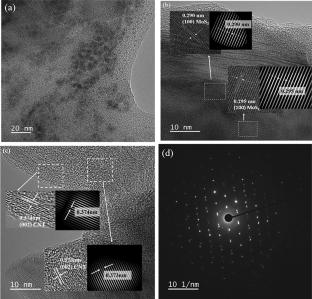
Two-dimensional transition metal dichalcogenides, especially MoS2, are widely exploited for their proficiency owing to the optimum energy band gap required for photocatalytic mechanism. However, the electron–hole pair recombination hampers the photocatalytic efficiency of pristine 2D MoS2. In this work, multi-walled carbon nanotubes (MWCNTs) are reinforced into 2D MoS2 nanosheets via an ultrasound-driven liquid exfoliation technique to synthesize an efficient photocatalyst. The resulting composite nanosheets are characterized structurally by high-resolution transmission electron microscopy (HRTEM), Fourier-transform infrared spectroscopy (FTIR), and Raman spectroscopy. The ultraviolet–visible (UV–vis) absorption and photoluminescence spectroscopy reveal changes in the band gap and the recombination rate probability of the photogenerated charge carriers, respectively. The photocatalytic performance of the composite nanosheets is investigated by photodegradation of methylene blue dye. The efficiency of the photocatalysts is studied for varying concentrations of the reinforcement. The values of rate constant (at 665 nm) are 0.0047 min−1 for pristine MoS2 nanosheets, 0.0171 min−1, 0.0177 min−1, and 0.0183 min−1 for MoS2@MWCNT composite nanosheets of 2%, 4%, and 8% of MWCNT, respectively. The degradation percentage is 60%, 84%, 85%, and 86% for pristine MoS2, MoS2@MWCNT composite nanosheets of 2%, 4%, and 8% of MWCNT, respectively. The results of the study show the enhanced degradation efficiency of the MoS2@MWCNT composite nanosheets in comparison to pristine MoS2 nanosheets. Consequently, this work suggests an alternate hybrid of MoS2 with MWCNTs synthesized via a rapid, easy, cost-effective, and efficient route for superior degradation efficiency, which can be beneficial for engineering hybrid structures of MoS2 -based photocatalysts with promising potential for photocatalytic activities.
二维过渡金属二硫族化合物,特别是MoS2,由于其具有光催化机制所需的最佳能带隙而被广泛利用。然而,电子-空穴对复合阻碍了原始二维二硫化钼的光催化效率。在这项工作中,通过超声驱动的液体剥离技术将多壁碳纳米管(MWCNTs)增强成二维二硫化钼纳米片,以合成一种高效的光催化剂。通过高分辨率透射电子显微镜(HRTEM)、傅里叶变换红外光谱(FTIR)和拉曼光谱对合成的纳米片进行了结构表征。紫外-可见吸收光谱和光致发光光谱分别揭示了光生载流子带隙和复合率概率的变化。通过对亚甲基蓝染料的光降解研究了复合纳米片的光催化性能。研究了光催化剂在不同强化浓度下的效率。原始二硫化钼纳米片的速率常数(665 nm)分别为0.0047 min - 1,含有2%、4%和8% MWCNT的MoS2@MWCNT复合纳米片的速率常数分别为0.0171 min - 1、0.0177 min - 1和0.0183 min - 1。原始二硫化钼和MoS2@MWCNT复合纳米片的降解率分别为60%,84%,85%和86%,分别为2%,4%和8%的MWCNT。研究结果表明,MoS2@MWCNT复合纳米片与原始二硫化钼纳米片相比,降解效率更高。因此,本研究建议通过一种快速、简单、经济、高效的途径合成MoS2与MWCNTs的替代杂化物,以获得更高的降解效率,这对具有光催化活性潜力的MoS2基光催化剂的工程杂化结构有益。
期刊介绍:
The Journal of Electronic Materials (JEM) reports monthly on the science and technology of electronic materials, while examining new applications for semiconductors, magnetic alloys, dielectrics, nanoscale materials, and photonic materials. The journal welcomes articles on methods for preparing and evaluating the chemical, physical, electronic, and optical properties of these materials. Specific areas of interest are materials for state-of-the-art transistors, nanotechnology, electronic packaging, detectors, emitters, metallization, superconductivity, and energy applications.
Review papers on current topics enable individuals in the field of electronics to keep abreast of activities in areas peripheral to their own. JEM also selects papers from conferences such as the Electronic Materials Conference, the U.S. Workshop on the Physics and Chemistry of II-VI Materials, and the International Conference on Thermoelectrics. It benefits both specialists and non-specialists in the electronic materials field.
A journal of The Minerals, Metals & Materials Society.



 京公网安备 11010802042870号
京ICP备2023020795号-1
京公网安备 11010802042870号
京ICP备2023020795号-1

 分享
分享
 求助内容:
求助内容: 应助结果提醒方式:
 扫码关注我们
