Ilham Essaket, Mohamed El Wazna, Oussama Azmami, Laila Sajid, Ilham Allam, Anas El Maliki, Abdeslam El Bouari, Omar Cherkaoui
{"title":"Extraction and chemical treatments of Moroccan sisal fiber for composite applications","authors":"Ilham Essaket, Mohamed El Wazna, Oussama Azmami, Laila Sajid, Ilham Allam, Anas El Maliki, Abdeslam El Bouari, Omar Cherkaoui","doi":"10.1007/s13399-024-05790-0","DOIUrl":null,"url":null,"abstract":"<div><p>This study focuses on the valorization of the <i>Agave sisalana</i> plant from the southern region of Morocco. The research objective is to enhance the sisal fiber extraction process and examine the impact of various chemical treatments on their mechanical properties, crucial for composite reinforcement. The sisal fibers were mechanically extracted from the leaves, initially washed and calendered under a pressure of 5KN, then mechanically scraped to separate the fibers from the pulp. Subsequently, they were combed and washed three times to remove impurities and then dried at 105 °C for 24 h. To effectively remove impurities, treatment with NaOH was carried out by adjusting three variables: NaOH concentration (0.5%, 1%, and 1.5%), temperature (60, 70, and 80 °C), and duration (30, 60, and 90 min). The optimal conditions for NaOH treatment were determined using a response surface methodology (RSM) approach. The highest results were obtained with samples treated with 0.5% NaOH at a temperature of 65 °C for 40 min. Sisal fibers with the highest tensile properties were treated with potassium permanganate (KMnO<sub>4</sub>) and the other sodium chlorite (NaClO<sub>2</sub>). The effects of these treatments on physical and chemical properties were subsequently analyzed through various methods, including scanning electron microscopy (SEM), Fourier-transform infrared spectroscopy (FTIR), thermogravimetric analysis, mechanical tests, and water resistance assessment. The results indicate that Moroccan sisal fiber has a low density of 1.21 ± 0.0347 g/cm<sup>3</sup> and a high cellulose content of 63.33%. The microstructural observations through scanning electron microscopy (SEM) depicted a noticeable morphological change in both untreated and treated sisal fibers, presenting a roughened surface. The FTIR analysis revealed a reduction in phenolic and secondary alcohol functional groups, as well as a decrease in hydrogen bonding resulting from the treatment of sisal fiber. According to the results, the most effective treatment for increasing the tensile strength of sisal fibers was achieved with 0.5% NaOH and 0.09% KMnO<sub>4</sub>, reaching a maximum value of 535 ± 8 MPa. This same treatment also led to a reduction in moisture absorption and water absorption of raw sisal fiber by 61 and 56%, respectively. Pull-out test results indicate that treating Moroccan sisal fibers with KMnO<sub>4</sub> and NaClO<sub>2</sub> can increase the pull-out load from 26 N to 98 ± 1.8 N and 87 ± 1.5 N, respectively. In conclusion, the findings of this study emphasize the significant promise of sisal fiber as a reinforcement material for composites. With its demonstrated capabilities, sisal emerges as a viable option for sustainable and environmentally friendly reinforcement across various applications.</p></div>","PeriodicalId":488,"journal":{"name":"Biomass Conversion and Biorefinery","volume":"15 5","pages":"7077 - 7094"},"PeriodicalIF":4.1000,"publicationDate":"2024-06-13","publicationTypes":"Journal Article","fieldsOfStudy":null,"isOpenAccess":false,"openAccessPdf":"","citationCount":"0","resultStr":null,"platform":"Semanticscholar","paperid":null,"PeriodicalName":"Biomass Conversion and Biorefinery","FirstCategoryId":"5","ListUrlMain":"https://link.springer.com/article/10.1007/s13399-024-05790-0","RegionNum":4,"RegionCategory":"工程技术","ArticlePicture":[],"TitleCN":null,"AbstractTextCN":null,"PMCID":null,"EPubDate":"","PubModel":"","JCR":"Q3","JCRName":"ENERGY & FUELS","Score":null,"Total":0}
引用次数: 0
Abstract
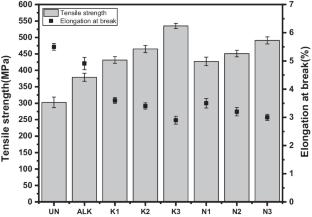
This study focuses on the valorization of the Agave sisalana plant from the southern region of Morocco. The research objective is to enhance the sisal fiber extraction process and examine the impact of various chemical treatments on their mechanical properties, crucial for composite reinforcement. The sisal fibers were mechanically extracted from the leaves, initially washed and calendered under a pressure of 5KN, then mechanically scraped to separate the fibers from the pulp. Subsequently, they were combed and washed three times to remove impurities and then dried at 105 °C for 24 h. To effectively remove impurities, treatment with NaOH was carried out by adjusting three variables: NaOH concentration (0.5%, 1%, and 1.5%), temperature (60, 70, and 80 °C), and duration (30, 60, and 90 min). The optimal conditions for NaOH treatment were determined using a response surface methodology (RSM) approach. The highest results were obtained with samples treated with 0.5% NaOH at a temperature of 65 °C for 40 min. Sisal fibers with the highest tensile properties were treated with potassium permanganate (KMnO4) and the other sodium chlorite (NaClO2). The effects of these treatments on physical and chemical properties were subsequently analyzed through various methods, including scanning electron microscopy (SEM), Fourier-transform infrared spectroscopy (FTIR), thermogravimetric analysis, mechanical tests, and water resistance assessment. The results indicate that Moroccan sisal fiber has a low density of 1.21 ± 0.0347 g/cm3 and a high cellulose content of 63.33%. The microstructural observations through scanning electron microscopy (SEM) depicted a noticeable morphological change in both untreated and treated sisal fibers, presenting a roughened surface. The FTIR analysis revealed a reduction in phenolic and secondary alcohol functional groups, as well as a decrease in hydrogen bonding resulting from the treatment of sisal fiber. According to the results, the most effective treatment for increasing the tensile strength of sisal fibers was achieved with 0.5% NaOH and 0.09% KMnO4, reaching a maximum value of 535 ± 8 MPa. This same treatment also led to a reduction in moisture absorption and water absorption of raw sisal fiber by 61 and 56%, respectively. Pull-out test results indicate that treating Moroccan sisal fibers with KMnO4 and NaClO2 can increase the pull-out load from 26 N to 98 ± 1.8 N and 87 ± 1.5 N, respectively. In conclusion, the findings of this study emphasize the significant promise of sisal fiber as a reinforcement material for composites. With its demonstrated capabilities, sisal emerges as a viable option for sustainable and environmentally friendly reinforcement across various applications.
期刊介绍:
Biomass Conversion and Biorefinery presents articles and information on research, development and applications in thermo-chemical conversion; physico-chemical conversion and bio-chemical conversion, including all necessary steps for the provision and preparation of the biomass as well as all possible downstream processing steps for the environmentally sound and economically viable provision of energy and chemical products.



 京公网安备 11010802042870号
京ICP备2023020795号-1
京公网安备 11010802042870号
京ICP备2023020795号-1

 分享
分享
 求助内容:
求助内容: 应助结果提醒方式:
 扫码关注我们
