{"title":"Nanosized Al/Cu-NiO catalyst: integrated adsorption-photocatalysis for fast removal of rhodamine B, reactive black 5 and chlorpyrifos waste","authors":"Ali Moulahi","doi":"10.1007/s10971-024-06447-0","DOIUrl":null,"url":null,"abstract":"<div><p>In this study, Al/Cu incorporated NiO nanostructures was acted as a new active photocatalyst for purification of wastewater. The efficient sol gel method was used to prepare pure and Al/Cu incorporated NiO samples with formula of NiO, Ni<sub>0.95</sub>Al<sub>0.03</sub>Cu<sub>0.02</sub>O and Ni<sub>0.93</sub>Al<sub>0.03</sub>Cu<sub>0.04</sub>O. The analysis of crystal structure verified the formation of cubic NiO structure for the different synthesized powders. The TEM images of pure and Al/Cu codoped NiO powders demonstrated the production of nanosized spherical particles have uniform size within 15–17 nm. The insertion of Al/Cu ions transferred the UV absorption edge of pure NiO nanopowder towards the direction of low energy (visible light side) which is very advantage for the photocatalytic applications. The catalyst with high concentration of Cu dopant (Ni<sub>0.97</sub>Al<sub>0.03</sub>Cu<sub>0.04</sub>O) has shown fast removal activities for rhodamine b (RhB), and reactive black 5 (RB5) and chlorpyrifos contaminants with high degradation efficiency (94–98%) during 30 min of sunlight radiation. Besides, the catalyst exhibited a complete mineralization of RhB, RB5 and chlorpyrifos pollutants to CO<sub>2</sub> and H<sub>2</sub>O with high stability for many cycles.</p><h3>Graphical Abstract</h3><div><figure><div><div><picture><source><img></source></picture></div></div></figure></div></div>","PeriodicalId":664,"journal":{"name":"Journal of Sol-Gel Science and Technology","volume":"111 1","pages":"243 - 254"},"PeriodicalIF":3.2000,"publicationDate":"2024-06-13","publicationTypes":"Journal Article","fieldsOfStudy":null,"isOpenAccess":false,"openAccessPdf":"","citationCount":"0","resultStr":null,"platform":"Semanticscholar","paperid":null,"PeriodicalName":"Journal of Sol-Gel Science and Technology","FirstCategoryId":"88","ListUrlMain":"https://link.springer.com/article/10.1007/s10971-024-06447-0","RegionNum":4,"RegionCategory":"材料科学","ArticlePicture":[],"TitleCN":null,"AbstractTextCN":null,"PMCID":null,"EPubDate":"","PubModel":"","JCR":"Q2","JCRName":"MATERIALS SCIENCE, CERAMICS","Score":null,"Total":0}
引用次数: 0
Abstract
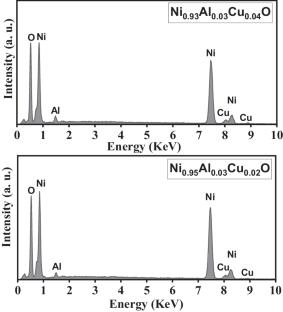
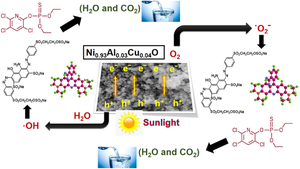
In this study, Al/Cu incorporated NiO nanostructures was acted as a new active photocatalyst for purification of wastewater. The efficient sol gel method was used to prepare pure and Al/Cu incorporated NiO samples with formula of NiO, Ni0.95Al0.03Cu0.02O and Ni0.93Al0.03Cu0.04O. The analysis of crystal structure verified the formation of cubic NiO structure for the different synthesized powders. The TEM images of pure and Al/Cu codoped NiO powders demonstrated the production of nanosized spherical particles have uniform size within 15–17 nm. The insertion of Al/Cu ions transferred the UV absorption edge of pure NiO nanopowder towards the direction of low energy (visible light side) which is very advantage for the photocatalytic applications. The catalyst with high concentration of Cu dopant (Ni0.97Al0.03Cu0.04O) has shown fast removal activities for rhodamine b (RhB), and reactive black 5 (RB5) and chlorpyrifos contaminants with high degradation efficiency (94–98%) during 30 min of sunlight radiation. Besides, the catalyst exhibited a complete mineralization of RhB, RB5 and chlorpyrifos pollutants to CO2 and H2O with high stability for many cycles.
期刊介绍:
The primary objective of the Journal of Sol-Gel Science and Technology (JSST), the official journal of the International Sol-Gel Society, is to provide an international forum for the dissemination of scientific, technological, and general knowledge about materials processed by chemical nanotechnologies known as the "sol-gel" process. The materials of interest include gels, gel-derived glasses, ceramics in form of nano- and micro-powders, bulk, fibres, thin films and coatings as well as more recent materials such as hybrid organic-inorganic materials and composites. Such materials exhibit a wide range of optical, electronic, magnetic, chemical, environmental, and biomedical properties and functionalities. Methods for producing sol-gel-derived materials and the industrial uses of these materials are also of great interest.



 京公网安备 11010802042870号
京ICP备2023020795号-1
京公网安备 11010802042870号
京ICP备2023020795号-1

 分享
分享
 求助内容:
求助内容: 应助结果提醒方式:
 扫码关注我们
