Effect of pH on the chemical composition, morphology, and densification of magnesium aluminate spinel nanopowder synthesized by the coprecipitation method
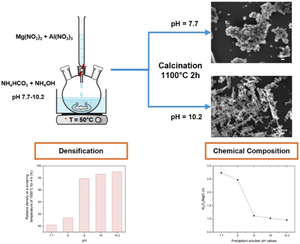
{"title":"Effect of pH on the chemical composition, morphology, and densification of magnesium aluminate spinel nanopowder synthesized by the coprecipitation method","authors":"Karn Serivalsatit, Adison Saelee, Sirithan Jiemsirilers, Supatra Jinawath","doi":"10.1007/s10971-024-06453-2","DOIUrl":null,"url":null,"abstract":"<div><p>Magnesium aluminate (MgAl<sub>2</sub>O<sub>4</sub>) spinel nanopowder was prepared by coprecipitation using ammonium bicarbonate solutions with pH values varying from 7.7 to 10.2. At lower pH (7.7 and 8.0), the precipitates obtained were equiaxed ammonium dawsonite and hydrotalcite with low crystallinity. As the pH was increased above 9.0, the precipitates transformed into rod-like ammonium dawsonite and hydrotalcite with higher crystallinity. The precipitates were calcined at 1100 °C for 2 h, resulting in spinel nanopowders with Al<sub>2</sub>O<sub>3</sub>/MgO molar ratios ranging from 2.74 to 0.96, depending on the pH of the precipitant solution. The morphology of the spinel nanopowders evolved from equiaxed primary particles to rod-like structures with increasing pH. The sinterability of the spinel nanopowders was enhanced at higher precipitant solution pH, with the nanopowder synthesized at pH 10.2 (Al<sub>2</sub>O<sub>3</sub>/MgO molar ratio of 0.96) achieving 99% theoretical density after sintering at 1550 °C for 4 h. This study demonstrates the significant influence of precipitant solution pH on the composition, morphology, and sintering characteristics of spinel nanopowders.</p><h3>Graphical Abstract</h3><div><figure><div><div><picture><source><img></source></picture></div></div></figure></div></div>","PeriodicalId":664,"journal":{"name":"Journal of Sol-Gel Science and Technology","volume":"111 1","pages":"230 - 242"},"PeriodicalIF":3.2000,"publicationDate":"2024-06-12","publicationTypes":"Journal Article","fieldsOfStudy":null,"isOpenAccess":false,"openAccessPdf":"","citationCount":"0","resultStr":null,"platform":"Semanticscholar","paperid":null,"PeriodicalName":"Journal of Sol-Gel Science and Technology","FirstCategoryId":"88","ListUrlMain":"https://link.springer.com/article/10.1007/s10971-024-06453-2","RegionNum":4,"RegionCategory":"材料科学","ArticlePicture":[],"TitleCN":null,"AbstractTextCN":null,"PMCID":null,"EPubDate":"","PubModel":"","JCR":"Q2","JCRName":"MATERIALS SCIENCE, CERAMICS","Score":null,"Total":0}
引用次数: 0
Abstract
Magnesium aluminate (MgAl2O4) spinel nanopowder was prepared by coprecipitation using ammonium bicarbonate solutions with pH values varying from 7.7 to 10.2. At lower pH (7.7 and 8.0), the precipitates obtained were equiaxed ammonium dawsonite and hydrotalcite with low crystallinity. As the pH was increased above 9.0, the precipitates transformed into rod-like ammonium dawsonite and hydrotalcite with higher crystallinity. The precipitates were calcined at 1100 °C for 2 h, resulting in spinel nanopowders with Al2O3/MgO molar ratios ranging from 2.74 to 0.96, depending on the pH of the precipitant solution. The morphology of the spinel nanopowders evolved from equiaxed primary particles to rod-like structures with increasing pH. The sinterability of the spinel nanopowders was enhanced at higher precipitant solution pH, with the nanopowder synthesized at pH 10.2 (Al2O3/MgO molar ratio of 0.96) achieving 99% theoretical density after sintering at 1550 °C for 4 h. This study demonstrates the significant influence of precipitant solution pH on the composition, morphology, and sintering characteristics of spinel nanopowders.
期刊介绍:
The primary objective of the Journal of Sol-Gel Science and Technology (JSST), the official journal of the International Sol-Gel Society, is to provide an international forum for the dissemination of scientific, technological, and general knowledge about materials processed by chemical nanotechnologies known as the "sol-gel" process. The materials of interest include gels, gel-derived glasses, ceramics in form of nano- and micro-powders, bulk, fibres, thin films and coatings as well as more recent materials such as hybrid organic-inorganic materials and composites. Such materials exhibit a wide range of optical, electronic, magnetic, chemical, environmental, and biomedical properties and functionalities. Methods for producing sol-gel-derived materials and the industrial uses of these materials are also of great interest.





 京公网安备 11010802042870号
京ICP备2023020795号-1
京公网安备 11010802042870号
京ICP备2023020795号-1

 分享
分享
 求助内容:
求助内容: 应助结果提醒方式:
 扫码关注我们
