Rebecca Knight, Laura E. Kilpatrick, Stephen J. Hill and Michael J. Stocks*,
{"title":"Design, Synthesis, and Evaluation of a New Chemotype Fluorescent Ligand for the P2Y2 Receptor","authors":"Rebecca Knight, Laura E. Kilpatrick, Stephen J. Hill and Michael J. Stocks*, ","doi":"10.1021/acsmedchemlett.4c00211","DOIUrl":null,"url":null,"abstract":"<p >The P2Y<sub>2</sub> receptor (P2Y<sub>2</sub>R) is a target for diseases including cancer, idiopathic pulmonary fibrosis, and atherosclerosis. However, there are insufficient P2Y<sub>2</sub>R antagonists available for validating P2Y<sub>2</sub>R function and future drug development. Evaluation of how (<i>R</i>)-5-(7-chloro-2-((2-ethoxyethyl)amino)-4<i>H</i>-benzo[5,6]cyclohepta[1,2-<i>d</i>]thiazol-4-yl)-1-methyl-4-thioxo-3,4-dihydropyrimidin-2(1<i>H</i>)-one, a previously published thiazole-based analogue of AR-C118925, binds in a P2Y<sub>2</sub>R homology model was used to design new P2Y<sub>2</sub>R antagonist scaffolds. One P2Y<sub>2</sub>R antagonist scaffold retained millimolar affinity for the P2Y<sub>2</sub>R and upon further functionalization with terminal carboxylic acid groups affinity was improved over 100-fold. This functionalized P2Y<sub>2</sub>R antagonist scaffold was employed to develop new chemotype P2Y<sub>2</sub>R fluorescent ligands, that were attainable in a convergent five-step synthesis. One of these fluorescent ligands demonstrated micromolar affinity (p<i>K</i><sub>d</sub> = 6.02 ± 0.12, <i>n</i> = 5) for the P2Y<sub>2</sub>R in isolated cell membranes and distinct pharmacology from an existing P2Y<sub>2</sub>R fluorescent antagonist, suggesting it may occupy a different binding site on the P2Y<sub>2</sub>R.</p>","PeriodicalId":20,"journal":{"name":"ACS Medicinal Chemistry Letters","volume":"15 7","pages":"1127–1135"},"PeriodicalIF":4.0000,"publicationDate":"2024-06-12","publicationTypes":"Journal Article","fieldsOfStudy":null,"isOpenAccess":false,"openAccessPdf":"https://pubs.acs.org/doi/epdf/10.1021/acsmedchemlett.4c00211","citationCount":"0","resultStr":null,"platform":"Semanticscholar","paperid":null,"PeriodicalName":"ACS Medicinal Chemistry Letters","FirstCategoryId":"3","ListUrlMain":"https://pubs.acs.org/doi/10.1021/acsmedchemlett.4c00211","RegionNum":3,"RegionCategory":"医学","ArticlePicture":[],"TitleCN":null,"AbstractTextCN":null,"PMCID":null,"EPubDate":"","PubModel":"","JCR":"Q2","JCRName":"CHEMISTRY, MEDICINAL","Score":null,"Total":0}
引用次数: 0
Abstract
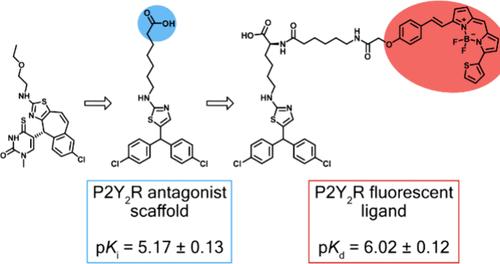
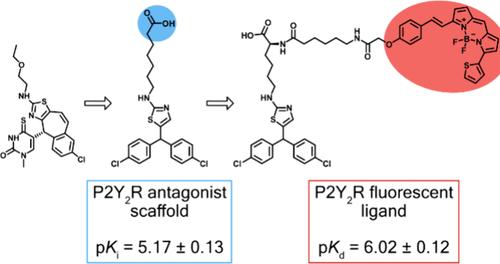
The P2Y2 receptor (P2Y2R) is a target for diseases including cancer, idiopathic pulmonary fibrosis, and atherosclerosis. However, there are insufficient P2Y2R antagonists available for validating P2Y2R function and future drug development. Evaluation of how (R)-5-(7-chloro-2-((2-ethoxyethyl)amino)-4H-benzo[5,6]cyclohepta[1,2-d]thiazol-4-yl)-1-methyl-4-thioxo-3,4-dihydropyrimidin-2(1H)-one, a previously published thiazole-based analogue of AR-C118925, binds in a P2Y2R homology model was used to design new P2Y2R antagonist scaffolds. One P2Y2R antagonist scaffold retained millimolar affinity for the P2Y2R and upon further functionalization with terminal carboxylic acid groups affinity was improved over 100-fold. This functionalized P2Y2R antagonist scaffold was employed to develop new chemotype P2Y2R fluorescent ligands, that were attainable in a convergent five-step synthesis. One of these fluorescent ligands demonstrated micromolar affinity (pKd = 6.02 ± 0.12, n = 5) for the P2Y2R in isolated cell membranes and distinct pharmacology from an existing P2Y2R fluorescent antagonist, suggesting it may occupy a different binding site on the P2Y2R.
期刊介绍:
ACS Medicinal Chemistry Letters is interested in receiving manuscripts that discuss various aspects of medicinal chemistry. The journal will publish studies that pertain to a broad range of subject matter, including compound design and optimization, biological evaluation, drug delivery, imaging agents, and pharmacology of both small and large bioactive molecules. Specific areas include but are not limited to:
Identification, synthesis, and optimization of lead biologically active molecules and drugs (small molecules and biologics)
Biological characterization of new molecular entities in the context of drug discovery
Computational, cheminformatics, and structural studies for the identification or SAR analysis of bioactive molecules, ligands and their targets, etc.
Novel and improved methodologies, including radiation biochemistry, with broad application to medicinal chemistry
Discovery technologies for biologically active molecules from both synthetic and natural (plant and other) sources
Pharmacokinetic/pharmacodynamic studies that address mechanisms underlying drug disposition and response
Pharmacogenetic and pharmacogenomic studies used to enhance drug design and the translation of medicinal chemistry into the clinic
Mechanistic drug metabolism and regulation of metabolic enzyme gene expression
Chemistry patents relevant to the medicinal chemistry field.




 京公网安备 11010802042870号
京ICP备2023020795号-1
京公网安备 11010802042870号
京ICP备2023020795号-1

 分享
分享
 求助内容:
求助内容: 应助结果提醒方式:
 扫码关注我们
