Study of the luminescence mechanism of gadolinium and yttrium oxide hosts for Eu3+ rare earth ion synthesized by sol-gel method assisted with oleic acid
Edgar F. Armendáriz-Alonso, O. Meza, E. G. Villabona-Leal, Elías Pérez
{"title":"Study of the luminescence mechanism of gadolinium and yttrium oxide hosts for Eu3+ rare earth ion synthesized by sol-gel method assisted with oleic acid","authors":"Edgar F. Armendáriz-Alonso, O. Meza, E. G. Villabona-Leal, Elías Pérez","doi":"10.1007/s10971-024-06450-5","DOIUrl":null,"url":null,"abstract":"<div><p>Yttrium and gadolinium oxides doped with Eu<sup>3+</sup> ions were synthesized using the sol-gel method, which was assisted with oleic acid as a surface-directing agent. Their morphology and structure were characterized by X-ray diffraction and transmission electron microscopy. Yttrium oxide synthesized phosphors exhibited well-defined facets and good dispersion, while gadolinium oxide particles presented high coalescence. Moreover, all synthesized materials showed a cubic structure. A formation mechanism was proposed using the results of Fourier transform infrared spectroscopy, where the as-precipitated phosphors transformations from oxo-hydroxide to crystalline yttrium and gadolinium oxides were observed. In addition, a surface modification of particles was produced by the synthesis method. On the other hand, luminescence analyses showed a strong emission peak at 612 nm in both oxides, and it was found that gadolinium oxide was the most effective host for luminescence emission. This matrix required a smaller dopant content to reach its maximum luminescence emission and exhibited the highest theoretical quantum efficiency. Also, color purity was evaluated using the CIE 1931 coordinate system, where <i>x</i> coordinate was found to increase as a function of dopant content indicating a higher perception of red color for gadolinium oxide matrix. Finally, energy diagrams and rate equations were proposed to explain their energy transfer mechanisms.</p><h3>Graphical Abstract</h3><div><figure><div><div><picture><source><img></source></picture></div></div></figure></div></div>","PeriodicalId":664,"journal":{"name":"Journal of Sol-Gel Science and Technology","volume":"111 1","pages":"216 - 229"},"PeriodicalIF":3.2000,"publicationDate":"2024-06-11","publicationTypes":"Journal Article","fieldsOfStudy":null,"isOpenAccess":false,"openAccessPdf":"","citationCount":"0","resultStr":null,"platform":"Semanticscholar","paperid":null,"PeriodicalName":"Journal of Sol-Gel Science and Technology","FirstCategoryId":"88","ListUrlMain":"https://link.springer.com/article/10.1007/s10971-024-06450-5","RegionNum":4,"RegionCategory":"材料科学","ArticlePicture":[],"TitleCN":null,"AbstractTextCN":null,"PMCID":null,"EPubDate":"","PubModel":"","JCR":"Q2","JCRName":"MATERIALS SCIENCE, CERAMICS","Score":null,"Total":0}
引用次数: 0
Abstract
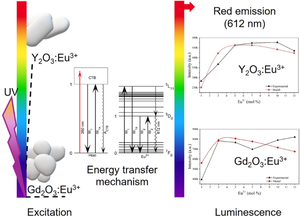
Yttrium and gadolinium oxides doped with Eu3+ ions were synthesized using the sol-gel method, which was assisted with oleic acid as a surface-directing agent. Their morphology and structure were characterized by X-ray diffraction and transmission electron microscopy. Yttrium oxide synthesized phosphors exhibited well-defined facets and good dispersion, while gadolinium oxide particles presented high coalescence. Moreover, all synthesized materials showed a cubic structure. A formation mechanism was proposed using the results of Fourier transform infrared spectroscopy, where the as-precipitated phosphors transformations from oxo-hydroxide to crystalline yttrium and gadolinium oxides were observed. In addition, a surface modification of particles was produced by the synthesis method. On the other hand, luminescence analyses showed a strong emission peak at 612 nm in both oxides, and it was found that gadolinium oxide was the most effective host for luminescence emission. This matrix required a smaller dopant content to reach its maximum luminescence emission and exhibited the highest theoretical quantum efficiency. Also, color purity was evaluated using the CIE 1931 coordinate system, where x coordinate was found to increase as a function of dopant content indicating a higher perception of red color for gadolinium oxide matrix. Finally, energy diagrams and rate equations were proposed to explain their energy transfer mechanisms.
期刊介绍:
The primary objective of the Journal of Sol-Gel Science and Technology (JSST), the official journal of the International Sol-Gel Society, is to provide an international forum for the dissemination of scientific, technological, and general knowledge about materials processed by chemical nanotechnologies known as the "sol-gel" process. The materials of interest include gels, gel-derived glasses, ceramics in form of nano- and micro-powders, bulk, fibres, thin films and coatings as well as more recent materials such as hybrid organic-inorganic materials and composites. Such materials exhibit a wide range of optical, electronic, magnetic, chemical, environmental, and biomedical properties and functionalities. Methods for producing sol-gel-derived materials and the industrial uses of these materials are also of great interest.




 京公网安备 11010802042870号
京ICP备2023020795号-1
京公网安备 11010802042870号
京ICP备2023020795号-1

 分享
分享
 求助内容:
求助内容: 应助结果提醒方式:
 扫码关注我们
