Synergistic Photocatalysis of Bayerite/Zeolite Loaded TiO2 Nanocomposites for Highly Efficient Degradation of Organic Pollutants in Aqueous Environments
Abdellah Ait baha, Aziz Ait-Karra, Rachid Idouhli, Kamal Tabit, Othmane Zakir, Burak Dikici, Mohy Eddine Khadiri, Abdesselam Abouelfida
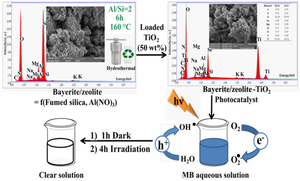
{"title":"Synergistic Photocatalysis of Bayerite/Zeolite Loaded TiO2 Nanocomposites for Highly Efficient Degradation of Organic Pollutants in Aqueous Environments","authors":"Abdellah Ait baha, Aziz Ait-Karra, Rachid Idouhli, Kamal Tabit, Othmane Zakir, Burak Dikici, Mohy Eddine Khadiri, Abdesselam Abouelfida","doi":"10.1007/s12633-024-03056-y","DOIUrl":null,"url":null,"abstract":"<div><p>Methylene blue dye (MB), prevalent in textiles like cotton, wood, and silk, raises environmental and health concerns. This study presents a successful synthesis of a Bayerite/zeolite nanocomposite powder using fumed silica by-product and aluminum nitrate. Hydrothermal exploration of factors, including duration, temperature, and Al/Si ratios, revealed that high temperature (160°C) and short duration (6h) favored optimal crystallization of bayerite/zeolite phases. Subsequently, an integrated photocatalytic adsorbent (IPA) was developed by mechanically mixing the synthesized bayerite/zeolite with TiO<sub>2</sub>, followed by calcination (500 °C, 2 h), demonstrating superior efficiency in MB photodegradation under UV–Vis light. The IPA achieved 100% degradation efficiency for 60 mg/L of MB and maintained good photostability over three cycles. The bayerite/zeolite-supported TiO<sub>2</sub> nanocomposite exhibited the generation of positive holes (h +) and active hydroxyl radicals (OH•), showcasing its potential as a promising material for wastewater treatment applications.</p><h3>Graphical Abstract</h3>\n<div><figure><div><div><picture><source><img></source></picture></div></div></figure></div></div>","PeriodicalId":776,"journal":{"name":"Silicon","volume":"16 11","pages":"4843 - 4856"},"PeriodicalIF":3.3000,"publicationDate":"2024-06-10","publicationTypes":"Journal Article","fieldsOfStudy":null,"isOpenAccess":false,"openAccessPdf":"","citationCount":"0","resultStr":null,"platform":"Semanticscholar","paperid":null,"PeriodicalName":"Silicon","FirstCategoryId":"88","ListUrlMain":"https://link.springer.com/article/10.1007/s12633-024-03056-y","RegionNum":3,"RegionCategory":"材料科学","ArticlePicture":[],"TitleCN":null,"AbstractTextCN":null,"PMCID":null,"EPubDate":"","PubModel":"","JCR":"Q3","JCRName":"CHEMISTRY, PHYSICAL","Score":null,"Total":0}
引用次数: 0
Abstract
Methylene blue dye (MB), prevalent in textiles like cotton, wood, and silk, raises environmental and health concerns. This study presents a successful synthesis of a Bayerite/zeolite nanocomposite powder using fumed silica by-product and aluminum nitrate. Hydrothermal exploration of factors, including duration, temperature, and Al/Si ratios, revealed that high temperature (160°C) and short duration (6h) favored optimal crystallization of bayerite/zeolite phases. Subsequently, an integrated photocatalytic adsorbent (IPA) was developed by mechanically mixing the synthesized bayerite/zeolite with TiO2, followed by calcination (500 °C, 2 h), demonstrating superior efficiency in MB photodegradation under UV–Vis light. The IPA achieved 100% degradation efficiency for 60 mg/L of MB and maintained good photostability over three cycles. The bayerite/zeolite-supported TiO2 nanocomposite exhibited the generation of positive holes (h +) and active hydroxyl radicals (OH•), showcasing its potential as a promising material for wastewater treatment applications.
期刊介绍:
The journal Silicon is intended to serve all those involved in studying the role of silicon as an enabling element in materials science. There are no restrictions on disciplinary boundaries provided the focus is on silicon-based materials or adds significantly to the understanding of such materials. Accordingly, such contributions are welcome in the areas of inorganic and organic chemistry, physics, biology, engineering, nanoscience, environmental science, electronics and optoelectronics, and modeling and theory. Relevant silicon-based materials include, but are not limited to, semiconductors, polymers, composites, ceramics, glasses, coatings, resins, composites, small molecules, and thin films.



 京公网安备 11010802042870号
京ICP备2023020795号-1
京公网安备 11010802042870号
京ICP备2023020795号-1

 分享
分享
 求助内容:
求助内容: 应助结果提醒方式:
 扫码关注我们
