The Impact of Different Metal Dopants on the Structural, Dielectric, and Electrical Characteristics of Bentonite: Electrical Measurements Supported by Tight-Binding Calculations
{"title":"The Impact of Different Metal Dopants on the Structural, Dielectric, and Electrical Characteristics of Bentonite: Electrical Measurements Supported by Tight-Binding Calculations","authors":"Ali H. Bashal","doi":"10.1007/s11664-024-11196-5","DOIUrl":null,"url":null,"abstract":"<div><p>Composite dielectric materials with different dielectric characteristics are crucial for energy storage devices. In this study, a composite material of 5 wt.% metal (M)/bentonite (Bento) (M = Cd, Cu, Fe, or Zn) was synthesized using a wet impregnation technique to examine the effect of metal incorporation in bentonite. X-ray diffraction, scanning electron microscopy, energy-dispersive x-ray analysis, and impedance analysis were carried out to investigate the structural, morphological, electrical, and dielectric properties of the samples. A low-frequency dielectric response provided evidence of dielectric relaxation, which was associated with local charge polarizations occurring at the grain (or particle) site. A reduction in the dielectric constant was observed in metal-doped composites, attributed to the variation in grain size and the resulting change in the dipole number per unit volume generated by doping. Interestingly, the AC conductivity dispersion decreased for dopants with a larger ionic radius, in line with qualitative expectations. Tight-binding calculations demonstrated that the changes in binding energy, hardness, and the positioning of the highest occupied molecular orbital and lowest unoccupied molecular orbital of Bento were responsible for the differences in dielectric properties resulting from the incorporation of different metals into Bento. Thus, our results demonstrate the successful metal doping-induced tunability of the dielectric and structural properties of Bento, with significant implications for its use as supercapacitor (optimal dopant is Fe, as it induces larger permittivity), and hence its polarizability. The lowest permittivity was achieved for Cd doping, suggesting its potential use for insulator applications.</p></div>","PeriodicalId":626,"journal":{"name":"Journal of Electronic Materials","volume":"53 8","pages":"4696 - 4705"},"PeriodicalIF":2.5000,"publicationDate":"2024-06-10","publicationTypes":"Journal Article","fieldsOfStudy":null,"isOpenAccess":false,"openAccessPdf":"","citationCount":"0","resultStr":null,"platform":"Semanticscholar","paperid":null,"PeriodicalName":"Journal of Electronic Materials","FirstCategoryId":"5","ListUrlMain":"https://link.springer.com/article/10.1007/s11664-024-11196-5","RegionNum":4,"RegionCategory":"工程技术","ArticlePicture":[],"TitleCN":null,"AbstractTextCN":null,"PMCID":null,"EPubDate":"","PubModel":"","JCR":"Q3","JCRName":"ENGINEERING, ELECTRICAL & ELECTRONIC","Score":null,"Total":0}
引用次数: 0
Abstract
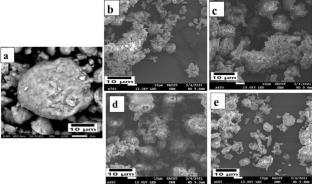
Composite dielectric materials with different dielectric characteristics are crucial for energy storage devices. In this study, a composite material of 5 wt.% metal (M)/bentonite (Bento) (M = Cd, Cu, Fe, or Zn) was synthesized using a wet impregnation technique to examine the effect of metal incorporation in bentonite. X-ray diffraction, scanning electron microscopy, energy-dispersive x-ray analysis, and impedance analysis were carried out to investigate the structural, morphological, electrical, and dielectric properties of the samples. A low-frequency dielectric response provided evidence of dielectric relaxation, which was associated with local charge polarizations occurring at the grain (or particle) site. A reduction in the dielectric constant was observed in metal-doped composites, attributed to the variation in grain size and the resulting change in the dipole number per unit volume generated by doping. Interestingly, the AC conductivity dispersion decreased for dopants with a larger ionic radius, in line with qualitative expectations. Tight-binding calculations demonstrated that the changes in binding energy, hardness, and the positioning of the highest occupied molecular orbital and lowest unoccupied molecular orbital of Bento were responsible for the differences in dielectric properties resulting from the incorporation of different metals into Bento. Thus, our results demonstrate the successful metal doping-induced tunability of the dielectric and structural properties of Bento, with significant implications for its use as supercapacitor (optimal dopant is Fe, as it induces larger permittivity), and hence its polarizability. The lowest permittivity was achieved for Cd doping, suggesting its potential use for insulator applications.
期刊介绍:
The Journal of Electronic Materials (JEM) reports monthly on the science and technology of electronic materials, while examining new applications for semiconductors, magnetic alloys, dielectrics, nanoscale materials, and photonic materials. The journal welcomes articles on methods for preparing and evaluating the chemical, physical, electronic, and optical properties of these materials. Specific areas of interest are materials for state-of-the-art transistors, nanotechnology, electronic packaging, detectors, emitters, metallization, superconductivity, and energy applications.
Review papers on current topics enable individuals in the field of electronics to keep abreast of activities in areas peripheral to their own. JEM also selects papers from conferences such as the Electronic Materials Conference, the U.S. Workshop on the Physics and Chemistry of II-VI Materials, and the International Conference on Thermoelectrics. It benefits both specialists and non-specialists in the electronic materials field.
A journal of The Minerals, Metals & Materials Society.




 京公网安备 11010802042870号
京ICP备2023020795号-1
京公网安备 11010802042870号
京ICP备2023020795号-1

 分享
分享
 求助内容:
求助内容: 应助结果提醒方式:
 扫码关注我们
