{"title":"Impact of land use and rainfall change on runoff and flood resilience of an urban environment: a case study of Chennai City, India","authors":"Asheesh Sharma, Mandeep Poonia, Ankush Rai, Rajesh B. Biniwale, Ashish Tiwari, Sagar Lachure, Franziska Tuegel, Ekkehard Holzbecher, Reinhard Hinkelmann","doi":"10.1007/s12517-024-11985-6","DOIUrl":null,"url":null,"abstract":"<div><p>Urban flooding can differ significantly from rural flooding due to the influence of rapidly changing land use and rainfall patterns on runoff in urban areas. Consequently, understanding and managing urban flooding necessitate a comprehensive grasp of these influential factors. This study focuses on assessing the impact of land use and rainfall changes on runoff and flood resilience in urban areas of Chennai, India, utilizing the InVEST-UFRM model. The research includes an evaluation of flood risk and potential damage to building infrastructure, examining 14 sub-basins within the study area with diverse land use and rainfall depths for 2015, 2020, and 2025. Observed rainfall and land use data were employed for 2015 and 2020, while future rainfall data relied on Global Circulation Models (GCMs) of the Coupled Model Inter-comparison Project-6 (CMIP6) outputs and QGIS MOLUSCE plugin predicted land use for 2025. The study identified that the change in land use had a more significant impact on runoff than the temporal change in rainfall amount. Notably, the reduction of water bodies in the study area emerged as a major contributing factor to excessive runoff. The estimated maximum potential damage to built infrastructure in the study area reached approximately 10 billion USD. This research provides valuable insights into urban flood resilience and the impact of land use and rainfall changes and proposes effective measures for flood adaptation and mitigation. The study findings can serve as essential tools for urban planners in an effective management of urban floods in similar regions as investigated here.</p></div>","PeriodicalId":476,"journal":{"name":"Arabian Journal of Geosciences","volume":"17 7","pages":""},"PeriodicalIF":1.8270,"publicationDate":"2024-06-10","publicationTypes":"Journal Article","fieldsOfStudy":null,"isOpenAccess":false,"openAccessPdf":"","citationCount":"0","resultStr":null,"platform":"Semanticscholar","paperid":null,"PeriodicalName":"Arabian Journal of Geosciences","FirstCategoryId":"1085","ListUrlMain":"https://link.springer.com/article/10.1007/s12517-024-11985-6","RegionNum":0,"RegionCategory":null,"ArticlePicture":[],"TitleCN":null,"AbstractTextCN":null,"PMCID":null,"EPubDate":"","PubModel":"","JCR":"Q2","JCRName":"Earth and Planetary Sciences","Score":null,"Total":0}
引用次数: 0
Abstract
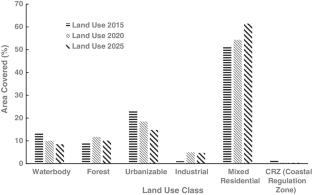
Urban flooding can differ significantly from rural flooding due to the influence of rapidly changing land use and rainfall patterns on runoff in urban areas. Consequently, understanding and managing urban flooding necessitate a comprehensive grasp of these influential factors. This study focuses on assessing the impact of land use and rainfall changes on runoff and flood resilience in urban areas of Chennai, India, utilizing the InVEST-UFRM model. The research includes an evaluation of flood risk and potential damage to building infrastructure, examining 14 sub-basins within the study area with diverse land use and rainfall depths for 2015, 2020, and 2025. Observed rainfall and land use data were employed for 2015 and 2020, while future rainfall data relied on Global Circulation Models (GCMs) of the Coupled Model Inter-comparison Project-6 (CMIP6) outputs and QGIS MOLUSCE plugin predicted land use for 2025. The study identified that the change in land use had a more significant impact on runoff than the temporal change in rainfall amount. Notably, the reduction of water bodies in the study area emerged as a major contributing factor to excessive runoff. The estimated maximum potential damage to built infrastructure in the study area reached approximately 10 billion USD. This research provides valuable insights into urban flood resilience and the impact of land use and rainfall changes and proposes effective measures for flood adaptation and mitigation. The study findings can serve as essential tools for urban planners in an effective management of urban floods in similar regions as investigated here.
期刊介绍:
The Arabian Journal of Geosciences is the official journal of the Saudi Society for Geosciences and publishes peer-reviewed original and review articles on the entire range of Earth Science themes, focused on, but not limited to, those that have regional significance to the Middle East and the Euro-Mediterranean Zone.
Key topics therefore include; geology, hydrogeology, earth system science, petroleum sciences, geophysics, seismology and crustal structures, tectonics, sedimentology, palaeontology, metamorphic and igneous petrology, natural hazards, environmental sciences and sustainable development, geoarchaeology, geomorphology, paleo-environment studies, oceanography, atmospheric sciences, GIS and remote sensing, geodesy, mineralogy, volcanology, geochemistry and metallogenesis.