V. Ranjan, J. G. Manjunatha, D. Sumanth, Samar A. Aldossari, Saikh Mohammad, N. Ataollahi
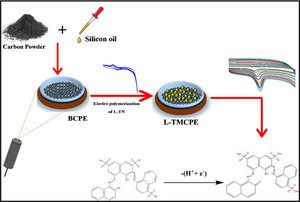
{"title":"Electrochemical Analysis of Fast Sulphon Black F Using Poly(L-Tyrosine)-Modified Carbon Paste Electrode","authors":"V. Ranjan, J. G. Manjunatha, D. Sumanth, Samar A. Aldossari, Saikh Mohammad, N. Ataollahi","doi":"10.1007/s11664-024-11202-w","DOIUrl":null,"url":null,"abstract":"<div><p>An electrochemical approach has been employed for the selective and sensitive determination of fast sulphon black F (FSB-F) using an electrochemically polymerized L-tyrosine (L-TN)-modified carbon paste electrode (L-TNMCPE). This modified electrode exhibits an effective irreversible oxidation peak at a potential of 0.6180 V, with a current sensitivity of 17.88 <i>µ</i>A in 0.2 M phosphate-buffered saline (PBS) at pH 6.5, indicating its ability to clearly detect the oxidation of FSB-F. The characterization of the L-TNMCPE and the bare carbon paste electrode (BCPE) was observed using scanning electron microscopy (SEM), electrochemical impedance spectroscopy (EIS), differential pulse voltammetry (DPV), and cyclic voltammetry (CV). The developed sensor presents a favorable approach for simultaneously detecting FSB-F and indigo carmine (IC), while also investigating potential interference from various metals and organic compounds. Scan rate results indicate that the reaction is absorption-controlled. Additionally, various experimental aspects are examined, including the pH and concentration variation. The modified electrode exhibits remarkable electrochemical behavior with a limit of detection (LOD) of 0.75 × 10<sup>−6</sup> M and a limit of quantification (LOQ) of 2.5 × 10<sup>6</sup> M. The L-tyrosine (L-TN)-modified carbon paste electrode shows good reproducibility, repeatability, and stability.</p><h3>Graphical Abstract</h3>\n<div><figure><div><div><picture><source><img></source></picture></div></div></figure></div></div>","PeriodicalId":626,"journal":{"name":"Journal of Electronic Materials","volume":"53 8","pages":"4762 - 4772"},"PeriodicalIF":2.5000,"publicationDate":"2024-06-10","publicationTypes":"Journal Article","fieldsOfStudy":null,"isOpenAccess":false,"openAccessPdf":"","citationCount":"0","resultStr":null,"platform":"Semanticscholar","paperid":null,"PeriodicalName":"Journal of Electronic Materials","FirstCategoryId":"5","ListUrlMain":"https://link.springer.com/article/10.1007/s11664-024-11202-w","RegionNum":4,"RegionCategory":"工程技术","ArticlePicture":[],"TitleCN":null,"AbstractTextCN":null,"PMCID":null,"EPubDate":"","PubModel":"","JCR":"Q3","JCRName":"ENGINEERING, ELECTRICAL & ELECTRONIC","Score":null,"Total":0}
引用次数: 0
Abstract
An electrochemical approach has been employed for the selective and sensitive determination of fast sulphon black F (FSB-F) using an electrochemically polymerized L-tyrosine (L-TN)-modified carbon paste electrode (L-TNMCPE). This modified electrode exhibits an effective irreversible oxidation peak at a potential of 0.6180 V, with a current sensitivity of 17.88 µA in 0.2 M phosphate-buffered saline (PBS) at pH 6.5, indicating its ability to clearly detect the oxidation of FSB-F. The characterization of the L-TNMCPE and the bare carbon paste electrode (BCPE) was observed using scanning electron microscopy (SEM), electrochemical impedance spectroscopy (EIS), differential pulse voltammetry (DPV), and cyclic voltammetry (CV). The developed sensor presents a favorable approach for simultaneously detecting FSB-F and indigo carmine (IC), while also investigating potential interference from various metals and organic compounds. Scan rate results indicate that the reaction is absorption-controlled. Additionally, various experimental aspects are examined, including the pH and concentration variation. The modified electrode exhibits remarkable electrochemical behavior with a limit of detection (LOD) of 0.75 × 10⁻⁶ M and a limit of quantification (LOQ) of 2.5 × 10⁶ M. The L-tyrosine (L-TN)-modified carbon paste electrode shows good reproducibility, repeatability, and stability.
期刊介绍:
The Journal of Electronic Materials (JEM) reports monthly on the science and technology of electronic materials, while examining new applications for semiconductors, magnetic alloys, dielectrics, nanoscale materials, and photonic materials. The journal welcomes articles on methods for preparing and evaluating the chemical, physical, electronic, and optical properties of these materials. Specific areas of interest are materials for state-of-the-art transistors, nanotechnology, electronic packaging, detectors, emitters, metallization, superconductivity, and energy applications.
Review papers on current topics enable individuals in the field of electronics to keep abreast of activities in areas peripheral to their own. JEM also selects papers from conferences such as the Electronic Materials Conference, the U.S. Workshop on the Physics and Chemistry of II-VI Materials, and the International Conference on Thermoelectrics. It benefits both specialists and non-specialists in the electronic materials field.
A journal of The Minerals, Metals & Materials Society.



 京公网安备 11010802042870号
京ICP备2023020795号-1
京公网安备 11010802042870号
京ICP备2023020795号-1

 分享
分享
 求助内容:
求助内容: 应助结果提醒方式:
 扫码关注我们
