Rida Fatima, Nadim Ullah, Uzma Bilal, Hasnain Asghar Khan, Tahani Mazyad Almutairi, Shahroz Saleem
{"title":"Facile and sustainable synthesis of metal nanoparticles (Ag, Fe, Cu, and Zn) using polyamide and polyhydrazide","authors":"Rida Fatima, Nadim Ullah, Uzma Bilal, Hasnain Asghar Khan, Tahani Mazyad Almutairi, Shahroz Saleem","doi":"10.1007/s10971-024-06439-0","DOIUrl":null,"url":null,"abstract":"<div><p>In recent years, metal nanoparticles (MNPs) have gained significant research interest owing to their versatile characteristics in diversified applications ranging from catalysis to biomedical sciences. Due to their notable and improved properties such as higher flexibility, facile processability, thermal stability, mechanical strength, and exceptional optoelectrical and magnetic behavior as compared to pristine metal nanoparticles, the polymer mediated nanoparticles have recently drawn interest from both industry and academia. In this novel investigation, we report a sustainable synthesis of Ag, Fe, Cu, and Zn metal nanoparticles using a chemical reduction method using polyamide (PA) and polyhydrazide (PH) matrices. This work is innovative in that it makes use of these polymer matrices for improved MNP synthesis, offering a unique combination of thermal and structural features. The polymers-supported metal nanoparticles were characterized for structural, thermal, optical, chemical, and morphological characteristics using XRD, TGA, UV-Vis, IR spectroscopy, and SEM analysis, respectively. XRD measurements demonstrated a significant rise in the crystallinity index for the produced metal nanoparticles, indicating a significant increase in crystallinity quantitatively. The effective synthesis of nanoparticles with precise attributes was confirmed by UV-Vis spectroscopy, which showed a significant absorption peak in the UV region. The thermogravimetric study suggested an improvement in thermal stability of around 25%. This work offers a flexible and eco-friendly method for synthesizing metal nanoparticles, demonstrating the usefulness of polyamide and polyhydrazide matrices as platforms for the synthesis of nanomaterials for numerous applications including catalysis, electronics, sensors, and biomedical applications.</p><h3>Graphical Abstract</h3><div><figure><div><div><picture><source><img></source></picture></div></div></figure></div></div>","PeriodicalId":664,"journal":{"name":"Journal of Sol-Gel Science and Technology","volume":"111 1","pages":"166 - 176"},"PeriodicalIF":3.2000,"publicationDate":"2024-06-10","publicationTypes":"Journal Article","fieldsOfStudy":null,"isOpenAccess":false,"openAccessPdf":"","citationCount":"0","resultStr":null,"platform":"Semanticscholar","paperid":null,"PeriodicalName":"Journal of Sol-Gel Science and Technology","FirstCategoryId":"88","ListUrlMain":"https://link.springer.com/article/10.1007/s10971-024-06439-0","RegionNum":4,"RegionCategory":"材料科学","ArticlePicture":[],"TitleCN":null,"AbstractTextCN":null,"PMCID":null,"EPubDate":"","PubModel":"","JCR":"Q2","JCRName":"MATERIALS SCIENCE, CERAMICS","Score":null,"Total":0}
引用次数: 0
Abstract
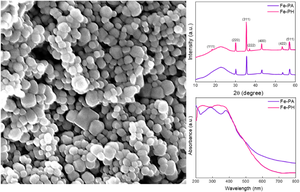
In recent years, metal nanoparticles (MNPs) have gained significant research interest owing to their versatile characteristics in diversified applications ranging from catalysis to biomedical sciences. Due to their notable and improved properties such as higher flexibility, facile processability, thermal stability, mechanical strength, and exceptional optoelectrical and magnetic behavior as compared to pristine metal nanoparticles, the polymer mediated nanoparticles have recently drawn interest from both industry and academia. In this novel investigation, we report a sustainable synthesis of Ag, Fe, Cu, and Zn metal nanoparticles using a chemical reduction method using polyamide (PA) and polyhydrazide (PH) matrices. This work is innovative in that it makes use of these polymer matrices for improved MNP synthesis, offering a unique combination of thermal and structural features. The polymers-supported metal nanoparticles were characterized for structural, thermal, optical, chemical, and morphological characteristics using XRD, TGA, UV-Vis, IR spectroscopy, and SEM analysis, respectively. XRD measurements demonstrated a significant rise in the crystallinity index for the produced metal nanoparticles, indicating a significant increase in crystallinity quantitatively. The effective synthesis of nanoparticles with precise attributes was confirmed by UV-Vis spectroscopy, which showed a significant absorption peak in the UV region. The thermogravimetric study suggested an improvement in thermal stability of around 25%. This work offers a flexible and eco-friendly method for synthesizing metal nanoparticles, demonstrating the usefulness of polyamide and polyhydrazide matrices as platforms for the synthesis of nanomaterials for numerous applications including catalysis, electronics, sensors, and biomedical applications.
期刊介绍:
The primary objective of the Journal of Sol-Gel Science and Technology (JSST), the official journal of the International Sol-Gel Society, is to provide an international forum for the dissemination of scientific, technological, and general knowledge about materials processed by chemical nanotechnologies known as the "sol-gel" process. The materials of interest include gels, gel-derived glasses, ceramics in form of nano- and micro-powders, bulk, fibres, thin films and coatings as well as more recent materials such as hybrid organic-inorganic materials and composites. Such materials exhibit a wide range of optical, electronic, magnetic, chemical, environmental, and biomedical properties and functionalities. Methods for producing sol-gel-derived materials and the industrial uses of these materials are also of great interest.



 京公网安备 11010802042870号
京ICP备2023020795号-1
京公网安备 11010802042870号
京ICP备2023020795号-1

 分享
分享
 求助内容:
求助内容: 应助结果提醒方式:
 扫码关注我们
