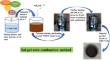
Frequency and Morphology Modulated Electrical, Dielectric, and Relaxation Metrics in Sol–Gel-Synthesized Sr \({Co}_{1.5z}{La}_{0.5z}{Fe}_{12-2z}{O}_{19}\) Hexaferrite: Corroboration with Impedance Spectroscopy Software
Manisha Thakur, Charanjeet Singh, R. B. Jotania, Sayed Tathir Abbas Naqvi, A. K. Srivastava
{"title":"Frequency and Morphology Modulated Electrical, Dielectric, and Relaxation Metrics in Sol–Gel-Synthesized Sr \\({Co}_{1.5z}{La}_{0.5z}{Fe}_{12-2z}{O}_{19}\\) Hexaferrite: Corroboration with Impedance Spectroscopy Software","authors":"Manisha Thakur, Charanjeet Singh, R. B. Jotania, Sayed Tathir Abbas Naqvi, A. K. Srivastava","doi":"10.1007/s11664-024-11195-6","DOIUrl":null,"url":null,"abstract":"<div><p>Hexaferrite samples, in which lanthanum (La) and cCobalt (Co) have been substituted (Sr <span>\\({Co}_{1.5z}{La}_{0.5z}{Fe}_{12-2z}{O}_{19}\\)</span>), were synthesized using the sol–gel combustion method. X-ray diffraction (XRD) measurements revealed that all the samples maintained a magnetoplumbite structure. Fourier-transform infrared (FTIR) spectroscopy showed an absorption peak within the IR range of 1000–380 cm<sup>−1</sup>, indicating vibrations likely attributed to Fe–O bonds. Substitution caused a non-linear decrement in grain size and the existence of grain clusters in <i>z</i> = 0.1 along with an increment in porosity. The calculated porosity from XRD was consistent with the porosity observed with scanning electron microscopy. Both the dielectric constant and loss tangent parameters were found to be decreased non-linearly with substitution in the low-frequency region. The AC conductivity value decreased from 9.09 × 10<sup>−4</sup> to 1.10 × 10<sup>−4</sup> Ω<sup>−1</sup> m<sup>−1</sup> at 2-MHz frequency with Co-La substitution. Non-Debye behavior was noted in all the samples by evaluating the electric moduli and impedance spectra. The conductivity relaxation was dominant over the dielectric relaxation in the samples.</p></div>","PeriodicalId":626,"journal":{"name":"Journal of Electronic Materials","volume":"53 8","pages":"4682 - 4695"},"PeriodicalIF":2.5000,"publicationDate":"2024-06-09","publicationTypes":"Journal Article","fieldsOfStudy":null,"isOpenAccess":false,"openAccessPdf":"","citationCount":"0","resultStr":null,"platform":"Semanticscholar","paperid":null,"PeriodicalName":"Journal of Electronic Materials","FirstCategoryId":"5","ListUrlMain":"https://link.springer.com/article/10.1007/s11664-024-11195-6","RegionNum":4,"RegionCategory":"工程技术","ArticlePicture":[],"TitleCN":null,"AbstractTextCN":null,"PMCID":null,"EPubDate":"","PubModel":"","JCR":"Q3","JCRName":"ENGINEERING, ELECTRICAL & ELECTRONIC","Score":null,"Total":0}
引用次数: 0
Abstract
Hexaferrite samples, in which lanthanum (La) and cCobalt (Co) have been substituted (Sr \({Co}_{1.5z}{La}_{0.5z}{Fe}_{12-2z}{O}_{19}\)), were synthesized using the sol–gel combustion method. X-ray diffraction (XRD) measurements revealed that all the samples maintained a magnetoplumbite structure. Fourier-transform infrared (FTIR) spectroscopy showed an absorption peak within the IR range of 1000–380 cm−1, indicating vibrations likely attributed to Fe–O bonds. Substitution caused a non-linear decrement in grain size and the existence of grain clusters in z = 0.1 along with an increment in porosity. The calculated porosity from XRD was consistent with the porosity observed with scanning electron microscopy. Both the dielectric constant and loss tangent parameters were found to be decreased non-linearly with substitution in the low-frequency region. The AC conductivity value decreased from 9.09 × 10⁻⁴ to 1.10 × 10⁻⁴ Ω−1 m−1 at 2-MHz frequency with Co-La substitution. Non-Debye behavior was noted in all the samples by evaluating the electric moduli and impedance spectra. The conductivity relaxation was dominant over the dielectric relaxation in the samples.
期刊介绍:
The Journal of Electronic Materials (JEM) reports monthly on the science and technology of electronic materials, while examining new applications for semiconductors, magnetic alloys, dielectrics, nanoscale materials, and photonic materials. The journal welcomes articles on methods for preparing and evaluating the chemical, physical, electronic, and optical properties of these materials. Specific areas of interest are materials for state-of-the-art transistors, nanotechnology, electronic packaging, detectors, emitters, metallization, superconductivity, and energy applications.
Review papers on current topics enable individuals in the field of electronics to keep abreast of activities in areas peripheral to their own. JEM also selects papers from conferences such as the Electronic Materials Conference, the U.S. Workshop on the Physics and Chemistry of II-VI Materials, and the International Conference on Thermoelectrics. It benefits both specialists and non-specialists in the electronic materials field.
A journal of The Minerals, Metals & Materials Society.



 京公网安备 11010802042870号
京ICP备2023020795号-1
京公网安备 11010802042870号
京ICP备2023020795号-1

 分享
分享
 求助内容:
求助内容: 应助结果提醒方式:
 扫码关注我们
