Malik Hisseine Malik, Gilbert François NgonNgon, Akumbom Vishiti, Anne-Sylvie André Mayer, Moussa Isseini, Felix Djerossem, Issaka Ousman Al-Gadam
{"title":"Petrography and mineral microchemical signature of lode gold mineralization in Goz-Beida, southern Ouaddaï massif, eastern Chad","authors":"Malik Hisseine Malik, Gilbert François NgonNgon, Akumbom Vishiti, Anne-Sylvie André Mayer, Moussa Isseini, Felix Djerossem, Issaka Ousman Al-Gadam","doi":"10.1007/s12517-024-12011-5","DOIUrl":null,"url":null,"abstract":"<div><p>Gold mineralisation in Goz-Beida within the southern Ouaddai massif in eastern Chad is hosted by quartz veins oriented NW-SE to NE-SW in Abilelaï and ENE-WSW to NE-SW in Kalaka. Quartz in the veins from both sites is brecciated with foliated wall-rock selvages and cut across Neoproterozoic metasedimentary rock. Alteration minerals include quartz, pyrite, chalcopyrite, galena, covellite, telluride, hematite, magnetite, sericite and chlorite, with the quartz and pyrite assemblage closely associated with gold mineralisation. The phases of hydrothermal alteration include silicification, sulphidation, ferruginisation, sericitisation and chloritisation. Parameters that consistently define alteration in the wall-rock include silicification, sulphidation, carbonitisation and K-feldspar alterations. Paragenetic and micro-structural characterisation of the vein minerals reveals that the gold-bearing veins might have been emplaced during brittle/ductile deformation events within a shear zones. The gold grains are alloyed with Ag. Gold grains that occur as inclusions in pyrite from Abilelaï show fineness values that vary between 438 and 860 and are characterised by inclusions of galena and telluride. The occurrence of galena as inclusions in gold and pyrite reflects a hydrothermal quartz vein sulphide system possibly related to a fluid system with inputs from the granitoids in the area. Free gold grains from Kalaka show fineness values that range from 903 to 922. The primary Ag content of the gold is typical of granitoid-related vein systems. Such high fineness values can be attributed to sulphidation as the dominant mechanism for ore deposition. Electron microprobe analysis on sulphide phases in the vein and wall-rock in Abilelaï depicts a Au-Ag-Pb assemblage. Analysis on sulphides and telluride phases in quartz veins from Kalaka reveals a characteristic Au-Ag-Pb-Te assemblage. Thus, brecciated stockwork sulphide and telluride-bearing veins and the wall-rock within an arc setting in prospective mining sites are the main target for gold in Goz- Beida.</p></div>","PeriodicalId":476,"journal":{"name":"Arabian Journal of Geosciences","volume":"17 7","pages":""},"PeriodicalIF":1.8270,"publicationDate":"2024-06-08","publicationTypes":"Journal Article","fieldsOfStudy":null,"isOpenAccess":false,"openAccessPdf":"","citationCount":"0","resultStr":null,"platform":"Semanticscholar","paperid":null,"PeriodicalName":"Arabian Journal of Geosciences","FirstCategoryId":"1085","ListUrlMain":"https://link.springer.com/article/10.1007/s12517-024-12011-5","RegionNum":0,"RegionCategory":null,"ArticlePicture":[],"TitleCN":null,"AbstractTextCN":null,"PMCID":null,"EPubDate":"","PubModel":"","JCR":"Q2","JCRName":"Earth and Planetary Sciences","Score":null,"Total":0}
引用次数: 0
Abstract
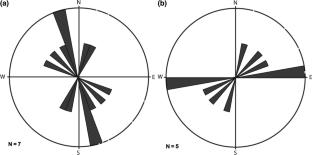
Gold mineralisation in Goz-Beida within the southern Ouaddai massif in eastern Chad is hosted by quartz veins oriented NW-SE to NE-SW in Abilelaï and ENE-WSW to NE-SW in Kalaka. Quartz in the veins from both sites is brecciated with foliated wall-rock selvages and cut across Neoproterozoic metasedimentary rock. Alteration minerals include quartz, pyrite, chalcopyrite, galena, covellite, telluride, hematite, magnetite, sericite and chlorite, with the quartz and pyrite assemblage closely associated with gold mineralisation. The phases of hydrothermal alteration include silicification, sulphidation, ferruginisation, sericitisation and chloritisation. Parameters that consistently define alteration in the wall-rock include silicification, sulphidation, carbonitisation and K-feldspar alterations. Paragenetic and micro-structural characterisation of the vein minerals reveals that the gold-bearing veins might have been emplaced during brittle/ductile deformation events within a shear zones. The gold grains are alloyed with Ag. Gold grains that occur as inclusions in pyrite from Abilelaï show fineness values that vary between 438 and 860 and are characterised by inclusions of galena and telluride. The occurrence of galena as inclusions in gold and pyrite reflects a hydrothermal quartz vein sulphide system possibly related to a fluid system with inputs from the granitoids in the area. Free gold grains from Kalaka show fineness values that range from 903 to 922. The primary Ag content of the gold is typical of granitoid-related vein systems. Such high fineness values can be attributed to sulphidation as the dominant mechanism for ore deposition. Electron microprobe analysis on sulphide phases in the vein and wall-rock in Abilelaï depicts a Au-Ag-Pb assemblage. Analysis on sulphides and telluride phases in quartz veins from Kalaka reveals a characteristic Au-Ag-Pb-Te assemblage. Thus, brecciated stockwork sulphide and telluride-bearing veins and the wall-rock within an arc setting in prospective mining sites are the main target for gold in Goz- Beida.
期刊介绍:
The Arabian Journal of Geosciences is the official journal of the Saudi Society for Geosciences and publishes peer-reviewed original and review articles on the entire range of Earth Science themes, focused on, but not limited to, those that have regional significance to the Middle East and the Euro-Mediterranean Zone.
Key topics therefore include; geology, hydrogeology, earth system science, petroleum sciences, geophysics, seismology and crustal structures, tectonics, sedimentology, palaeontology, metamorphic and igneous petrology, natural hazards, environmental sciences and sustainable development, geoarchaeology, geomorphology, paleo-environment studies, oceanography, atmospheric sciences, GIS and remote sensing, geodesy, mineralogy, volcanology, geochemistry and metallogenesis.



 京公网安备 11010802042870号
京ICP备2023020795号-1
京公网安备 11010802042870号
京ICP备2023020795号-1

 分享
分享
 求助内容:
求助内容: 应助结果提醒方式:
 扫码关注我们
