Yuya Doi, Jürgen Allgaier, Stephan Förster, Shin-ichi Takata, Michael Ohl
{"title":"Chain dimensions of poly(ethylene carbonate/ethylene oxide) copolymer with salt addition studied by SANS","authors":"Yuya Doi, Jürgen Allgaier, Stephan Förster, Shin-ichi Takata, Michael Ohl","doi":"10.1007/s00396-024-05279-2","DOIUrl":null,"url":null,"abstract":"<div><p>In this study, we investigated polymer chain dimensions in solid polymer electrolytes (SPEs) composed of hydrogenated and deuterated poly(ethylene carbonate/ethylene oxide) (<i>h</i>-/<i>d</i>-P(EC/EO)) copolymers and lithium bis(trifluoromethane)sulfonimide (LiTFSI) at various lithium-ion concentrations. The results were compared with <i>h</i>/<i>d</i>-poly(ethylene oxide) (PEO)/LiTFSI systems, extensively studied for their ionic conduction properties. The scattering intensity <i>I</i>(<i>q</i>) at low scattering vector <i>q</i> (≤ 0.4 Å<sup>−1</sup>) decreased with increasing lithium-ion concentration. From the low <i>q</i> data, the radius of gyration <i>R</i><sub>g</sub> of the polymer chains in SPE was estimated by the Guinier method. For both PEO and P(EC/EO) systems, with increasing the lithium-ion concentration (i.e., molar ratio of lithium ion to monomer, <i>r</i><sub>s</sub>), <i>R</i><sub>g</sub>(<i>r</i><sub>s</sub>) first decreased and then increased. Furthermore, the normalized <i>R</i><sub>g</sub>(<i>r</i><sub>s</sub>) by <i>R</i><sub>g</sub>(0) exhibited a minimum at <i>r</i><sub>s</sub> ≈ 0.15 for the PEO systems, whereas the P(EC/EO) system displayed a decrease in <i>R</i><sub>g</sub> to a higher <i>r</i><sub>s</sub> (≈ 0.20) followed by a weak re-increase. Previous MD simulations (Y. Doi, et al., <i>J. Phys. Chem. C</i>2022, <i>126</i>, 20,284) in the P(EC/EO)/LiTFSI systems have reported preferential coordination of carbonyl oxygens to lithium ions and an increase in the coordination number of oxygen atoms (resulting in the disrupted coordination structure) compared to the corresponding PEO systems, which can well explain the results in this study. The above experimental facts in this study are important findings in that they include data on new polymer systems other than PEO, while the number of reports for polymer conformation studies of SPE systems by SANS is still limited.</p><h3>Graphical abstract</h3>\n<div><figure><div><div><picture><source><img></source></picture></div></div></figure></div></div>","PeriodicalId":520,"journal":{"name":"Colloid and Polymer Science","volume":"303 dedicated","pages":"1779 - 1786"},"PeriodicalIF":2.3000,"publicationDate":"2024-06-08","publicationTypes":"Journal Article","fieldsOfStudy":null,"isOpenAccess":false,"openAccessPdf":"","citationCount":"0","resultStr":null,"platform":"Semanticscholar","paperid":null,"PeriodicalName":"Colloid and Polymer Science","FirstCategoryId":"92","ListUrlMain":"https://link.springer.com/article/10.1007/s00396-024-05279-2","RegionNum":4,"RegionCategory":"化学","ArticlePicture":[],"TitleCN":null,"AbstractTextCN":null,"PMCID":null,"EPubDate":"","PubModel":"","JCR":"Q3","JCRName":"CHEMISTRY, PHYSICAL","Score":null,"Total":0}
引用次数: 0
Abstract
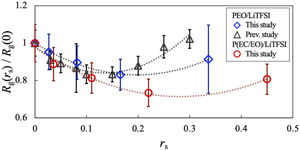
In this study, we investigated polymer chain dimensions in solid polymer electrolytes (SPEs) composed of hydrogenated and deuterated poly(ethylene carbonate/ethylene oxide) (h-/d-P(EC/EO)) copolymers and lithium bis(trifluoromethane)sulfonimide (LiTFSI) at various lithium-ion concentrations. The results were compared with h/d-poly(ethylene oxide) (PEO)/LiTFSI systems, extensively studied for their ionic conduction properties. The scattering intensity I(q) at low scattering vector q (≤ 0.4 Å−1) decreased with increasing lithium-ion concentration. From the low q data, the radius of gyration Rg of the polymer chains in SPE was estimated by the Guinier method. For both PEO and P(EC/EO) systems, with increasing the lithium-ion concentration (i.e., molar ratio of lithium ion to monomer, rs), Rg(rs) first decreased and then increased. Furthermore, the normalized Rg(rs) by Rg(0) exhibited a minimum at rs ≈ 0.15 for the PEO systems, whereas the P(EC/EO) system displayed a decrease in Rg to a higher rs (≈ 0.20) followed by a weak re-increase. Previous MD simulations (Y. Doi, et al., J. Phys. Chem. C2022, 126, 20,284) in the P(EC/EO)/LiTFSI systems have reported preferential coordination of carbonyl oxygens to lithium ions and an increase in the coordination number of oxygen atoms (resulting in the disrupted coordination structure) compared to the corresponding PEO systems, which can well explain the results in this study. The above experimental facts in this study are important findings in that they include data on new polymer systems other than PEO, while the number of reports for polymer conformation studies of SPE systems by SANS is still limited.
在这项研究中,我们研究了在不同锂离子浓度下,由氢化和氘化聚(碳酸乙烯/环氧乙烷)(h-/d-P(EC/EO))共聚物和二(三氟甲烷)磺酰亚胺锂(LiTFSI)组成的固体聚合物电解质(spe)的聚合物链尺寸。结果与h/d-聚环氧乙烷(PEO)/LiTFSI体系进行了比较,广泛研究了它们的离子导电性能。低散射矢量q(≤0.4 Å−1)处的散射强度I(q)随着锂离子浓度的增加而减小。根据低q数据,用Guinier方法估计了聚合物链在SPE中的旋转半径Rg。对于PEO和P(EC/EO)体系,随着锂离子浓度(即锂离子与单体的摩尔比rs)的增加,Rg(rs)先减小后增大。PEO体系经Rg(0)归一化后的Rg(rs)在rs≈0.15时达到最小值,而P(EC/EO)体系的Rg先下降到较高的rs(≈0.20),然后再弱增加。以前的MD模拟(Doi, et al., J. Phys.)化学。C2022, 126, 20,284)在P(EC/EO)/LiTFSI体系中,与相应的PEO体系相比,羰基氧与锂离子优先配位,氧原子配位数增加(导致配位结构被破坏),这可以很好地解释本研究的结果。本研究的上述实验事实是重要的发现,因为它们包括了除PEO以外的新聚合物体系的数据,而SANS对SPE体系的聚合物构象研究的报告数量仍然有限。图形抽象
期刊介绍:
Colloid and Polymer Science - a leading international journal of longstanding tradition - is devoted to colloid and polymer science and its interdisciplinary interactions. As such, it responds to a demand which has lost none of its actuality as revealed in the trends of contemporary materials science.




 京公网安备 11010802042870号
京ICP备2023020795号-1
京公网安备 11010802042870号
京ICP备2023020795号-1

 分享
分享
 求助内容:
求助内容: 应助结果提醒方式:
 扫码关注我们
