Gavin W. Collie*, Ulf Börjesson, Yunhua Chen, Zhiqiang Dong, Paolo Di Fruscia, Andrea Gohlke, Anna Hoyle, Thomas A. Hunt, Mehul H. Jesani, Haiou Luo, Jakub Luptak, Alexander G. Milbradt, Priyanka Narasimhan, Martin Packer, Saleha Patel, Jingchuan Qiao, R. Ian Storer, Christopher J. Stubbs, Jonathan Tart, Caroline Truman, Anderson T. Wang, Matthew G. Wheeler and Jon Winter-Holt,
{"title":"Fragment-Based Discovery of Novel MUS81 Inhibitors","authors":"Gavin W. Collie*, Ulf Börjesson, Yunhua Chen, Zhiqiang Dong, Paolo Di Fruscia, Andrea Gohlke, Anna Hoyle, Thomas A. Hunt, Mehul H. Jesani, Haiou Luo, Jakub Luptak, Alexander G. Milbradt, Priyanka Narasimhan, Martin Packer, Saleha Patel, Jingchuan Qiao, R. Ian Storer, Christopher J. Stubbs, Jonathan Tart, Caroline Truman, Anderson T. Wang, Matthew G. Wheeler and Jon Winter-Holt, ","doi":"10.1021/acsmedchemlett.3c00453","DOIUrl":null,"url":null,"abstract":"<p >MUS81 is a structure-selective endonuclease that cleaves various branched DNA structures arising from natural physiological processes such as homologous recombination and mitosis. Due to this, MUS81 is able to relieve replication stress, and its function has been reported to be critical to the survival of many cancers, particularly those with dysfunctional DNA-repair machinery. There is therefore interest in MUS81 as a cancer drug target, yet there are currently few small molecule inhibitors of this enzyme reported, and no liganded crystal structures are available to guide hit optimization. Here we report the fragment-based discovery of novel small molecule MUS81 inhibitors with sub-μM biochemical activity. These inhibitors were used to develop a novel crystal system, providing the first structural insight into the inhibition of MUS81 with small molecules.</p>","PeriodicalId":20,"journal":{"name":"ACS Medicinal Chemistry Letters","volume":"15 7","pages":"1151–1158"},"PeriodicalIF":4.0000,"publicationDate":"2024-06-07","publicationTypes":"Journal Article","fieldsOfStudy":null,"isOpenAccess":false,"openAccessPdf":"https://pubs.acs.org/doi/epdf/10.1021/acsmedchemlett.3c00453","citationCount":"0","resultStr":null,"platform":"Semanticscholar","paperid":null,"PeriodicalName":"ACS Medicinal Chemistry Letters","FirstCategoryId":"3","ListUrlMain":"https://pubs.acs.org/doi/10.1021/acsmedchemlett.3c00453","RegionNum":3,"RegionCategory":"医学","ArticlePicture":[],"TitleCN":null,"AbstractTextCN":null,"PMCID":null,"EPubDate":"","PubModel":"","JCR":"Q2","JCRName":"CHEMISTRY, MEDICINAL","Score":null,"Total":0}
引用次数: 0
Abstract
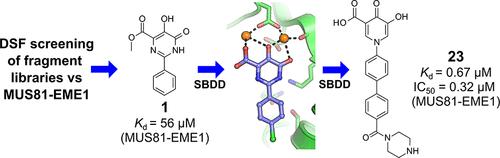
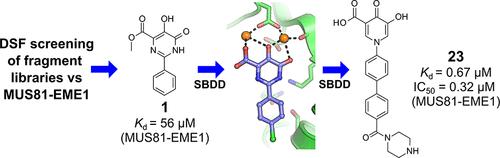
MUS81 is a structure-selective endonuclease that cleaves various branched DNA structures arising from natural physiological processes such as homologous recombination and mitosis. Due to this, MUS81 is able to relieve replication stress, and its function has been reported to be critical to the survival of many cancers, particularly those with dysfunctional DNA-repair machinery. There is therefore interest in MUS81 as a cancer drug target, yet there are currently few small molecule inhibitors of this enzyme reported, and no liganded crystal structures are available to guide hit optimization. Here we report the fragment-based discovery of novel small molecule MUS81 inhibitors with sub-μM biochemical activity. These inhibitors were used to develop a novel crystal system, providing the first structural insight into the inhibition of MUS81 with small molecules.
期刊介绍:
ACS Medicinal Chemistry Letters is interested in receiving manuscripts that discuss various aspects of medicinal chemistry. The journal will publish studies that pertain to a broad range of subject matter, including compound design and optimization, biological evaluation, drug delivery, imaging agents, and pharmacology of both small and large bioactive molecules. Specific areas include but are not limited to:
Identification, synthesis, and optimization of lead biologically active molecules and drugs (small molecules and biologics)
Biological characterization of new molecular entities in the context of drug discovery
Computational, cheminformatics, and structural studies for the identification or SAR analysis of bioactive molecules, ligands and their targets, etc.
Novel and improved methodologies, including radiation biochemistry, with broad application to medicinal chemistry
Discovery technologies for biologically active molecules from both synthetic and natural (plant and other) sources
Pharmacokinetic/pharmacodynamic studies that address mechanisms underlying drug disposition and response
Pharmacogenetic and pharmacogenomic studies used to enhance drug design and the translation of medicinal chemistry into the clinic
Mechanistic drug metabolism and regulation of metabolic enzyme gene expression
Chemistry patents relevant to the medicinal chemistry field.




 京公网安备 11010802042870号
京ICP备2023020795号-1
京公网安备 11010802042870号
京ICP备2023020795号-1

 分享
分享
 求助内容:
求助内容: 应助结果提醒方式:
 扫码关注我们
