Hajar Barkhor, Mohammad Ali Nasseri, Negin Nasseh, Ali Zeraatkar Moghaddam
{"title":"Investigating mathematical models for the surface adsorption process of tetracycline antibiotic using a CuFe12O19/CuS green magnetic nanocomposite","authors":"Hajar Barkhor, Mohammad Ali Nasseri, Negin Nasseh, Ali Zeraatkar Moghaddam","doi":"10.1007/s13399-024-05730-y","DOIUrl":null,"url":null,"abstract":"<div><p>Since water source treatment processes are generally done chemically (e.g., via surface adsorption), the ongoing synthesis of new and efficient adsorbent materials is necessary. Hence, in this study, a new and magnetic CuFe<sub>12</sub>O<sub>19</sub>/CuS nanoadsorbent was synthesized on a laboratory scale, using the extract of the <i>Artemisia</i> plant as a reducing agent, and its morphological features were specified using FESEM, FT-IR, XRD, TEM, BET, EDS, DLS, and VSM analyses. Then, its efficiency was assessed in the surface adsorption of a tetracycline pollutant, whereby the pH, contact time, initial pollutant concentration, nanocomposite dose, and temperature parameters were studied. The results indicate that the investigated adsorbent was correctly synthesized. It had many pores and an appropriate and specific surface on which to perform the adsorption process, and it also demonstrated superparamagnetic features. In addition, the results of removal processes showed that with increasing pH, the adsorption efficiency first increases from 21.02 to 80.02% and then decreases to 56.14%. Meanwhile, with increasing nanocomposite dose and temperature, the adsorption percentage rises to 94.08% and 96.84%, respectively, and with the increase in the initial concentration of the pollutant, the adsorption efficiency decreases to 45.19%. Thus, under optimal conditions (nanoadsorbent dose of 2 g/L, tetracycline concentration of 20 mg/L, and neutral pH over 200 min), a 100% efficiency in the tetracycline adsorption process can be obtained. The data obtained from nonlinear models of the Langmuir (<i>R</i><sup>2</sup> = 0.903), Freundlich (<i>R</i><sup>2</sup> = 0.72), and Temkin (<i>R</i><sup>2</sup> = 0.99) equilibrium isotherms showed that the adsorption process of tetracycline through green magnetic CuFe<sub>12</sub>O<sub>19</sub>/CuS nanocomposite synthesized with Temkin model is compatible. Furthermore, the data obtained from the reaction’s kinetic calculations show that the adsorption of tetracycline in this process can be described according to the pseudo-quadratic model (<i>R</i><sup>2</sup> = 0.999). Also, based on the results of thermodynamic studies including entropy changes (ΔS = 104.34 J/mol. k), enthalpy changes (ΔH = − 47.71 kJ/mol), and negative Gibbs free energy (ΔG), we conclude that the desired adsorption process is endothermic. Additionally, investigating the recovery and reuse of the synthesized nanocomposite in this research showed that after five consecutive cycles, the efficiency of the adsorbent is reduced by 14.67%. Finally, based on the results obtained in the present study, we may conclude that tetracycline can be removed from aqueous environments by the CuFe<sub>12</sub>O<sub>19</sub>/CuS magnetic nanocomposite synthesized using the green method.</p></div>","PeriodicalId":488,"journal":{"name":"Biomass Conversion and Biorefinery","volume":"15 22","pages":"28389 - 28403"},"PeriodicalIF":4.1000,"publicationDate":"2024-06-07","publicationTypes":"Journal Article","fieldsOfStudy":null,"isOpenAccess":false,"openAccessPdf":"","citationCount":"0","resultStr":null,"platform":"Semanticscholar","paperid":null,"PeriodicalName":"Biomass Conversion and Biorefinery","FirstCategoryId":"5","ListUrlMain":"https://link.springer.com/article/10.1007/s13399-024-05730-y","RegionNum":4,"RegionCategory":"工程技术","ArticlePicture":[],"TitleCN":null,"AbstractTextCN":null,"PMCID":null,"EPubDate":"","PubModel":"","JCR":"Q3","JCRName":"ENERGY & FUELS","Score":null,"Total":0}
引用次数: 0
Abstract
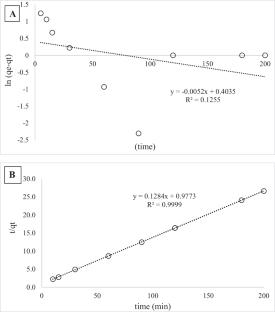
Since water source treatment processes are generally done chemically (e.g., via surface adsorption), the ongoing synthesis of new and efficient adsorbent materials is necessary. Hence, in this study, a new and magnetic CuFe12O19/CuS nanoadsorbent was synthesized on a laboratory scale, using the extract of the Artemisia plant as a reducing agent, and its morphological features were specified using FESEM, FT-IR, XRD, TEM, BET, EDS, DLS, and VSM analyses. Then, its efficiency was assessed in the surface adsorption of a tetracycline pollutant, whereby the pH, contact time, initial pollutant concentration, nanocomposite dose, and temperature parameters were studied. The results indicate that the investigated adsorbent was correctly synthesized. It had many pores and an appropriate and specific surface on which to perform the adsorption process, and it also demonstrated superparamagnetic features. In addition, the results of removal processes showed that with increasing pH, the adsorption efficiency first increases from 21.02 to 80.02% and then decreases to 56.14%. Meanwhile, with increasing nanocomposite dose and temperature, the adsorption percentage rises to 94.08% and 96.84%, respectively, and with the increase in the initial concentration of the pollutant, the adsorption efficiency decreases to 45.19%. Thus, under optimal conditions (nanoadsorbent dose of 2 g/L, tetracycline concentration of 20 mg/L, and neutral pH over 200 min), a 100% efficiency in the tetracycline adsorption process can be obtained. The data obtained from nonlinear models of the Langmuir (R2 = 0.903), Freundlich (R2 = 0.72), and Temkin (R2 = 0.99) equilibrium isotherms showed that the adsorption process of tetracycline through green magnetic CuFe12O19/CuS nanocomposite synthesized with Temkin model is compatible. Furthermore, the data obtained from the reaction’s kinetic calculations show that the adsorption of tetracycline in this process can be described according to the pseudo-quadratic model (R2 = 0.999). Also, based on the results of thermodynamic studies including entropy changes (ΔS = 104.34 J/mol. k), enthalpy changes (ΔH = − 47.71 kJ/mol), and negative Gibbs free energy (ΔG), we conclude that the desired adsorption process is endothermic. Additionally, investigating the recovery and reuse of the synthesized nanocomposite in this research showed that after five consecutive cycles, the efficiency of the adsorbent is reduced by 14.67%. Finally, based on the results obtained in the present study, we may conclude that tetracycline can be removed from aqueous environments by the CuFe12O19/CuS magnetic nanocomposite synthesized using the green method.
期刊介绍:
Biomass Conversion and Biorefinery presents articles and information on research, development and applications in thermo-chemical conversion; physico-chemical conversion and bio-chemical conversion, including all necessary steps for the provision and preparation of the biomass as well as all possible downstream processing steps for the environmentally sound and economically viable provision of energy and chemical products.




 京公网安备 11010802042870号
京ICP备2023020795号-1
京公网安备 11010802042870号
京ICP备2023020795号-1

 分享
分享
 求助内容:
求助内容: 应助结果提醒方式:
 扫码关注我们
