{"title":"Crystal Growth of Triglycine Sulfate Crystals Under 40-GHz Irradiation and the Infrared Detection of their Device Characteristics","authors":"Kazuma Iwasaki, Sho Fujii, Tsuyoshi Kimura, Masaya Yamamoto, Tadao Tanabe","doi":"10.1007/s11664-024-11181-y","DOIUrl":null,"url":null,"abstract":"<div><p>Triglycine sulfate (TGS) crystals are pyroelectric crystals that exhibit ferroelectricity in a room-temperature environment. They have application as infrared detector elements. In this study, it was found that irradiation with 40-GHz electromagnetic waves accelerates the growth of TGS crystals, with a growth rate about 2.2 times faster than that without irradiation. This leads to a reduction in process time and therefore crystals that will be used as elements in the production of detectors can be obtained more quickly. The TGS crystals were irradiated with a CO<sub>2</sub> laser at a wavelength of 10.6 <i>μ</i>m. The maximum voltage value obtained was about 0.24 V, the photosensitivity was 24.7 V/W, and the noise equivalent power (NEP) was 2.7 × 10<sup>−8</sup> W/Hz<sup>½</sup>. In addition, it was confirmed that the sensitivity increased with decreasing area of the crystal. These results show that TGS crystals grown under electromagnetic irradiation can be used as infrared detector elements.</p><h3>Graphical Abstract</h3>\n<div><figure><div><div><picture><source><img></source></picture></div></div></figure></div></div>","PeriodicalId":626,"journal":{"name":"Journal of Electronic Materials","volume":"53 8","pages":"4841 - 4847"},"PeriodicalIF":2.5000,"publicationDate":"2024-06-06","publicationTypes":"Journal Article","fieldsOfStudy":null,"isOpenAccess":false,"openAccessPdf":"","citationCount":"0","resultStr":null,"platform":"Semanticscholar","paperid":null,"PeriodicalName":"Journal of Electronic Materials","FirstCategoryId":"5","ListUrlMain":"https://link.springer.com/article/10.1007/s11664-024-11181-y","RegionNum":4,"RegionCategory":"工程技术","ArticlePicture":[],"TitleCN":null,"AbstractTextCN":null,"PMCID":null,"EPubDate":"","PubModel":"","JCR":"Q3","JCRName":"ENGINEERING, ELECTRICAL & ELECTRONIC","Score":null,"Total":0}
引用次数: 0
Abstract
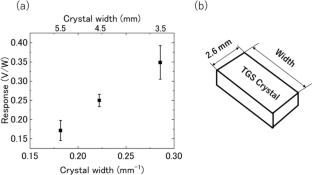
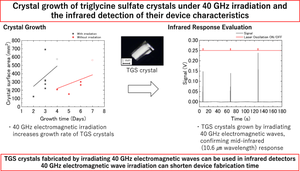
Triglycine sulfate (TGS) crystals are pyroelectric crystals that exhibit ferroelectricity in a room-temperature environment. They have application as infrared detector elements. In this study, it was found that irradiation with 40-GHz electromagnetic waves accelerates the growth of TGS crystals, with a growth rate about 2.2 times faster than that without irradiation. This leads to a reduction in process time and therefore crystals that will be used as elements in the production of detectors can be obtained more quickly. The TGS crystals were irradiated with a CO2 laser at a wavelength of 10.6 μm. The maximum voltage value obtained was about 0.24 V, the photosensitivity was 24.7 V/W, and the noise equivalent power (NEP) was 2.7 × 10⁻⁸ W/Hz½. In addition, it was confirmed that the sensitivity increased with decreasing area of the crystal. These results show that TGS crystals grown under electromagnetic irradiation can be used as infrared detector elements.
期刊介绍:
The Journal of Electronic Materials (JEM) reports monthly on the science and technology of electronic materials, while examining new applications for semiconductors, magnetic alloys, dielectrics, nanoscale materials, and photonic materials. The journal welcomes articles on methods for preparing and evaluating the chemical, physical, electronic, and optical properties of these materials. Specific areas of interest are materials for state-of-the-art transistors, nanotechnology, electronic packaging, detectors, emitters, metallization, superconductivity, and energy applications.
Review papers on current topics enable individuals in the field of electronics to keep abreast of activities in areas peripheral to their own. JEM also selects papers from conferences such as the Electronic Materials Conference, the U.S. Workshop on the Physics and Chemistry of II-VI Materials, and the International Conference on Thermoelectrics. It benefits both specialists and non-specialists in the electronic materials field.
A journal of The Minerals, Metals & Materials Society.



 京公网安备 11010802042870号
京ICP备2023020795号-1
京公网安备 11010802042870号
京ICP备2023020795号-1

 分享
分享
 求助内容:
求助内容: 应助结果提醒方式:
 扫码关注我们
