Longqin Hu*, Haifa Albanyan, Jeffrey Yang, Yiling Wang, Min Yang, Xiangduan Tan, Xiaodi Zhong, Michael D. Ward and Amrik Sahota,
{"title":"8-l-Cystinyl Bis(1,8-diazaspiro[4.5]decane) as an Orally Bioavailable l-Cystine Crystallization Inhibitor for Cystinuria","authors":"Longqin Hu*, Haifa Albanyan, Jeffrey Yang, Yiling Wang, Min Yang, Xiangduan Tan, Xiaodi Zhong, Michael D. Ward and Amrik Sahota, ","doi":"10.1021/acsmedchemlett.4c00066","DOIUrl":null,"url":null,"abstract":"<p >Cystinuria, a rare genetic disorder, is characterized by defective <span>l</span>-cystine reabsorption from the renal proximal tubule, resulting in abnormally high concentrations of <span>l</span>-cystine and subsequent <span>l</span>-cystine crystallization in urine and stone formation in the urinary tract. Inhibition of <span>l</span>-cystine crystallization by <span>l</span>-cystine diamides such as LH708 (<b>2</b>) represents a promising new approach to prevent stone formation in patients with cystinuria. While <b>2</b> shows promising <i>in vivo</i> efficacy and a good safety profile in a <i>Slc3a1</i>-knockout mouse model of cystinuria, further structural modification of <b>2</b> led to the discovery of 8-<span>l</span>-cystinyl bis(1,8-diazaspiro[4.5]decane) (LH1753, <b>3</b>) incorporating a bioisosteric spiro bicyclic diamine 1,8-diazaspiro[4.5]decane for the <i>N</i>-methylpiperazine terminal groups in <b>2</b> as a promising candidate with <b>3</b> being about 120× more potent than <span>l</span>-cystine dimethyl ester (CDME, <b>1</b>) and about 2× more potent than <b>2</b> in inhibiting <span>l</span>-cystine crystallization. Furthermore, <b>3</b> demonstrated good oral bioavailability and <i>in vivo</i> efficacy in preventing <span>l</span>-cystine stone formation in the <i>Slc3a1</i>-knockout mouse model of cystinuria.</p>","PeriodicalId":20,"journal":{"name":"ACS Medicinal Chemistry Letters","volume":"15 7","pages":"1026–1031"},"PeriodicalIF":4.0000,"publicationDate":"2024-06-06","publicationTypes":"Journal Article","fieldsOfStudy":null,"isOpenAccess":false,"openAccessPdf":"https://pubs.acs.org/doi/epdf/10.1021/acsmedchemlett.4c00066","citationCount":"0","resultStr":null,"platform":"Semanticscholar","paperid":null,"PeriodicalName":"ACS Medicinal Chemistry Letters","FirstCategoryId":"3","ListUrlMain":"https://pubs.acs.org/doi/10.1021/acsmedchemlett.4c00066","RegionNum":3,"RegionCategory":"医学","ArticlePicture":[],"TitleCN":null,"AbstractTextCN":null,"PMCID":null,"EPubDate":"","PubModel":"","JCR":"Q2","JCRName":"CHEMISTRY, MEDICINAL","Score":null,"Total":0}
引用次数: 0
Abstract
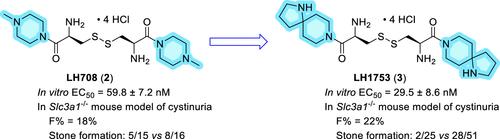
Cystinuria, a rare genetic disorder, is characterized by defective l-cystine reabsorption from the renal proximal tubule, resulting in abnormally high concentrations of l-cystine and subsequent l-cystine crystallization in urine and stone formation in the urinary tract. Inhibition of l-cystine crystallization by l-cystine diamides such as LH708 (2) represents a promising new approach to prevent stone formation in patients with cystinuria. While 2 shows promising in vivo efficacy and a good safety profile in a Slc3a1-knockout mouse model of cystinuria, further structural modification of 2 led to the discovery of 8-l-cystinyl bis(1,8-diazaspiro[4.5]decane) (LH1753, 3) incorporating a bioisosteric spiro bicyclic diamine 1,8-diazaspiro[4.5]decane for the N-methylpiperazine terminal groups in 2 as a promising candidate with 3 being about 120× more potent than l-cystine dimethyl ester (CDME, 1) and about 2× more potent than 2 in inhibiting l-cystine crystallization. Furthermore, 3 demonstrated good oral bioavailability and in vivo efficacy in preventing l-cystine stone formation in the Slc3a1-knockout mouse model of cystinuria.
期刊介绍:
ACS Medicinal Chemistry Letters is interested in receiving manuscripts that discuss various aspects of medicinal chemistry. The journal will publish studies that pertain to a broad range of subject matter, including compound design and optimization, biological evaluation, drug delivery, imaging agents, and pharmacology of both small and large bioactive molecules. Specific areas include but are not limited to:
Identification, synthesis, and optimization of lead biologically active molecules and drugs (small molecules and biologics)
Biological characterization of new molecular entities in the context of drug discovery
Computational, cheminformatics, and structural studies for the identification or SAR analysis of bioactive molecules, ligands and their targets, etc.
Novel and improved methodologies, including radiation biochemistry, with broad application to medicinal chemistry
Discovery technologies for biologically active molecules from both synthetic and natural (plant and other) sources
Pharmacokinetic/pharmacodynamic studies that address mechanisms underlying drug disposition and response
Pharmacogenetic and pharmacogenomic studies used to enhance drug design and the translation of medicinal chemistry into the clinic
Mechanistic drug metabolism and regulation of metabolic enzyme gene expression
Chemistry patents relevant to the medicinal chemistry field.




 京公网安备 11010802042870号
京ICP备2023020795号-1
京公网安备 11010802042870号
京ICP备2023020795号-1

 分享
分享
 求助内容:
求助内容: 应助结果提醒方式:
 扫码关注我们
