Mohammad Amirul Hairol Aman, Ahmad Fakhrurrazi Ahmad Noorden, Muhammad Zamzuri Abdul Kadir, Wan Hazman Danial, Suzairi Daud
{"title":"Effects of Electron Blocking Layer Thickness on the Electrical and Optical Properties of AlGaN-Based Deep-Ultraviolet Light-Emitting Diode","authors":"Mohammad Amirul Hairol Aman, Ahmad Fakhrurrazi Ahmad Noorden, Muhammad Zamzuri Abdul Kadir, Wan Hazman Danial, Suzairi Daud","doi":"10.1007/s11664-024-11190-x","DOIUrl":null,"url":null,"abstract":"<div><p>The aluminum gallium nitride (AlGaN)-based deep-ultraviolet light-emitting diode (DUV-LED) has been a prominent device due to its contribution in various fields. The electron blocking layer (EBL) is an additional layer in the epitaxy of the DUV-LED with the aim of reducing the overflow of electrons and improving the hole injection, consequently increasing the performance of the DUV-LED. However, the threshold of the EBL thickness and its influence on the electrical and optical properties is still not fully understood. Hence, the purpose of this research is to investigate the effects of varying the EBL thickness, ranging from 5 nm up to 60 nm, and investigate the threshold of EBL thickness for the AlGaN-based DUV-LED. The analysis includes the internal quantum efficiency (IQE), luminescence spectrum, band diagram behavior, and the current density of the carrier. It is found that EBL thickness of 15 nm produces the highest IQE (39.69%) for the DUV-LED with a single quantum well structure, where the wavelength emitted is ~ 257 nm, which is within the ultraviolet C (UVC) range.</p></div>","PeriodicalId":626,"journal":{"name":"Journal of Electronic Materials","volume":"53 8","pages":"4802 - 4811"},"PeriodicalIF":2.5000,"publicationDate":"2024-06-05","publicationTypes":"Journal Article","fieldsOfStudy":null,"isOpenAccess":false,"openAccessPdf":"","citationCount":"0","resultStr":null,"platform":"Semanticscholar","paperid":null,"PeriodicalName":"Journal of Electronic Materials","FirstCategoryId":"5","ListUrlMain":"https://link.springer.com/article/10.1007/s11664-024-11190-x","RegionNum":4,"RegionCategory":"工程技术","ArticlePicture":[],"TitleCN":null,"AbstractTextCN":null,"PMCID":null,"EPubDate":"","PubModel":"","JCR":"Q3","JCRName":"ENGINEERING, ELECTRICAL & ELECTRONIC","Score":null,"Total":0}
引用次数: 0
Abstract
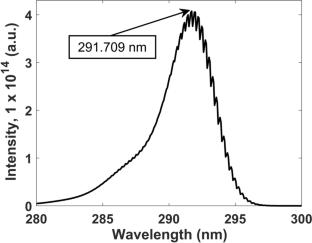
The aluminum gallium nitride (AlGaN)-based deep-ultraviolet light-emitting diode (DUV-LED) has been a prominent device due to its contribution in various fields. The electron blocking layer (EBL) is an additional layer in the epitaxy of the DUV-LED with the aim of reducing the overflow of electrons and improving the hole injection, consequently increasing the performance of the DUV-LED. However, the threshold of the EBL thickness and its influence on the electrical and optical properties is still not fully understood. Hence, the purpose of this research is to investigate the effects of varying the EBL thickness, ranging from 5 nm up to 60 nm, and investigate the threshold of EBL thickness for the AlGaN-based DUV-LED. The analysis includes the internal quantum efficiency (IQE), luminescence spectrum, band diagram behavior, and the current density of the carrier. It is found that EBL thickness of 15 nm produces the highest IQE (39.69%) for the DUV-LED with a single quantum well structure, where the wavelength emitted is ~ 257 nm, which is within the ultraviolet C (UVC) range.
期刊介绍:
The Journal of Electronic Materials (JEM) reports monthly on the science and technology of electronic materials, while examining new applications for semiconductors, magnetic alloys, dielectrics, nanoscale materials, and photonic materials. The journal welcomes articles on methods for preparing and evaluating the chemical, physical, electronic, and optical properties of these materials. Specific areas of interest are materials for state-of-the-art transistors, nanotechnology, electronic packaging, detectors, emitters, metallization, superconductivity, and energy applications.
Review papers on current topics enable individuals in the field of electronics to keep abreast of activities in areas peripheral to their own. JEM also selects papers from conferences such as the Electronic Materials Conference, the U.S. Workshop on the Physics and Chemistry of II-VI Materials, and the International Conference on Thermoelectrics. It benefits both specialists and non-specialists in the electronic materials field.
A journal of The Minerals, Metals & Materials Society.



 京公网安备 11010802042870号
京ICP备2023020795号-1
京公网安备 11010802042870号
京ICP备2023020795号-1

 分享
分享
 求助内容:
求助内容: 应助结果提醒方式:
 扫码关注我们
