Comparison of Modifications for Enhancing the Electrooxidation Performance of Porous Ni Foil Catalytic Electrodes Derived from Paper Templates: Cu-Added Alloying and In Situ Growth of Ni-S Nanosheets
{"title":"Comparison of Modifications for Enhancing the Electrooxidation Performance of Porous Ni Foil Catalytic Electrodes Derived from Paper Templates: Cu-Added Alloying and In Situ Growth of Ni-S Nanosheets","authors":"Guangya Hou, Yitao Wu, Qiang Chen, Jianli Zhang, Yiping Tang","doi":"10.1007/s11664-024-11203-9","DOIUrl":null,"url":null,"abstract":"<div><p>Improving the performance of porous nickel-based material used widely in the energy field is necessary. Alloying and increasing the specific surface area are essential approaches. This study used rice paper (Chinese traditional calligraphy and painting paper) as biomass templates to prepare hierarchical porous Ni and Ni-Cu foils (Ni<sub>p</sub> and NiCu<sub>p</sub>) with a thickness of about 60 <i>μ</i>m by impregnating and high-temperature reduction process. The Ni<sub>3</sub>S<sub>2</sub>/Ni<sub>p</sub> electrodes were prepared by an in situ-grown Ni<sub>3</sub>S<sub>2</sub> nanosheet array on the struts of Ni<sub>p</sub> via a hydrothermal process. Two modification methods using Cu-added alloying and Ni-S nanosheet growing were compared to determine their effects on the microstructure, phase, and performance in methanol oxidation (MOR) and urea oxidation (UOR). The results showed that both alloying effects and morphology control can promote MOR and UOR. Compared to the current density value of Ni<sub>p</sub> at 0.8 V, the values of the preferred Ni<sub>10</sub>Cu<sub>p</sub> and nanosheet array Ni<sub>3</sub>S<sub>2</sub>/Ni<sub>p</sub> increased by 24.5% and 27.3% for methanol oxidation and by 15.4% and 38.4% for urea oxidation, respectively. Adding Cu helped to improve electron transfer and facilitated the transition from Ni<sup>2+</sup> to Ni<sup>3+</sup>. The large specific surface area of Ni<sub>3</sub>S<sub>2</sub> nanosheets provided more active sites for the reaction. Compared to Ni<sub>10</sub>Cu<sub>p</sub>, Ni<sub>3</sub>S<sub>2</sub>/Ni<sub>p</sub> with a lower impedance value exhibits better electrocatalytic performance and stability, achieving peak current densities of 269.7 mA cm<sup>−2</sup> (MOR) and 303.9 mA cm<sup>−2</sup> (UOR) at 0.8 V, maintaining 91.2% (MOR) and 102.4% (UOR) of the initial peak current density after 2000 cycles. The foil electrodes obtained under both modification strategies can be used as anode material in portable cells, and might also be applied to the oxidation of other small organic molecules.</p><h3>Graphical Abstract</h3>\n<div><figure><div><div><picture><source><img></source></picture></div></div></figure></div></div>","PeriodicalId":626,"journal":{"name":"Journal of Electronic Materials","volume":"53 8","pages":"4378 - 4389"},"PeriodicalIF":2.5000,"publicationDate":"2024-06-05","publicationTypes":"Journal Article","fieldsOfStudy":null,"isOpenAccess":false,"openAccessPdf":"","citationCount":"0","resultStr":null,"platform":"Semanticscholar","paperid":null,"PeriodicalName":"Journal of Electronic Materials","FirstCategoryId":"5","ListUrlMain":"https://link.springer.com/article/10.1007/s11664-024-11203-9","RegionNum":4,"RegionCategory":"工程技术","ArticlePicture":[],"TitleCN":null,"AbstractTextCN":null,"PMCID":null,"EPubDate":"","PubModel":"","JCR":"Q3","JCRName":"ENGINEERING, ELECTRICAL & ELECTRONIC","Score":null,"Total":0}
引用次数: 0
Abstract
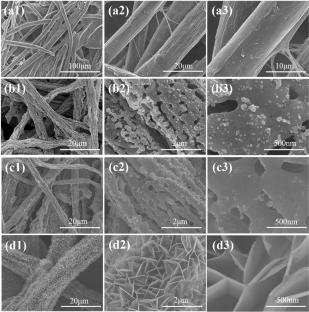
Improving the performance of porous nickel-based material used widely in the energy field is necessary. Alloying and increasing the specific surface area are essential approaches. This study used rice paper (Chinese traditional calligraphy and painting paper) as biomass templates to prepare hierarchical porous Ni and Ni-Cu foils (Nip and NiCup) with a thickness of about 60 μm by impregnating and high-temperature reduction process. The Ni3S2/Nip electrodes were prepared by an in situ-grown Ni3S2 nanosheet array on the struts of Nip via a hydrothermal process. Two modification methods using Cu-added alloying and Ni-S nanosheet growing were compared to determine their effects on the microstructure, phase, and performance in methanol oxidation (MOR) and urea oxidation (UOR). The results showed that both alloying effects and morphology control can promote MOR and UOR. Compared to the current density value of Nip at 0.8 V, the values of the preferred Ni10Cup and nanosheet array Ni3S2/Nip increased by 24.5% and 27.3% for methanol oxidation and by 15.4% and 38.4% for urea oxidation, respectively. Adding Cu helped to improve electron transfer and facilitated the transition from Ni2+ to Ni3+. The large specific surface area of Ni3S2 nanosheets provided more active sites for the reaction. Compared to Ni10Cup, Ni3S2/Nip with a lower impedance value exhibits better electrocatalytic performance and stability, achieving peak current densities of 269.7 mA cm−2 (MOR) and 303.9 mA cm−2 (UOR) at 0.8 V, maintaining 91.2% (MOR) and 102.4% (UOR) of the initial peak current density after 2000 cycles. The foil electrodes obtained under both modification strategies can be used as anode material in portable cells, and might also be applied to the oxidation of other small organic molecules.
期刊介绍:
The Journal of Electronic Materials (JEM) reports monthly on the science and technology of electronic materials, while examining new applications for semiconductors, magnetic alloys, dielectrics, nanoscale materials, and photonic materials. The journal welcomes articles on methods for preparing and evaluating the chemical, physical, electronic, and optical properties of these materials. Specific areas of interest are materials for state-of-the-art transistors, nanotechnology, electronic packaging, detectors, emitters, metallization, superconductivity, and energy applications.
Review papers on current topics enable individuals in the field of electronics to keep abreast of activities in areas peripheral to their own. JEM also selects papers from conferences such as the Electronic Materials Conference, the U.S. Workshop on the Physics and Chemistry of II-VI Materials, and the International Conference on Thermoelectrics. It benefits both specialists and non-specialists in the electronic materials field.
A journal of The Minerals, Metals & Materials Society.




 京公网安备 11010802042870号
京ICP备2023020795号-1
京公网安备 11010802042870号
京ICP备2023020795号-1

 分享
分享
 求助内容:
求助内容: 应助结果提醒方式:
 扫码关注我们
