{"title":"A short review on research progress of ZnIn2S4-based S-scheme heterojunction: Improvement strategies","authors":"Hongrui Zhang , Miaoying Cui , Yongjie Lv , Yongfang Rao , Yu Huang","doi":"10.1016/j.cclet.2024.110108","DOIUrl":null,"url":null,"abstract":"<div><div>ZnIn<sub>2</sub>S<sub>4</sub>, a typical n-type semiconductor, has received intensive attention due to its suitable bandgap, excellent visible light absorption performance, and simple and flexible preparation methods. However, its application is curbed by photo-generated carrier recombination and photo corrosion. Although constructing S-scheme heterojunctions by combining ZnIn<sub>2</sub>S<sub>4</sub> with other semiconductors can solve these problems, the photocatalytic activity of S-scheme heterojunctions can be further improved. Therefore, this short review summarizes modification strategies of ZnIn<sub>2</sub>S<sub>4</sub>-based S-scheme heterojunctions. This article also introduces the concept, design principles, and characterization methods of ZnIn<sub>2</sub>S<sub>4</sub>-based S-scheme heterojunction. Finally, current challenges and future research focuses related to ZnIn<sub>2</sub>S<sub>4</sub>-based S-scheme heterojunctions are discussed and summarized, including the utilization of advanced <em>in-situ</em> characterization techniques to further illuminate the photocatalytic mechanism, the DFT-assisted design of catalysts to increase the selectivity of products during photocatalytic CO<sub>2</sub> reduction, and extending the photo-response of ZnIn<sub>2</sub>S<sub>4</sub>-based S-scheme heterojunction to near-infrared range, <em>etc</em>.</div></div>","PeriodicalId":10088,"journal":{"name":"Chinese Chemical Letters","volume":"36 4","pages":"Article 110108"},"PeriodicalIF":8.9000,"publicationDate":"2024-06-12","publicationTypes":"Journal Article","fieldsOfStudy":null,"isOpenAccess":false,"openAccessPdf":"","citationCount":"0","resultStr":null,"platform":"Semanticscholar","paperid":null,"PeriodicalName":"Chinese Chemical Letters","FirstCategoryId":"92","ListUrlMain":"https://www.sciencedirect.com/science/article/pii/S1001841724006272","RegionNum":1,"RegionCategory":"化学","ArticlePicture":[],"TitleCN":null,"AbstractTextCN":null,"PMCID":null,"EPubDate":"","PubModel":"","JCR":"Q1","JCRName":"CHEMISTRY, MULTIDISCIPLINARY","Score":null,"Total":0}
引用次数: 0
Abstract
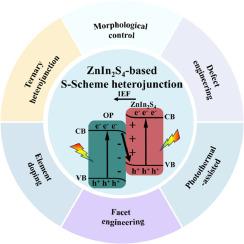
ZnIn2S4, a typical n-type semiconductor, has received intensive attention due to its suitable bandgap, excellent visible light absorption performance, and simple and flexible preparation methods. However, its application is curbed by photo-generated carrier recombination and photo corrosion. Although constructing S-scheme heterojunctions by combining ZnIn2S4 with other semiconductors can solve these problems, the photocatalytic activity of S-scheme heterojunctions can be further improved. Therefore, this short review summarizes modification strategies of ZnIn2S4-based S-scheme heterojunctions. This article also introduces the concept, design principles, and characterization methods of ZnIn2S4-based S-scheme heterojunction. Finally, current challenges and future research focuses related to ZnIn2S4-based S-scheme heterojunctions are discussed and summarized, including the utilization of advanced in-situ characterization techniques to further illuminate the photocatalytic mechanism, the DFT-assisted design of catalysts to increase the selectivity of products during photocatalytic CO2 reduction, and extending the photo-response of ZnIn2S4-based S-scheme heterojunction to near-infrared range, etc.
期刊介绍:
Chinese Chemical Letters (CCL) (ISSN 1001-8417) was founded in July 1990. The journal publishes preliminary accounts in the whole field of chemistry, including inorganic chemistry, organic chemistry, analytical chemistry, physical chemistry, polymer chemistry, applied chemistry, etc.Chinese Chemical Letters does not accept articles previously published or scheduled to be published. To verify originality, your article may be checked by the originality detection service CrossCheck.



 京公网安备 11010802042870号
京ICP备2023020795号-1
京公网安备 11010802042870号
京ICP备2023020795号-1

 分享
分享
 求助内容:
求助内容: 应助结果提醒方式:
 扫码关注我们
