Guang Zeng , Yue Zeng , Huamin Hu , Yaqing Bai , Fangjie Nie , Junfei Duan , Zhaoyong Chen , Qi-Long Zhu
{"title":"Regulating pore structure and pseudo-graphitic phase of hard carbon anode towards enhanced sodium storage performance","authors":"Guang Zeng , Yue Zeng , Huamin Hu , Yaqing Bai , Fangjie Nie , Junfei Duan , Zhaoyong Chen , Qi-Long Zhu","doi":"10.1016/j.cclet.2024.110122","DOIUrl":null,"url":null,"abstract":"<div><div>The pore structure and <em>pseudo</em>-graphitic phase (domain size and content) of a hard carbon anode play key roles in improving the plateau capacity of sodium-ion batteries (SIBs), while it is hard to regulate them effectively and simultaneously. This study delves into the synthesis of hard carbons with tailored microstructures from esterified sodium carboxymethyl cellulose (CMC<img>Na). The hard carbon (EHC-500) with maximized <em>pseudo</em>-graphitic content (73 %) and abundant uniformly dispersed closed pores was fabricated, which provides sufficient active sites for sodium ion intercalation and pore filling. Furthermore, minimized lateral width (<em>L</em><sub>a</sub>) of <em>pseudo</em>-graphitic domains in EHC-500 is simultaneously realized to improve the accessibility of sodium ions to the intercalation sites and filling sites. Therefore, the optimized microstructure of EHC-500 contributes to a remarkable reversible capacity of 340 mAh/g with a high plateau capacity of 236.7 mAh/g (below 0.08 V). These findings underscore the pivotal role of microcrystalline structure and pore structure in the electrochemical performance of hard carbons and provide a novel route to guide the design of hard carbons with optimal microstructures towards enhanced sodium storage performance.</div></div>","PeriodicalId":10088,"journal":{"name":"Chinese Chemical Letters","volume":"36 7","pages":"Article 110122"},"PeriodicalIF":8.9000,"publicationDate":"2025-07-01","publicationTypes":"Journal Article","fieldsOfStudy":null,"isOpenAccess":false,"openAccessPdf":"","citationCount":"0","resultStr":null,"platform":"Semanticscholar","paperid":null,"PeriodicalName":"Chinese Chemical Letters","FirstCategoryId":"92","ListUrlMain":"https://www.sciencedirect.com/science/article/pii/S1001841724006417","RegionNum":1,"RegionCategory":"化学","ArticlePicture":[],"TitleCN":null,"AbstractTextCN":null,"PMCID":null,"EPubDate":"2024/6/13 0:00:00","PubModel":"Epub","JCR":"Q1","JCRName":"CHEMISTRY, MULTIDISCIPLINARY","Score":null,"Total":0}
引用次数: 0
Abstract
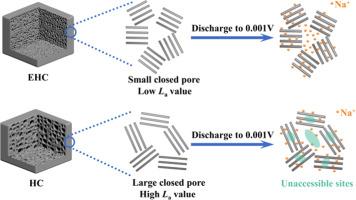
The pore structure and pseudo-graphitic phase (domain size and content) of a hard carbon anode play key roles in improving the plateau capacity of sodium-ion batteries (SIBs), while it is hard to regulate them effectively and simultaneously. This study delves into the synthesis of hard carbons with tailored microstructures from esterified sodium carboxymethyl cellulose (CMCNa). The hard carbon (EHC-500) with maximized pseudo-graphitic content (73 %) and abundant uniformly dispersed closed pores was fabricated, which provides sufficient active sites for sodium ion intercalation and pore filling. Furthermore, minimized lateral width (La) of pseudo-graphitic domains in EHC-500 is simultaneously realized to improve the accessibility of sodium ions to the intercalation sites and filling sites. Therefore, the optimized microstructure of EHC-500 contributes to a remarkable reversible capacity of 340 mAh/g with a high plateau capacity of 236.7 mAh/g (below 0.08 V). These findings underscore the pivotal role of microcrystalline structure and pore structure in the electrochemical performance of hard carbons and provide a novel route to guide the design of hard carbons with optimal microstructures towards enhanced sodium storage performance.
期刊介绍:
Chinese Chemical Letters (CCL) (ISSN 1001-8417) was founded in July 1990. The journal publishes preliminary accounts in the whole field of chemistry, including inorganic chemistry, organic chemistry, analytical chemistry, physical chemistry, polymer chemistry, applied chemistry, etc.Chinese Chemical Letters does not accept articles previously published or scheduled to be published. To verify originality, your article may be checked by the originality detection service CrossCheck.




 京公网安备 11010802042870号
京ICP备2023020795号-1
京公网安备 11010802042870号
京ICP备2023020795号-1

 分享
分享
 求助内容:
求助内容: 应助结果提醒方式:
 扫码关注我们
